
At a glance: Halo: Combat Evolved · Xbox · Bungie / Microsoft Game Studios, 2001 · First-person shooter · Score: 9.5/10
There is a moment, about twenty minutes into Halo: Combat Evolved, when the game stops teaching and starts trusting. You have crashed on a ringworld the size of a small planet, fought your first skirmishes against the Covenant, and then the level simply opens up: a valley of grass and waterfalls, a dropship coming in low, allies calling for help in three directions at once, and no instruction more specific than survive and explore. In November 2001, on a console from a company that had never made one before, that openness felt like the future arriving early. Judged purely as a game — not as a launch story, not as a development saga — Halo remains one of the finest shooters ever made, and the Xbox version is where its design still sings loudest.
The core of it is the combat loop, the famous thirty seconds of fun that Bungie built everything else around. You carry only two weapons. Your energy shield recharges if you find a breath of cover. Grenades sit on their own trigger, ready without swapping guns, and the melee attack is always one button away. Those four decisions — two guns, recharging shield, instant grenade, instant melee — sound small on paper and turned out to be revolutionary in practice, because together they make every fight a short, readable puzzle. Do you spend your plasma pistol charge to strip an Elite’s shield, then finish him with the assault rifle? Do you stick a Grunt with a plasma grenade and watch the panic do your work for you? Fights rarely last longer than half a minute, and almost every one asks a slightly different question.
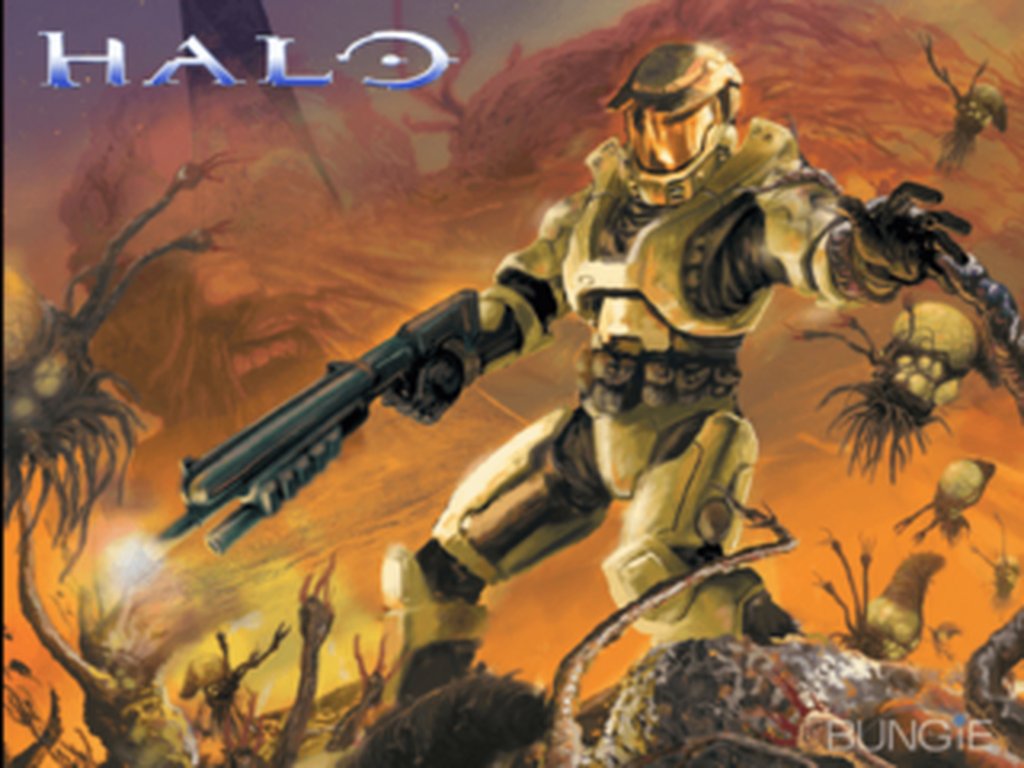
The enemy design carries that loop. The Covenant are not a ladder of ever-bigger health bars; they are a small cast of distinct behaviours that combine in nasty ways. Grunts flee when their leader dies. Jackals hide behind energy shields that demand flanking or a charged shot. Elites dodge, taunt and press you when your shield pops. Hunters arrive in bonded pairs and turn a corridor into an argument about positioning. On the higher difficulties — Heroic is the way Halo was meant to be played, and Legendary is a genuine second game hiding inside the first — the artificial intelligence still embarrasses most modern shooters. Enemies use cover because cover works, for them exactly as it works for you.
A ring worth wandering
The campaign’s level design swings between two registers, and both are superb. The wide-open exteriors — the island of The Silent Cartographer, the snowy canyons of Assault on the Control Room — give you vehicles, sightlines and freedom to approach a fight from angles the designers clearly only half-expected. The Warthog, with its deliberately loose, bouncing physics and a gunner who actually matters, turned vehicle sections from the era’s usual gimmick into Halo’s second language. Then there are the interiors: tight, atmospheric, and in the case of The Library, famously gruelling. The mid-game arrival of the Flood recontextualises everything — suddenly the careful Covenant tactics give way to sheer biological horror, shotguns and panic, and the tone of the whole campaign pivots without a cutscene needing to explain why.
Halo’s genius is not any single feature. It is that every system — shield, grenade, melee, vehicle, enemy — was designed to argue with the others, and the argument is the game.
What dates the Xbox original, honestly assessed? The back half repeats room geometry in ways a modern player will notice immediately; Two Betrayals and Keyes remix earlier spaces, and The Library’s endless identical corridors against Flood waves remains the campaign’s weakest stretch, a test of endurance more than skill. Checkpoint spacing can be unkind on Legendary. The pistol — gloriously, absurdly overpowered, a scoped three-shot instrument of death — unbalances both campaign and multiplayer in ways Bungie plainly did not intend, though most players have long since decided to love it for exactly that reason. None of this dents the whole. It is the texture of a game made by humans at the edge of what the hardware allowed.

The multiplayer that built a dorm-room culture
Split-screen Halo was a social phenomenon before it was an e-sport. Four players on one television, sixteen via system link across networked Xboxes in the same building — in 2001, console multiplayer meant this or nothing. Blood Gulch’s two bases and endless middle, Hang ‘Em High’s tombstone cover, Chill Out’s teleporters: the map pool is small and nearly perfect, and the custom game options (all rockets, no radar, invisible players) let every dorm room invent its own house rules. The Xbox version had no online play — the service did not exist yet — and somehow that absence became a virtue: Halo multiplayer was physical, local and loud. Playing the original today, ideally on original hardware with three friends and one big old television, remains the definitive way to understand what the fuss was about.
Technically, the Xbox original still impresses. The draw distance across the ring’s valleys, the dynamic lighting of the flashlight in darkened corridors, the way a plasma grenade’s glow reflects off a Warthog’s bonnet — this was a launch title showing off a machine with a hard drive, bump mapping and horsepower its rivals could not match, and Bungie used every scrap of it. Load times hide inside elevator rides and airlocks. The sound design deserves its own paragraph: weapons crack and echo differently indoors and out, the Covenant chatter is characterful rather than noise, and Martin O’Donnell’s score — monks, strings, and that main theme — does as much world-building as any texture. Halo’s ring feels ancient and holy because it sounds ancient and holy.

Why the Xbox version specifically
Later re-releases smoothed, re-lit and in one case re-recorded this game, which is exactly why the original Xbox disc still matters as the review text. This is Halo as balanced in 2001: the pistol at full absurd strength, the Warthog’s physics at their loosest and most joyful, the colour palette of a machine whose output was tuned for the CRT televisions of its day. Played through component cables on a good display, the original still holds a rock-solid frame rate in all but the busiest co-operative moments, and the split-screen campaign — two players, one ring, endless emergent comedy as the physics engine referees your arguments — remains fully intact. System link still works exactly as it did in the dorm rooms. Nothing needs a server, an account or a patch. The disc is the game, complete, which is more than its own remasters can claim.
It is also worth saying plainly what Halo did to the controller, because the Xbox version is where that happened. Twin-stick aiming with clickable sticks, a dedicated grenade trigger, a dedicated melee button, vehicles entered with a single press: the layout feels inevitable now because this game made it inevitable. Developers spent the following decade copying the scheme, and players who learned shooters here carried its grammar to every console since. Returning to it feels less like archaeology than like coming home to the house everyone else copied. The house has a few cracked tiles in its back half. It remains the best-built house on the street.
Verdict
Revisited as a game rather than a monument, Halo: Combat Evolved earns its reputation the hard way: fight by fight, valley by valley. Its campaign is a masterclass in encounter design wrapped in genuinely mysterious science fiction, its multiplayer defined a generation’s social gaming, and its control scheme — twin sticks, triggers, that regenerating shield — became the template console shooters still follow. The repeated corridors and the Library’s slog are real flaws, and they are also, at this distance, part of the artefact. If you own an original Xbox, this is the first disc that belongs in it. If you are judging the machine by its best game, the judgement is easy: essential, then and now.