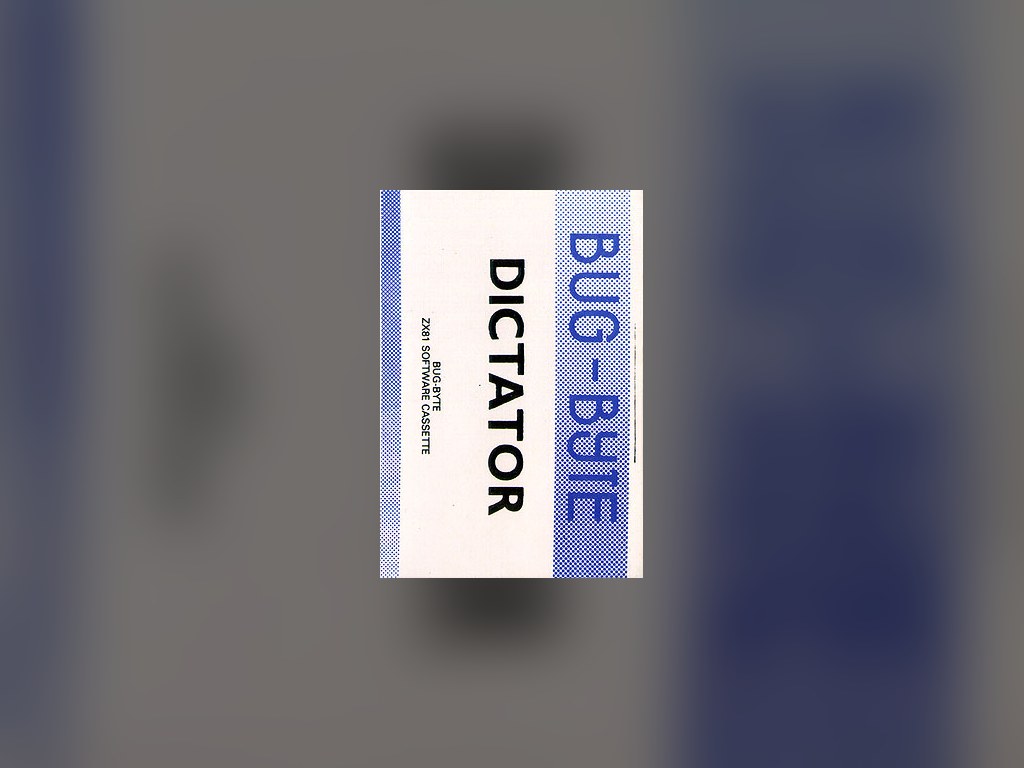
At a glance: Dictator · ZX81 · Bug-Byte, 1982 · Strategy · Score: 8.5/10
The most honest game ever written about power was written for the ZX81. Don Priestley’s Dictator, published by Bug-Byte in 1982 — the original version, before the better-known Spectrum edition from dK’Tronics — makes you president of Ritimba, an unstable banana republic, and states its terms without blinking. Permanent rule is effectively impossible. Your objectives, in order of candour, are to stay in office, divert as much of the national treasury as possible into your Swiss bank account, and escape the country alive before you are overthrown or killed. That is the whole design: a satire with a score system, in which the score that matters most only counts if you leave Ritimba breathing. It is very funny. It is also, four decades on, one of the sharpest pieces of political game design Britain produced in the 8-bit era.
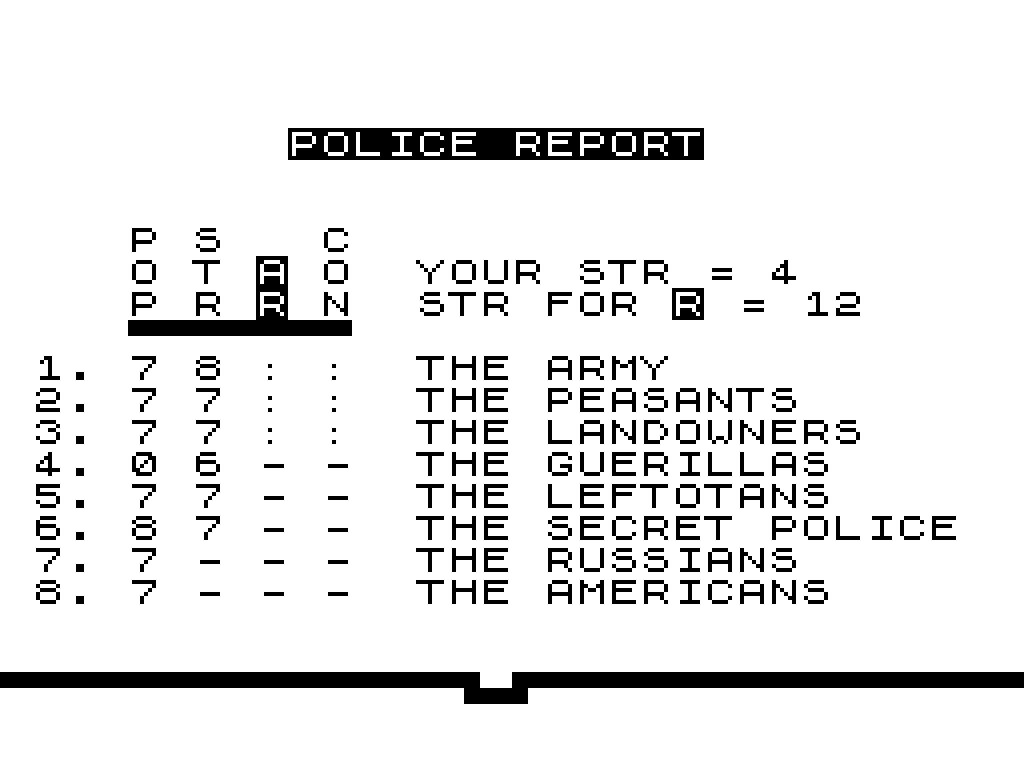
Priestley arrived at it as a schoolteacher writing freelance for Bug-Byte, in the same burst that produced Mazogs — the two games make a formidable pair of calling cards, one all graphics and mazes, the other all text and consequences. The system he built runs on factions. Ritimba’s politics are kept as a set of groups — the army, the peasants, the landowners, the guerrillas, your own secret police, and the two foreign paymasters, the Russians and the Americans, both prepared to lend solid currency to a president whose policies please them. Each month brings a request from one faction or another, which you may grant or refuse; each decision moves popularity and strength among the groups, money in or out of the treasury, and your regime one month closer to its inevitable crisis. Then come your own presidential decisions: appease or strengthen a faction, buy weapons, enlarge the bodyguard, suppress the guerrillas, seek foreign aid, buy the escape helicopter — the wisest purchase in the game — or transfer half the treasury to Switzerland, an option whose existence tells you everything about the intended arc of a presidency.
The arithmetic of staying alive
The engine of the comedy is that everything is legible and nothing is safe. The secret police will report on the factions’ popularity and strength — provided your relations with the secret police are good, a dependency with a sting in it. Foreign loans arrive with ideological strings. The guerrillas strengthen in the hills while you court the landowners. Every group you please is a group you have armed with gratitude or expectation, and the game keeps its accounts in the open: reports, figures, and the treasury balance dwindling beside the Swiss balance growing. Your final rating weighs the length of your presidency, your remaining popularity, your survival — and the money, which counts only if you got out. A dictator who loots brilliantly and dies in office scores worse than a modest thief who read the reports, bought the helicopter early, and left on time. As a moral system disguised as a scoring system, it has few equals in the decade.
The period reviews saw the quality clearly. Sinclair User’s retrospective on Bug-Byte’s ZX81 classics called Dictator “one of the best ‘land management’ games,” very funny and quite complex, listing the factions a president must juggle — peasants, army, landowners, guerrillas, secret police, foreign powers — and priced the 16K cassette at £5.95 with a Gilbert Factor of 7. MobyGames’ modern summary calls it a satirical political and economic strategy game and notes plainly what the archives confirm: the monochrome ZX81 release is the original, devised by Priestley and published by Bug-Byte; the colour-coded Spectrum edition followed. The original is the one with the joke told driest, in black and white, where Ritimba’s reports arrive like telegrams from a country you are ruining efficiently.
Stay in power. Rob the treasury. Buy the helicopter. Leave alive. Dictator’s four rules of government are a funnier — and more honest — political education than most civics courses manage.
A teacher’s satire
Priestley’s biography is the game’s secret ingredient. A schoolteacher writing at the start of the 1980s, in a Britain arguing about strongmen, unions, superpower clients and banana-republic coups on the evening news, built a system in which those arguments could be played. The Cold War is in the cassette — Washington and Moscow as rival bankers — and so is the era’s entire grammar of the coup d’état: the bodyguard’s loyalty, the army’s patience, the guerrillas’ arithmetic. That the game is funny is what makes it last; plenty of earnest strategy games of 1982 are unplayable now, while Dictator’s jokes keep landing because its system keeps generating them. Every presidency is a story the player writes against themselves, in monthly instalments, ending — as all Ritimban presidencies end — in a helicopter, a revolution, a war or an assassin, with a bank statement for an epitaph.

For the ZX81, it also completes a portrait of the machine’s range that this package keeps returning to. The same £70 wedge that hosted 3D Monster Maze’s terror and Flight Simulation’s cockpit hosted a complete political simulation with a satirical thesis — in text, in BASIC-era clothes, against no graphics worth mentioning and no need of any. Range was the ZX81’s argument for existing. Dictator is among its strongest exhibits.
A presidency, month by month
The rhythm of a Ritimban presidency is worth describing plainly, because its regularity is the joke’s machinery. A month opens with the state of the nation: the treasury, the monthly costs, the factions’ temper as reported — if the secret police still love you — by the intelligence summary. A request arrives: a faction petitions for money, policy or favour, and the president’s yes or no moves the hidden ledgers of popularity and strength. Then the presidential decision, the game’s menu of statecraft, from the statesmanlike (improve relations, strengthen an ally) to the purely personal (enlarge the bodyguard, buy the helicopter, move half the treasury to Switzerland in a single instruction of breathtaking honesty). Then the month turns, the costs fall due, the guerrillas do their arithmetic in the hills, and the republic holds its breath.
No two presidencies run alike, which for a text-and-numbers game of 1982 is a small miracle of systems design: the factions’ interplay generates the narrative, and the narrative is always, structurally, a tragedy with farce timing. You will be loved by the army and shot by a peasant, rich in Switzerland and dead in Ritimba, popular everywhere and broke by Christmas. The game’s rating at the end — length of rule, popularity, survival, and the Swiss balance counting only for the living — converts each farce into a score with a moral, and the moral is always available for one more attempt. Presidencies in Dictator last minutes. The desire to serve one more term has lasted, in some households, since 1982.
Verdict
Dictator is a masterpiece of the early British strategy game: a banana-republic simulator of perfect cynicism and perfect construction, in which power is a loan, popularity is a currency, and the helicopter is always the correct purchase. Priestley’s ZX81 original — monochrome, terse, and very funny — remains the purest version of one of the decade’s sharpest designs. Rule Ritimba. Rob Ritimba. Leave Ritimba. In that order, if you can manage it.

Score: 8.5/10 — The funniest civics lesson of the 8-bit age, and still the sharpest.