
At a glance: Krazy Kong · ZX81 · PSS, 1982 · Platform game · Score: 7.0/10
Of all the arcade sensations for the young ZX81 to attempt, Donkey Kong looked the most impossible. Nintendo’s 1981 classic is a platform game — girders, ladders, barrels, a hero who climbs and jumps — on a machine whose other platform games numbered, roughly, zero, whose display was a grid of characters, and whose hero would have to be conjured from block graphics while barrels rolled down ramps drawn in the same blocks. PSS — Personal Software Services, the label that would later find fame with strategy games — attempted it anyway. Krazy Kong, catalogued for the ZX81 in 1982, is the machine’s Donkey Kong in all but licence: a great ape, a construction site, a damsel’s predicament implied by the architecture, and a small determined figure picking his way up the scaffolding while the barrels come down.
The audacity is the headline, but the design intelligence is the story. Donkey Kong’s genius was always structural — the girders are lanes, the ladders are decisions, the barrels are traffic — and structure is exactly what survives a translation into character cells. A ramp is a diagonal of blocks; a ladder is a column; a barrel is a character with a trajectory; and the player’s whole game — when to climb, when to wait, when to run against the traffic — is legible in the ZX81’s monochrome geometry. Krazy Kong is not a facsimile of Nintendo’s artwork and never pretends to be. It is the game’s skeleton, correctly assembled, wearing the only clothes the machine owns.
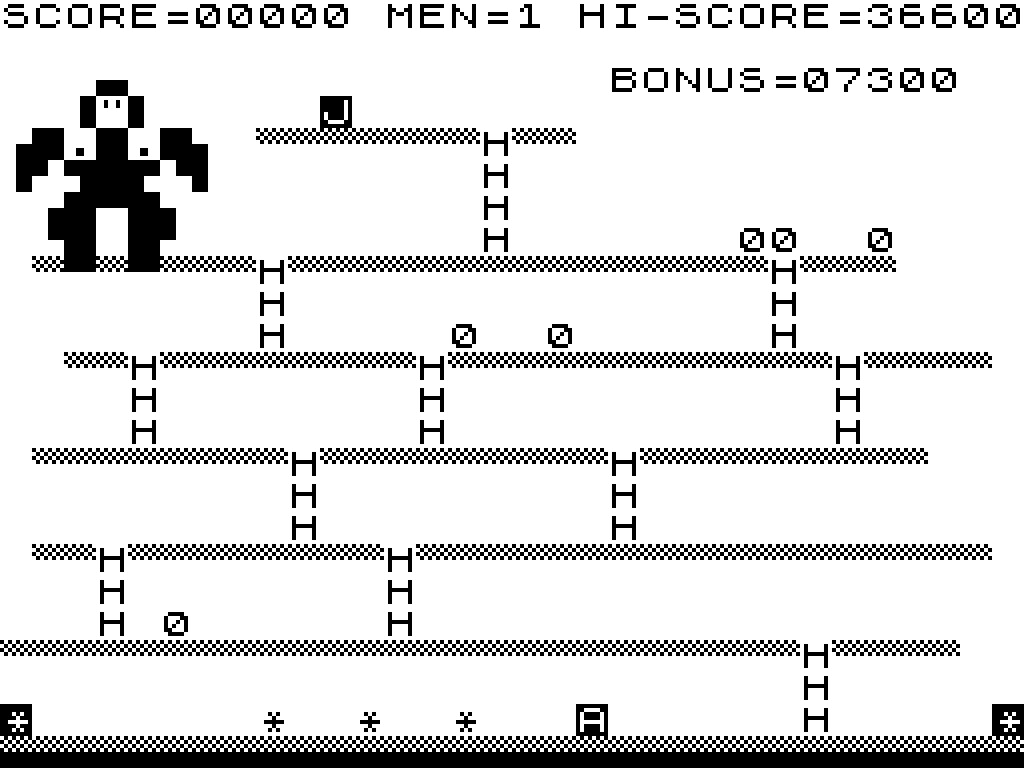
The ape in blocks
Start with the Kong himself, because the conversion stands or falls on whether the top of the screen holds a monster worth climbing toward. In character blocks, PSS’s ape is a pictogram — big, hunched, unmistakably the landlord of the building — and the barrels he sheds roll down the girder slopes with the arcade’s essential unfairness: gravity as an antagonist, spawning from the boss’s hands. The girder screen’s rhythm survives intact — cross, climb, cross back, climb again, each level of scaffolding a lane of descending barrels to be threaded — and with it the arcade’s particular tension, which is not speed but commitment: a ladder, once started, must be finished in traffic.
The compromises are real, and it is fair to name them. A jump on a membrane keyboard is a less joyful thing than a button press, and Donkey Kong without a fluid jump is Donkey Kong with its verbs rationed; the ZX81 game asks for timing and planning where the arcade asks for nerve and reflexes, making it a slightly more cerebral climb. There is no music, because there is never music. And the single-screen focus means the arcade’s parade of different structures — elevators, cement factory, rivets — is beyond a 16K cassette’s ambitions; Krazy Kong’s world is the construction site, thoroughly explored. What PSS chose to keep was the core: one screen, perfect information, ascending danger.
You cannot draw Donkey Kong on a ZX81. PSS proved you do not need to: draw its structure honestly — girders, ladders, barrels, ape — and the game climbs out of the blocks by itself.
PSS before the strategy years
There is a second story in the publisher’s name. Personal Software Services would become one of the respected British strategy houses of the later 1980s — the company of wargames and simulations, of The Battle of Britain and its peers. Krazy Kong belongs to its first, anything-goes period, when a young label’s catalogue was built from the arcade’s greatest hits translated at speed. That PSS could field a credible Kong in 1982 — catalogued by MobyGames among the ZX81’s 1982 releases, preserved in the archives in its PSS inlay — says something about the era’s democracy of ambition: the distance between a small British label and Nintendo’s arcade division was one cassette, one grid, and the willingness to try.

Played today, it remains one of the ZX81’s most surprising playable objects — the moment a sceptical modern player, told the black wedge could not do platform games, watches a hero climb a ladder under a rolling barrel and has to revise the sentence. It is not the best game in this package. It may be the most improbable one.
One screen, perfect information
The girder screen’s endurance as a design is the conversion’s best defence. Donkey Kong’s first screen contains no secrets: the ape is at the top, the ladders are where they are, the barrels obey gravity in public. Everything that will kill you is visible, and death is therefore always an autobiography — a ladder started too late, a crossing mis-timed, a moment of greed on the wrong girder. Krazy Kong preserves that contract exactly, because the contract is made of structure rather than presentation, and structure is what a 16K interpretation can carry without loss. It is the same reason the ZX81 does Frogger and Centipede so honestly, and the three games together make an argument about the machine that its critics missed: the wedge was not a failed arcade. It was an excellent interpreter of arcade designs whose genius is geometric.
There is one more period pleasure to record. The spelling — Krazy, with a K — belongs to a whole dialect of early British conversion culture, in which an arcade giant’s name was approached at one letter’s distance, close enough for the shop browser, far enough for the solicitor. The ZX81’s shelves are full of these near-names, and they read now as folk art: an industry inventing itself faster than its lawyers. PSS’s ape is the dialect’s most ambitious sentence — a platform game, the genre the machine was supposed to be incapable of, announced with a wink in the title and delivered, girders and all, in the playing.
Playing it in 2026
Krazy Kong is preserved in its PSS inlay in the standard archives and runs happily in emulation, where a modern keyboard partly redeems the membrane’s sins and the climb becomes the game it always wanted to be: read the barrels, choose your ladder, commit. New players should expect the first sittings to be short and educational — the girder screen’s discipline is learned in deaths, as it was in the arcades — and should resist judging the conversion by its ape, who is a pictogram and proud of it. Judge it instead at the third attempt, mid-screen, traffic above and below, when the structure clicks and the blocks disappear. That click is the whole case for the ZX81 as an interpreter of arcade design, delivered by a giant ape made of text.
Verdict
Krazy Kong is Donkey Kong’s skeleton wearing character blocks: girders, ladders, barrels and a pictogram ape, assembled by PSS in 1982 on a machine with no business hosting a platform game at all. The jump is rationed, the music is absent, and the climb — improbably, delightfully — works. The ZX81 could not draw the arcade. PSS showed it could still hold the arcade up.

Score: 7.0/10 — The impossible conversion: Donkey Kong’s structure, intact, in blocks and silence.