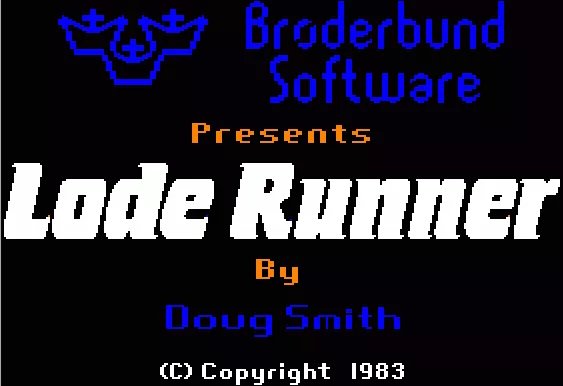
At a glance: Douglas Edwin Smith · born 28 October 1960, Renton, Washington · died 7 September 2014, aged 53 · creator of Lode Runner (Apple II, Brøderbund, 1983) · 150 levels and one of the first level editors ever shipped · later a key figure in Square’s American localisation era
When Tozai Games, the holder of the Lode Runner licence, announced Douglas E. Smith’s death on 12 September 2014, its statement carried the plain weight of a debt acknowledged: “What a contribution Doug made to the video game industry.” This site marked the news the next day with a forty-eight-word wire item, and got a basic fact wrong in doing so — the headline, like several rushed obituaries that week, said Smith was 54. He was 53: born on 28 October 1960 in Renton, Washington, and gone on 7 September 2014, seven weeks short of his fifty-fourth birthday. The correction matters, because almost everything else about Smith deserves to be gotten right. With a single game designed in a college summer, he invented a genre hybrid, smuggled user-created content into commercial gaming a decade early, and carried an American game further into Japan than any Western title had ever gone.
A Campus Cult, Written Between Classes
Smith was not a computer-science prodigy following a plan; he was an architecture student at the University of Washington who spent a summer building a game on the university’s VAX-11/780 mainframe. He wrote the prototype — early versions went by Kong, then Miner — in a mix of FORTRAN, Pascal and assembly, and the students around him played it on monochrome terminals and did what players have done ever since: they demanded more levels, and then they made their own. The feedback loop was the design process. When his nephew kept asking to play the game and had no mainframe, Smith solved the problem the way the home-computer era demanded: he borrowed an Apple II Plus, and over a single three-day weekend he ported the whole thing into 6502 assembly. Then he borrowed more money — for the colour monitor and the joystick he’d need to finish it — and submitted the result to four publishers around Christmas 1982. Brøderbund signed it. Smith dropped out of school to finish the game.
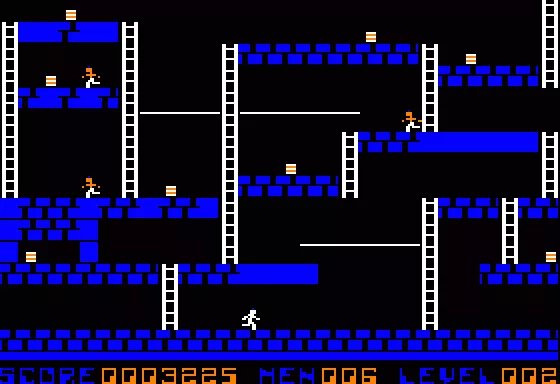
Lode Runner arrived in 1983 and looked like nothing else in the shop. You were a lone runner in a brick-built world of platforms, ladders and hand-over-hand bars, harvesting every nugget of gold in each chamber while the Bungeling Empire’s guards hunted you with single-minded patience. Your only tool was a digging laser: carve a hole in the brickwork, let a guard tumble in, cross over his head while the brick knitted itself back together. It was platform game, puzzle and chase in equal thirds, tuned so tightly that Alexey Pajitnov — who would shortly invent Tetris — kept it among his favourite games.
150 Levels, and the Editor That Changed the Contract
Smith shipped 150 levels, a number that borders on showing off for 1983 — and some of the best of them came from the same well as the prototype: the students and neighbourhood kids who had playtested the mainframe version contributed designs. Then he did the thing that secured the game’s immortality. Lode Runner included a level editor, one of the first ever bundled with a commercial game, inviting every buyer to become a designer and swap their chambers. In 1983, when the industry treated players strictly as an audience, Smith handed them the tools — because the game itself had been born that way, in a terminal room full of collaborators.
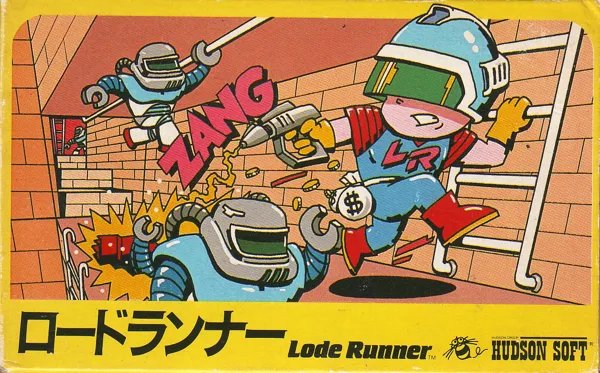
The sales made the point in every market. The game sold in the hundreds of thousands in the United States — and then Hudson Soft’s Famicom conversion carried it to something unprecedented — well over a million copies on the Famicom alone — making Lode Runner the first Western game to become a major success there. Sequels and versions followed for more than three decades — Championship Lode Runner within a year, ports and remakes across every era, an Xbox Live Arcade reinvention in 2009, Lode Runner Legacy in 2017 — more than thirty distinct takes on one man’s summer project.
The Second Career, in Someone Else’s Language

The industry Smith helped found moved fast and he moved with it into an unexpected second act: Japan, from the inside. Through the 1990s he worked in and around Square’s American operations, his name appearing in the credits of the era’s defining role-playing games — he contributed to the localisation of Chrono Trigger and served as executive producer on Secret of Evermore, Square’s American-built RPG, with credits touching Secret of Mana, Final Fantasy VII and Lemmings besides. There is a symmetry in it: the designer whose game had conquered Japan as an import spent his later career bringing Japan’s games West with the same care. He sold the Lode Runner rights in the mid-2000s and stepped away from the industry he had helped to start. His daughter later shared that he had taken his own life. He was 53 years old, and the statement from Tozai — the company that now tends his creation — stands as the trade’s official goodbye.
“An architecture student built it on a borrowed computer in a single summer. Forty years on, the bricks are still knitting themselves back together behind the runner.”
Every year the tributes repeat the same experiment and get the same result: load level 1 and the game is still modern — the guards still feel cleverer than code from 1983 has any right to be, the editor still asks what you would build. Douglas E. Smith dropped out of college to finish Lode Runner. The degree he never collected would have been in architecture. Looking at those 150 chambers — and the thousands more the players built — it is hard to argue he chose the wrong buildings.