
At a glance: Dragon Force · Sega Saturn · Sega, 1996 · Strategy / role-playing · Score: 8.5/10
Dragon Force promised a number no other console game of 1996 would dare print: two hundred soldiers on screen at once. Not sprites in a cutscene, not a number in a menu — two armies of a hundred troops each, charging, volleying and routing in real time under your general’s banner, while your dragon-scarred generals duel and cast spells over the melee. Sega’s strategy epic, localised for the West by Working Designs in the Saturn’s lean years, builds its whole design around that spectacle: eight kingdoms, eight monarchs, a continent of castles to besiege, and a war you direct like a god with a D-pad. It has rough edges its fans have long since memorised. It also has a magic no strategy game since has quite repeated, and the Saturn — of all machines — is where it lives.
The campaign structure is a warlord simulator of real charm. Choose one of eight monarchs — the knightly Wein, the sorceress Goldark, the monk Reinhart, the samurai Mikhal and their peers — each with a different starting position, temperament and story flavour, then conquer Legendra castle by castle. Your generals, recruited, captured and occasionally defecting, each command a troop type: soldiers, cavalry, archers, mages, monks, samurai, harpies, dragons for the lucky few. Between battles you manage your domain — fortify castles, search for items, hold audience with prisoners you would rather recruit than release. Then the map gives way to the battlefield, and Dragon Force becomes the game on its box: your hundred versus theirs, formations chosen, orders issued — advance, melee, regroup, special — while the generals’ spells and duels tilt the slaughter.
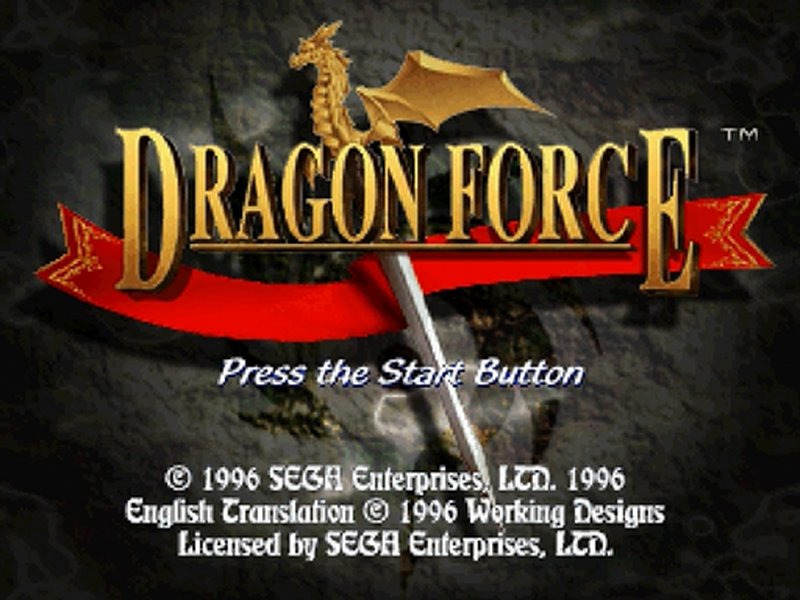
The battles are the Saturn’s sprite hardware performing its party trick at full scale. Two hundred combatants, plus spell effects, plus charging cavalry and dragon fire, with slowdown that arrives only at the very peaks of the chaos and reads, honestly, as grandeur. The tactics are broader than the spectacle suggests: troop matchups matter enormously — cavalry trample archers, monks humble the undead, harpies laugh at ground-bound knights — and formation and timing decide battles that raw numbers would lose. The duel system, in which generals can settle a clash personally, and the siege rhythm — batter a castle’s garrison down across repeated assaults, starve its defence, take the walls — give the campaign a pulse of expansion and consolidation that strategy fans will recognise from far more solemn games, delivered here at arcade speed and with a storybook smile.
Working Designs, working overtime
The Western version carries the Working Designs signature: a translation with jokes, warmth and a few liberties that purists debated then and mostly forgive now, because the alternative — the fate that met so many Saturn strategy games — was no translation at all. Their release also made Dragon Force one of the Saturn West’s defining cult objects: a big, strange, generous game that the magazines respected and the shops barely stocked. Its structure holds up remarkably: eight campaigns of genuinely different geography and difficulty, a roster of generals with faces and grudges, and a late-game turn — the awakening of the dark god Madruk, and the Dragon Force itself assembled against him — that lifts the war story into mythology. The sprite art throughout is the Saturn’s 2D at its most characterful, all chibi generals and vast, colourful fields of war.
Other strategy games counted their battles in dozens of units. Dragon Force counted in hundreds, then let you watch every single soldier earn it.
The debits, itemised with affection. The enemy AI is a romantic, not a strategist: it will charge cavalry into your monks, defend castles in the wrong order, and generally oblige a competent player — the challenge curve flattens once your best generals snowball, and experienced players impose their own handicaps. Castle management, for all its charm, is menu-deep rather than system-deep, and the mid-game can settle into a rhythm of siege, recruit, repeat that the story beats must work to interrupt. The two-hundred-soldier battles, miraculous as they are, occasionally cost the frame rate its dignity at the moment of the big cavalry charges. And the sequel — the one Western fans begged for — never came West at all, a story our feature on the Saturn fan-translation scene picks up, since fans eventually translated Dragon Force II themselves when the industry would not.

The Saturn’s strategy crown
Judged among its peers, Dragon Force owns a category of one on the Saturn: the real-time, big-army strategy epic, delivered in English, in the console’s lifetime, by a publisher that cared. Shining Force III fights its battles in dozens and thinks in chapters; Dragon Force thinks in continents and fights in centuries of soldiers. It is also a technical flex of the kind the Saturn’s reputation forgets — those two hundred sprites are the machine’s 2D processors doing exactly what they were built to do, at a scale the polygon-focused rivals of 1996 could not have matched in their sleep. The score’s half-step below the wave’s 9s is the AI and the repetition talking. The rest is a classic: playable, replayable across eight campaigns, and still visually like nothing else on the system.

Generals with grudges
The generals are the connective tissue that keeps a hundred castles from blurring into arithmetic. Dragon Force fields dozens of named commanders — knights, necromancers, beastmen, a vampire or two — each with a portrait, a troop affinity, a spell list and a loyalty that must be managed like a resource. Captured generals can be persuaded, released for honour, or left to rot at the cost of your reputation; your own stars can be poached by events and grudges. Domestic sessions between campaigns, in which your monarch holds audience, hands out medals and items, and hears the realm’s small news, give the war a courtly rhythm that pure battlefield games never find. It is light-touch character work, done with sprites and a few lines each, but multiplied across eight campaigns it accumulates into something strategy games chase to this day: the feeling that the map is populated by people, and that your hundred-soldier battles are being fought by somebody’s army rather than a spreadsheet’s. When a long-serving general finally falls in a duel on a burning field, Dragon Force earns a pang that its cheerful presentation has no business producing — and produces it anyway.
Verdict
Dragon Force is the Saturn’s great strategy spectacle: eight monarchs, a continent of sieges and two hundred soldiers settling your arguments in real time. Its AI is soft and its rhythm can repeat, but its scale, charm and campaign generosity remain unmatched on the console — and its Working Designs localisation makes it one of the Western Saturn’s essential ownable epics. Raise your banner. The field is waiting, all two hundred of them.