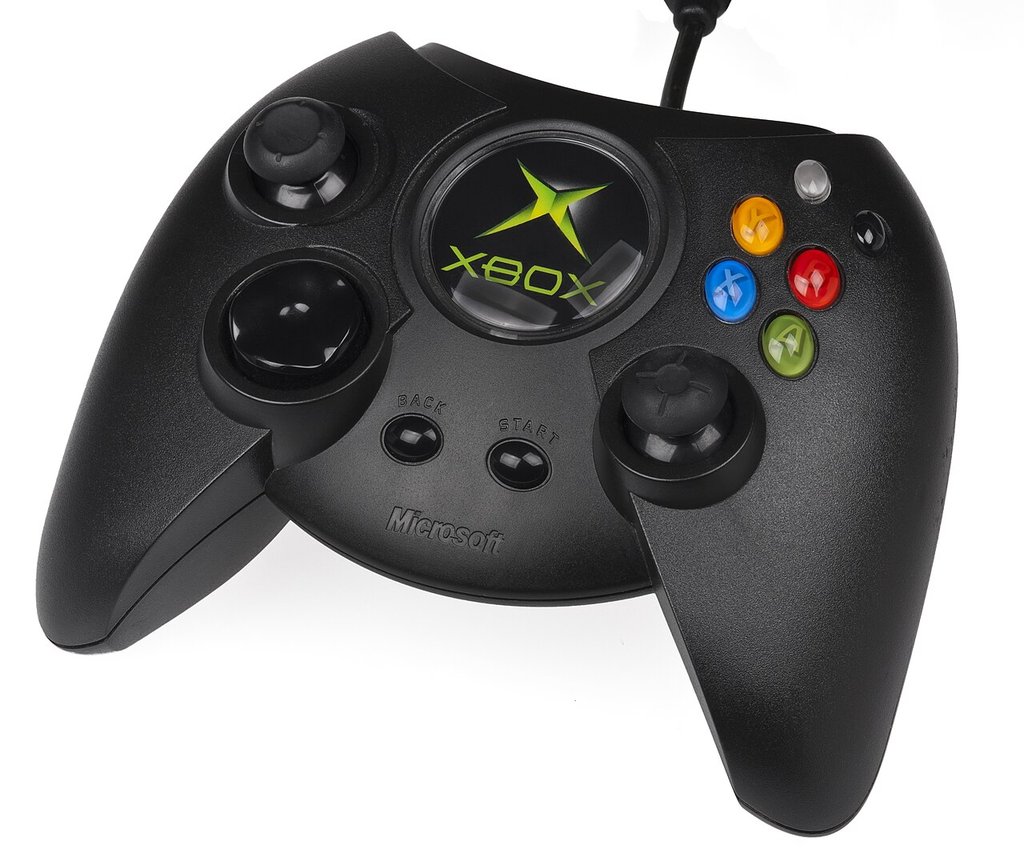
The Duke is the only games controller that became famous before the console it served had sold a single unit — famous the way a cruise ship is famous, for sheer tonnage. When Microsoft unveiled the Xbox in 2001, the enormous black gamepad bundled in North America and Europe measured roughly the width of the console’s ambitions: it weighed around 550 grams in an era of 200-gram controllers, carried a jewel the size of a medal in its centre, and filled the hands of the world’s press like a steering wheel. Gamers mocked it instantly, nicknamed it instantly — the Duke — and then, in the years since, something stranger happened. They got fond of it. This is the story of the biggest controller ever bundled with a console: how it happened, why it happened, and why it refuses to be forgotten.
Start with the design brief, because the Duke was not an accident of inattention; it was an accident of priorities. Microsoft’s hardware team, led on the industrial design side by Seamus Blackley and the Xbox group’s engineers, was building a controller around components ordered early and conservatively: the board inside the Duke is famously large because the electronics were sourced before miniaturisation was trusted, and the shell was designed around that board. The result inherited the Dreamcast controller’s broad layout — twin triggers, a VMU-style slot pair that became two accessory ports, offset ambitions the era was still working out — and wrapped it in a housing shaped by focus groups of American hands that, by most accounts, were not small hands. The left stick sat primary under the thumb, a genuinely forward-looking choice; the face buttons diamond; the black and white buttons, smaller, relegated above and below.

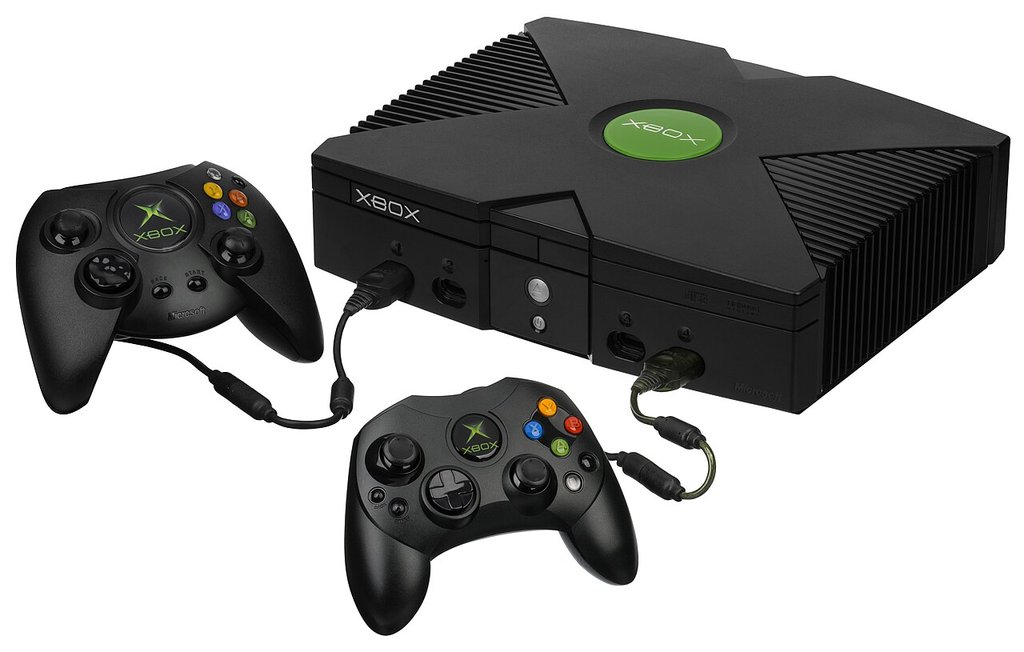
The backlash was immediate and specific. Japanese players — and a great many Western ones — found it simply too big: thumbs could not reach the black and white buttons without a grip shift, the start and back buttons hid as tiny ovals near the jewel, and smaller hands cramped in ten minutes. Gaming magazines ran size comparisons with dinner plates. Microsoft, to its credit, had already built the answer: Japan’s Xbox launched in February 2002 with a smaller pad — the Controller S, designed with Japanese hands and Japanese market standards in mind — and the S promptly became so obviously superior that by 2003 it had replaced the Duke as the pack-in controller worldwide. The Duke was discontinued in its prime, barely two years old, which in controller terms makes it less a product than an incident.
Why the Duke was not actually bad
Here is the heresy this feature exists to argue: for the hands it fit, the Duke was good. The sticks were tall with a firm, precise spring that FPS players — and this was the Halo machine — genuinely preferred for fine aim. The triggers were long-travel and progressive, excellent for racing games. The cable was three metres with a breakaway dongle, a safety-and-sanity feature Microsoft inherited from hard experience and kept for decades. And the sheer mass, mocked as a flaw, gave the pad a planted, two-handed solidity that modern ultralight controllers do not attempt. The black and white buttons were a mistake; the Start placement was a mistake; the jewel was pure vanity. But the bones — layout, sticks, triggers — were right, and the Controller S kept almost all of them while shrinking the waistline, which tells you the design team had built a good controller and merely upholstered it wrong.
The Duke was not a bad controller. It was a good controller at the wrong scale — a king-size bed delivered to a studio flat.
The afterlife is the best part of the story. The Duke became the original Xbox’s most recognisable silhouette after the console itself, a piece of folk design: modders stuffed screens into its jewel, collectors paid premiums for the translucent green variants, and “Duke hands” entered the hobby’s vocabulary as a compliment meaning a preference for substantial hardware. Then, in 2017, the story closed its loop: Hyperkin, with Seamus Blackley’s blessing and involvement, reissued the Duke for Xbox One and Windows — same vast shell, same jewel, now with an OLED screen inside the jewel playing the original Xbox boot animation, and modern internals. It sold to exactly the audience everyone predicted: the grown-up kids for whom the joke had become nostalgia. Microsoft itself leaned in, selling the reissue through its own store. The biggest controller ever made had become a beloved one, on the strength of the same excess that sank it.
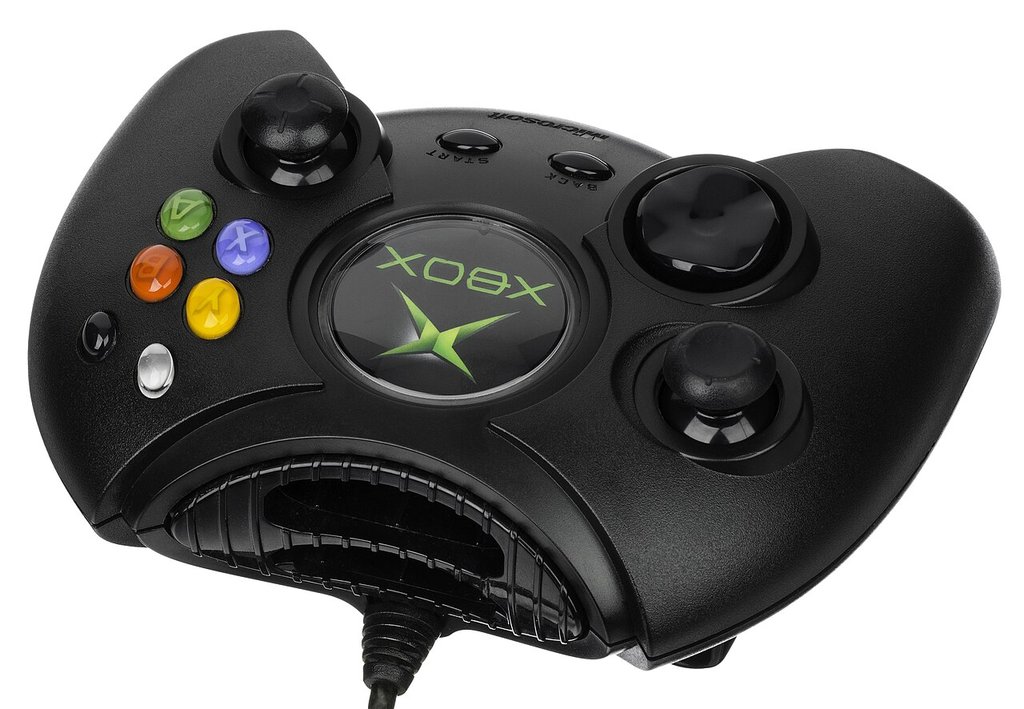
What does the Duke teach? That controller design in 2001 was still a frontier — Sony iterated conservatively, Nintendo gambled theatrically, and Microsoft, the newcomer, simply grabbed the biggest handful of future it could hold and shipped it. The Xbox succeeded on other pillars (Halo, Live, horsepower), but its first impression in the world’s hands was the Duke, and the lesson travelled: the Xbox 360 controller that followed is widely considered the finest standard pad of its generation, a direct descendant that kept the Duke’s sticks, triggers and layout while humanising everything else. Every great controller since walks a line the Duke found by overshooting it.
The design team, defended by history
It is worth being fair to the people who built the Duke, because the internet’s verdict — clownish excess — misses what they were solving. Microsoft was entering a market owned by two Japanese giants with decades of controller craft; its team came from PCs, where input meant keyboards and flight sticks, and from a company culture that believed in giving developers and players more: more power, more buttons, more cable. The Duke’s two expansion slots, its breakaway safety cable, its analogue everything, even its absurd jewel (a branding surface the size of a coaster, because a new platform needs a logo somewhere) were arguments about abundance. The Japanese market’s answer, the Controller S, was an argument about fit. Both arguments won: the S became the standard, and the abundance philosophy became the Xbox itself. The Duke’s designers were not wrong about what the platform stood for. They were simply early, and large.
The collectors’ market has delivered its own verdict in prices: clean Dukes command steady money, the translucent variants more, and the Hyperkin reissue’s success proved the affection is generational rather than ironic. Controllers are the part of a console you actually touch; they carry the memory of every game played on them in a way no disc can. By that measure the Duke, for its first-wave owners, is not the Xbox’s embarrassment. It is its handshake — remembered by everyone who ever held it, which is more than most hardware manages.
There is even a hierarchy for the faithful: the launch Duke, the green-jewel variants, the translucent shells, the Hyperkin reissue with its animated jewel — a whole collecting discipline built around a controller most consoles would have quietly forgotten. The Duke made forgetting impossible. It is too large to lose, in every sense.
Owning one today
For the collector, Dukes are common, inexpensive and durable — check the breakaway cable (the part most often lost), test the sticks for drift, and know that the membrane buttons soften with age in ways a clean usually fixes. Pair it with the games that justify it: Halo’s twin-stick grammar was tuned around this pad’s throw, and PGR2 through a Duke remains a small historical re-enactment worth performing. Hold one again, twenty years on, and the surprise is not that it is big. It is that it is good — big-hearted, overbuilt, unembarrassed — the first thing the Xbox ever said, said loudly: we are not doing this by halves.