At a glance: F-Zero GX · GameCube · Amusement Vision / Nintendo, 2003 · Anti-gravity racing · Score: 9.0/10
There are difficult racing games, and then there is F-Zero GX, a game so fast and so demanding that its own publisher’s series has essentially been in hiding ever since — not because GX failed, but because it set a standard so complete that following it up looks like a fool’s errand. Developed by Sega’s Amusement Vision team under Nintendo’s supervision, and twinned with the F-Zero AX arcade machine, GX took the N64 game’s skeleton and rebuilt it at a speed the GameCube barely seems able to contain. In 2003 it was the best-looking racing game on any console. Two decades later it remains, lap for lap, the most exhilarating.
Speed you can feel in your teeth
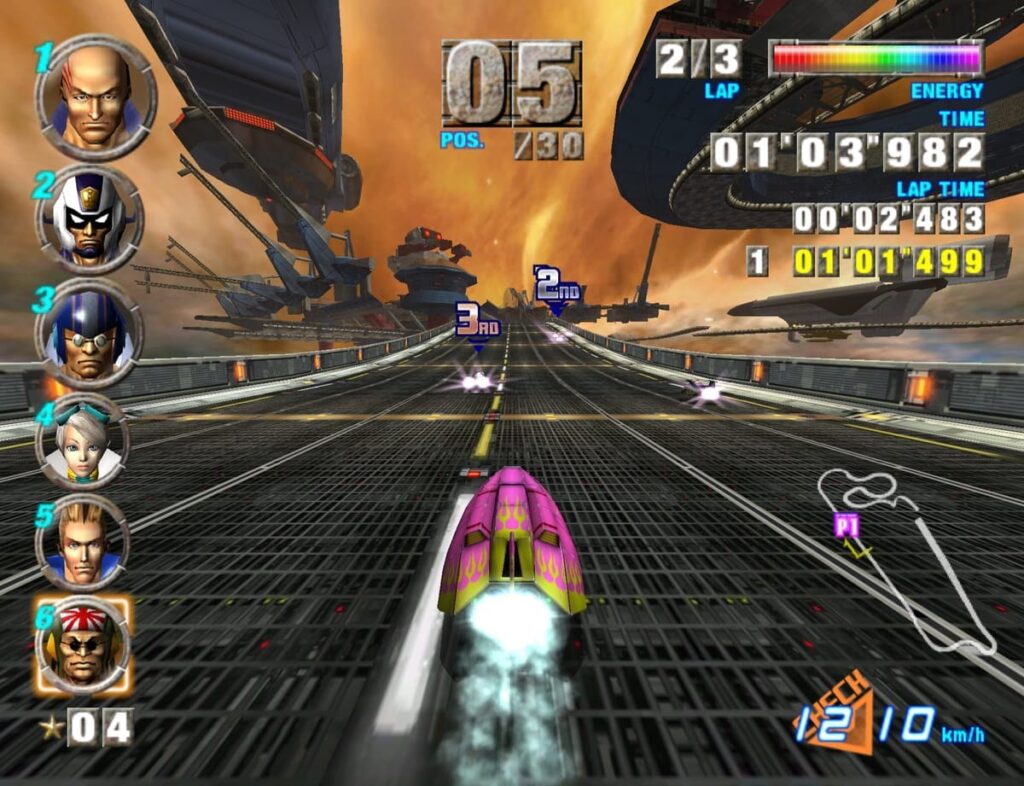
GX’s core sensation is violence barely under control. Thirty machines share tracks that corkscrew, dive, split and hang in the sky above cities, lava fields and ocean platforms, all of it streaming past at a locked, silken frame rate that sells velocity better than any motion blur. Your boost is your health — the same energy meter pays for speed and absorbs collisions — and that single economy turns every race into a negotiation with your own greed. Boost through the final straight on a sliver of energy and you are a hero. Clip the wall and you are debris. The famous “suicide” finishes of high-level play, where champions burn their entire hull to cross the line, are not exploits; they are the system working exactly as designed.

The handling model rewards mastery like few racers ever have. Weight shifting, drift boosts, the quick-turn, advanced techniques the community later named and systematised — snaking most controversially — give GX a skill ceiling measured in years. The Grand Prix structure is classic: four cups at launch, a hidden fifth for the accomplished, three difficulty tiers that transform the AI from traffic into rivals with genuine malice. Rubber-banding exists, and on Master difficulty it will occasionally feel like injustice; the honest counter is that GX’s community has spent twenty years proving every cup is beatable with technique, and the game’s own Story mode makes no apology at all.
Story mode: nine chapters of beautiful cruelty
Story mode deserves its reputation. Nine chapters follow Captain Falcon through scenarios — a training gauntlet, a canyon race against Samurai Goroh, an escape from a collapsing facility, a bomb-rigged run where slowing down is death — each with Normal, Hard and Very Hard variants, and each utterly unwilling to meet you halfway. Chapter 1 on Very Hard has ended more campaigns than some final bosses. It is also where GX’s personality lives: the cutscenes are gloriously earnest melodrama, the cast of more than forty pilots each gets an interview and a theme, and the whole production treats its absurd, wonderful universe — bounty hunters, clones, a geriatric racer, Death Born himself — with a straight face that makes it funnier and cooler at once.

Around the racing sits an embarrassment of content: Time Attack with staff ghosts, a garage with thousands of custom machine combinations from unlockable parts, versus for four players, replays, and — in one of the era’s great bonuses — compatibility with the AX arcade machine, whose tracks and pilots could be unlocked at home the hard way instead. The soundtrack, a pounding mix of electronic and rock with a bespoke theme for every pilot, is mixed loud and proud; the announcer’s enthusiasm is infectious rather than grating, which any racing game of the period will tell you is a minor miracle.
The caveats, such as they are
GX’s difficulty is a genuine barrier and this review will not pretend otherwise. New players will bounce off Story mode, Master difficulty assumes near-perfection, and there is no online play — in 2003, on GameCube, an entirely forgivable absence that nonetheless dates the package. The custom-machine editor is more toy than tool, and a handful of tracks lean on memorisation of hazards in a way that can feel like homework on first encounter. These are the complaints of a game whose ambitions all point the same direction: it would rather be legendary for the committed than pleasant for everyone.

A collaboration that should not have been possible
Pause on the credits, because they explain the magic. F-Zero GX was built by Amusement Vision — Sega’s team, led by Toshihiro Nagoshi of Super Monkey Ball — working on Nintendo’s hardware, on Nintendo’s franchise, in the immediate aftermath of the fiercest rivalry in games history. The result is neither company’s house style: it has Nintendo’s discipline and Sega’s arcade swagger, the polish of a first-party flagship and the cruelty of a coin-op that wants your next credit. The arcade twin, F-Zero AX, even let players carry their memory card between home and arcade, saving custom machines and licences across both — a connectivity dream the industry was not ready to standardise, preserved here as a glimpse of a road not taken.
The presentation wraps the speed in character: more than forty pilots, each with a rendered profile, a theme song and an interview, from the heroic Falcon and the villainous Black Shadow to the deeply strange corners of the roster — a dinosaur, a pop idol, a man racing to pay off debts, Death itself in the sequel-that-never-was hooks of the plot. GX treats this nonsense with total sincerity, and the sincerity is load-bearing: when Story mode asks you to care about a bomb on Captain Falcon’s machine, the game has spent enough time building its world that you do.
The verdict
F-Zero GX is the GameCube’s purest arcade achievement: a Sega-Nintendo collaboration that produced the fastest, hardest and most complete futuristic racer ever put on a home console, and a game whose reputation has only grown as the series’ silence stretches on. Every “will F-Zero return?” headline is really asking whether anything can be this good again. On original hardware, on the pad it was tuned for, GX still answers for itself — at about a thousand kilometres an hour.
A note on access, because it shapes every modern conversation about this game: GX has never been re-released in its original form on a Nintendo download store at the time of writing, which makes the GameCube disc — and the GameCube hardware it was tuned for, analogue triggers and all — the definitive article in a way few of its contemporaries still are. Its recent availability through Nintendo’s GameCube Classics library on Switch 2 is welcome and introduces it to new players, but the original package, with its garage, its AX connectivity dreams and its 2003 frame rate holding like a promise, remains the historian’s copy. Handle it accordingly. Then go and beat Chapter 1 on Very Hard. We’ll wait. We may wait some time.
New players, one piece of mercy: start on Novice, learn the tracks in Time Attack, and let the game be difficult on schedule rather than all at once. GX rewards patience with the steepest, most satisfying mastery curve in racing games. The wall is real, but so is the view from the top of it.
Score: 9.0/10 — Blistering, beautiful and gloriously unforgiving: the futuristic racer by which all others are measured, and most are found coasting.