At a glance: Star Control II · 3DO · Toys for Bob / Crystal Dynamics, 1994 · Space adventure · Score: 9.5/10
There is a strong case that Star Control II is the greatest space game ever made, and the 3DO version is the greatest way to play it. Toys for Bob’s 1992 PC original was already a masterpiece — a vast, funny, frightening adventure among alien empires, wrapped around arcade starship duels. The 3DO port, published by Crystal Dynamics in 1994, added the one thing the original lacked: voices. Every alien race, fully performed. The result is not a port but a completion — the game as it was always meant to be heard — and it stands as the single best reason to own this console.
The premise is the stuff of pulp legend. Earth and its allies lost the war. The Ur-Quan Hierarchy rules the galaxy, slave-shielding defeated worlds beneath impenetrable red domes — and you, a young captain raised in secret on an ancient Precursor starship, are the one free human with a ship powerful enough to matter. What follows is a genuinely open adventure across hundreds of star systems: exploration, mining, diplomacy, betrayal, archaeology and war, driven by dialogue with some of the best-written aliens in the medium.
Talking to the galaxy
The cast is the game. The cowardly, treacherous Spathi. The suicidal, ecstatic Pkunk. The terrifying Ur-Quan themselves, split into two doctrines of cruelty, each with a philosophy they will patiently explain while deciding your species’ fate. The Orz, whose translated speech — all *fingers* and *dancing* — remains the most unsettling alien voice ever written, precisely because it nearly makes sense. On the 3DO, all of it is performed, and performed well: the voice work turns superb writing into theatre. Conversations become performances you look forward to rather than text you skip.
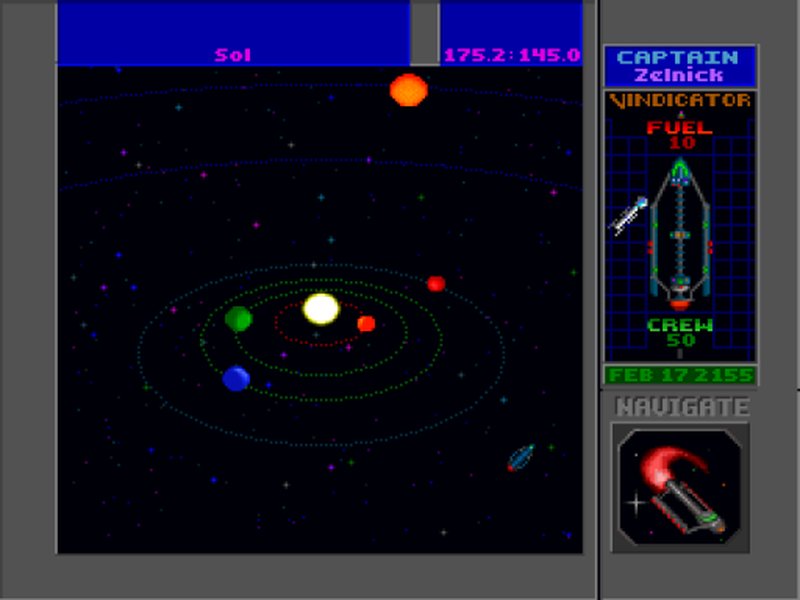
Structurally, the game trusts you completely. There is no quest log, no waypoint, no hand on your shoulder. You have a starmap, a fuel gauge, rumours, and a galaxy quietly moving without you — races meet, fleets move, and the war’s endgame advances on its own terrible schedule. The freedom can strand a new player: fuel is finite, Hyperspace is full of strangers, and it is entirely possible to spend your first hours happily mining the wrong moons. But the discovery that the galaxy is a system of stories, each alien race a puzzle with a history, is one of gaming’s great pleasures, and it is undiluted here.
Melee, the perfect minigame that ate the game
When talks fail, Star Control II resolves things with Super Melee: top-down duels between beautifully asymmetric starships, each with two weapons and a personality. The Earthling Cruiser’s point-defence lasers, the Chmmr Avatar’s unstoppable tractor-and-zap, the Yehat Terminator’s shields — twenty-five ships forming a rock-paper-scissors ecology deep enough that Melee alone supported its own multiplayer scene. Combat in the adventure matters because ships and crew are precious, and the flagship’s customisation — thrusters, guns, landers, fuel — makes your one-of-one Precursor vessel feel truly yours by the endgame.
Other games give you a galaxy to conquer. Star Control II gives you a galaxy to understand — and the understanding is the adventure.

The 3DO conversion itself is exemplary. The interface is rebuilt for a controller without losing precision, the music — already legendary on PC — is presented in rich CD quality, and load times are civilised. Purists will note the PC version’s slightly crisper text, and the open-source Ur-Quan Masters release has since carried this version’s voices and music to every modern machine. That lineage only confirms the judgement: when the fans rebuilt the game for posterity, it was the 3DO edition they chose as the definitive text.
Almost nothing about it has dated except the assumption underneath it — that a game could be this literate, this funny and this free, all at once. Its influence runs through Mass Effect and every dialogue-driven space opera since, yet none has matched its hit rate of ideas per hour, or its aliens.

The writing is the technology
Games of 1994 were not supposed to be written like this. Star Control II’s script runs to well over a hundred thousand words, and almost all of it earns its place: alien histories that recontextualise each other, jokes that pay off twenty hours later, and an endgame mystery — the fate of the Precursors — assembled from fragments a dozen races each hold one piece of. The Ur-Quan’s twin doctrines, the Kzer-Za’s eternal enslavement and the Kohr-Ah’s eternal cleansing, are tragedy written as ideology: two answers to the same ancient trauma, both monstrous, both argued with complete sincerity by their believers. The game never tells you its villains are sympathetic. It simply lets them explain themselves, at length, in voices full of sorrow, and lets you sit with it.
The voice production deserves its historical credit. Full speech for an entire adventure was a CD-ROM party trick in 1994, usually squandered on a narrator and three cutscenes. Crystal Dynamics and Toys for Bob instead cast a galaxy: dozens of performers giving the Spathi their whine, the Thraddash their bluster, the Syreen their warmth and the Ur-Quan a bass that seems to come from the centre of the earth. Sessions of this game feel like radio drama you can steer. That the fan-led Ur-Quan Masters project adopted this edition’s audio wholesale, and that it remains the standard way to experience the game thirty years on, settles the argument about which version is definitive.
Even its economy sings. Mining runs teach risk. Fuel teaches planning. Crew losses in Melee teach restraint — every victory bought with twenty dead spacers feels like exactly what it is. The game respects the player’s intelligence at every layer, from its star map to its final revelation, and asks only that the player respect it back with attention. Few games before or since have held up their end of that bargain so completely.
One more system: the clock
The design element newcomers least expect is the war’s independence. Star Control II’s galaxy does not wait for its hero: alliances shift on their own schedule, the conflict’s endgame approaches whether or not the Vindicator is ready, and the game can be lost by a calendar as surely as by a battle. Modern open-world games, terrified of failing the player, have largely abolished this kind of pressure. Here it creates the game’s signature emotion — not exploration’s leisure but a captain’s triage, the knowledge that every mining detour and rescue is bought with the galaxy’s remaining time. It makes heroes of the efficient and tragedians of the curious, and it is the final reason no two playthroughs tell quite the same story.
A practical footnote
New captains should know two mercies the game does offer: the flagship can always flee a battle it cannot win, at a price, and the starbase’s commander keeps the plot’s threads gathered for anyone who returns confused. Use both without shame. The galaxy is big, the war is patient only up to a point, and Captain Zelnick’s first tour has ended in an ignominious fuel-less drift for thirty years of players — most of whom restarted immediately, which is the game’s oldest and best review.
Verdict
Star Control II on 3DO is a landmark wearing a port’s clothing: the funniest, smartest and most generous space adventure of its era, completed by a full voice cast and presented at its best. If this console’s library contained nothing else of note, this game alone would justify its existence. It very nearly does justify the machine on its own. Score: 9.5/10