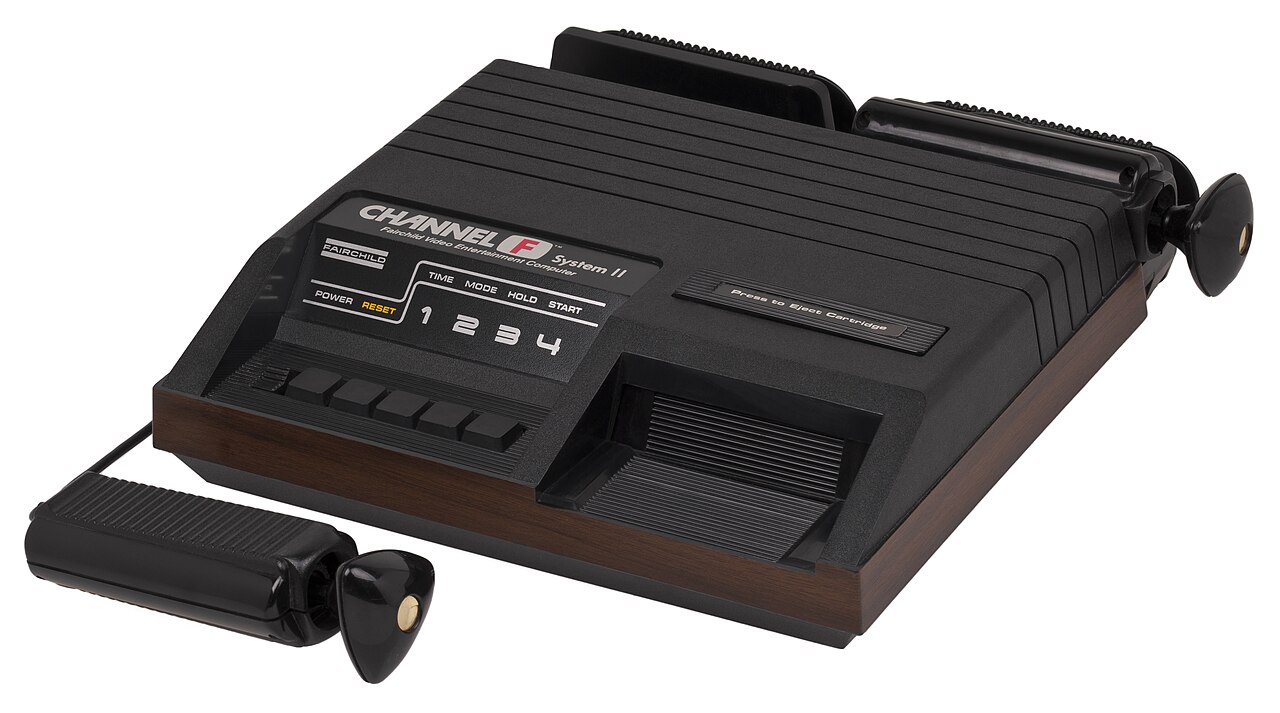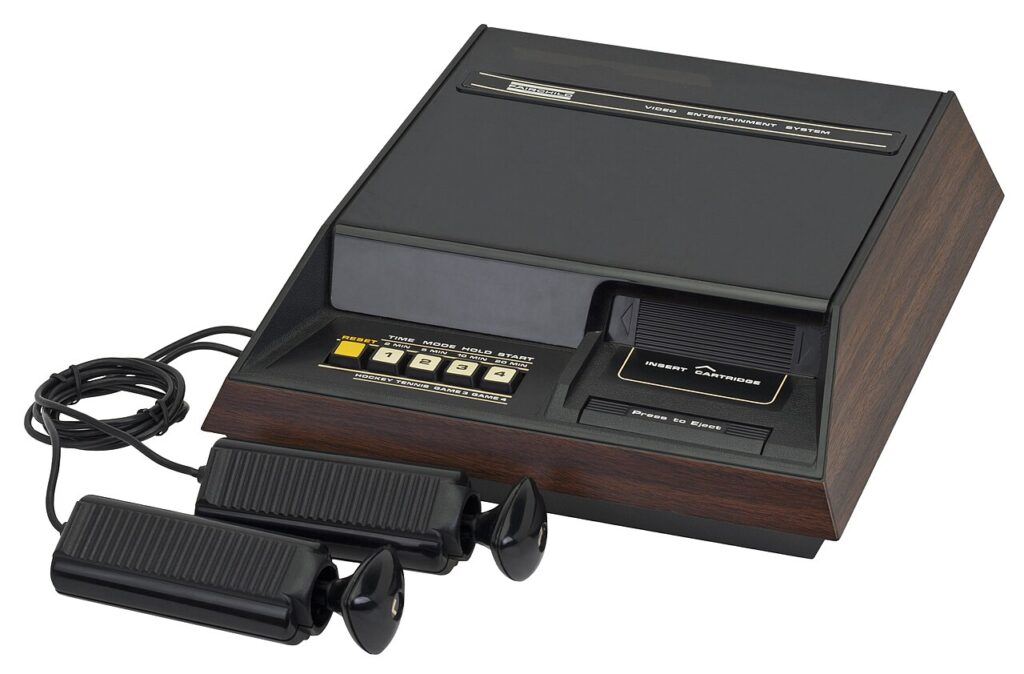
Every games console you have ever owned descends from this one. The Fairchild Channel F, launched in November 1976, was the first home console built on a microprocessor and the first to play interchangeable ROM cartridges – which is to say, it invented the object the industry has been selling ever since. It also carried the first pause button in console gaming and a controller stranger and cleverer than anything its rivals attempted. It sold only a few hundred thousand units, was eclipsed within a year by the Atari 2600, and was sold off by its maker inside three years. Its lead engineer, Jerry Lawson, went uncelebrated by the wider world for three decades. None of that diminishes the fact at the centre of this site’s whole subject: before the Channel F there were toys with circuits; after it, there was an industry, with software, libraries and sequels, and a shelf of yellow books standing in the corner of the room. This is its complete story.
A Chip Company Invents the Console
The Channel F’s parent was not a toy firm but Fairchild Semiconductor, the wellspring of Silicon Valley itself – the company whose defectors (the “Fairchildren”) founded Intel, AMD and much of the modern chip industry. Fairchild had silicon to sell, specifically the F8, a capable 8-bit microprocessor system, and in the mid-seventies a home games machine was a plausible shop window for it. The project – developed from a prototype lineage inside Fairchild under a team led, on the engineering side, by Gerald “Jerry” Lawson – took shape as the Video Entertainment System, renamed the Channel F before launch (the F stood for Fun). The design decisions were each a first in combination: a real CPU (the F8 at just under 2MHz) rather than dedicated logic, which meant the games were software; software on ROM cartridges – “Videocarts,” big yellow book-sized slabs, numbered like a record series – which meant the machine could grow a library; two games (Tennis and Hockey variants) built into the console so it played out of the box; and sound through the console rather than the television, a charming limitation of the original model. The price was $169.95, serious money in 1976, and the launch library was a handful of Videocarts at around $20 each. Magnavox’s Odyssey had sold game variations as circuit cards in 1972, but those selected logic already in the box; the Channel F’s cartridges carried the program itself. That distinction – software as a product, separable from hardware, sellable forever – is the founding idea of the console business, and it shipped from a chip company that treated the machine as a means to sell processors. The industry it created would quickly forget the reason, and eventually the inventor. Both omissions are repaired below.
The Controller From Another Planet, and the Pause Button
Pick up a Channel F hand controller and the alien ambition of the project becomes tactile. Where a joystick of the era was a stick on a box, Lawson’s controller is a pistol-grip wand topped by a knob that does everything: it moves in eight directions like a stick; it twists left and right, giving analogue paddle-style rotation; and it plunges – pushes down and pulls up – a third axis of input in 1976, all cabled to the console with a generous cord (the controllers stored in a compartment in the console’s own body, another thoughtful first). In practice the knob was the machine’s paddle, joystick and button in one, and games used its vocabulary inventively – twisting to aim, plunging to fire. Nothing like it survived into the mainstream (the industry standardised on the stick, then the pad), which makes the controller the Channel F’s purest what-if: an alternate evolutionary branch in input design, explored once and abandoned. The quieter first is on the console itself: a row of buttons including Hold – the first pause function in home gaming, a courtesy so fundamental now that its invention is hard to credit, born here because real software, unlike hardwired circuits, could be told to wait. Time, mode and channel selectors completed a front panel that treated the player as the operator of a computer, which is what Fairchild believed it had sold.
The Videocarts: Twenty-Six Yellow Books
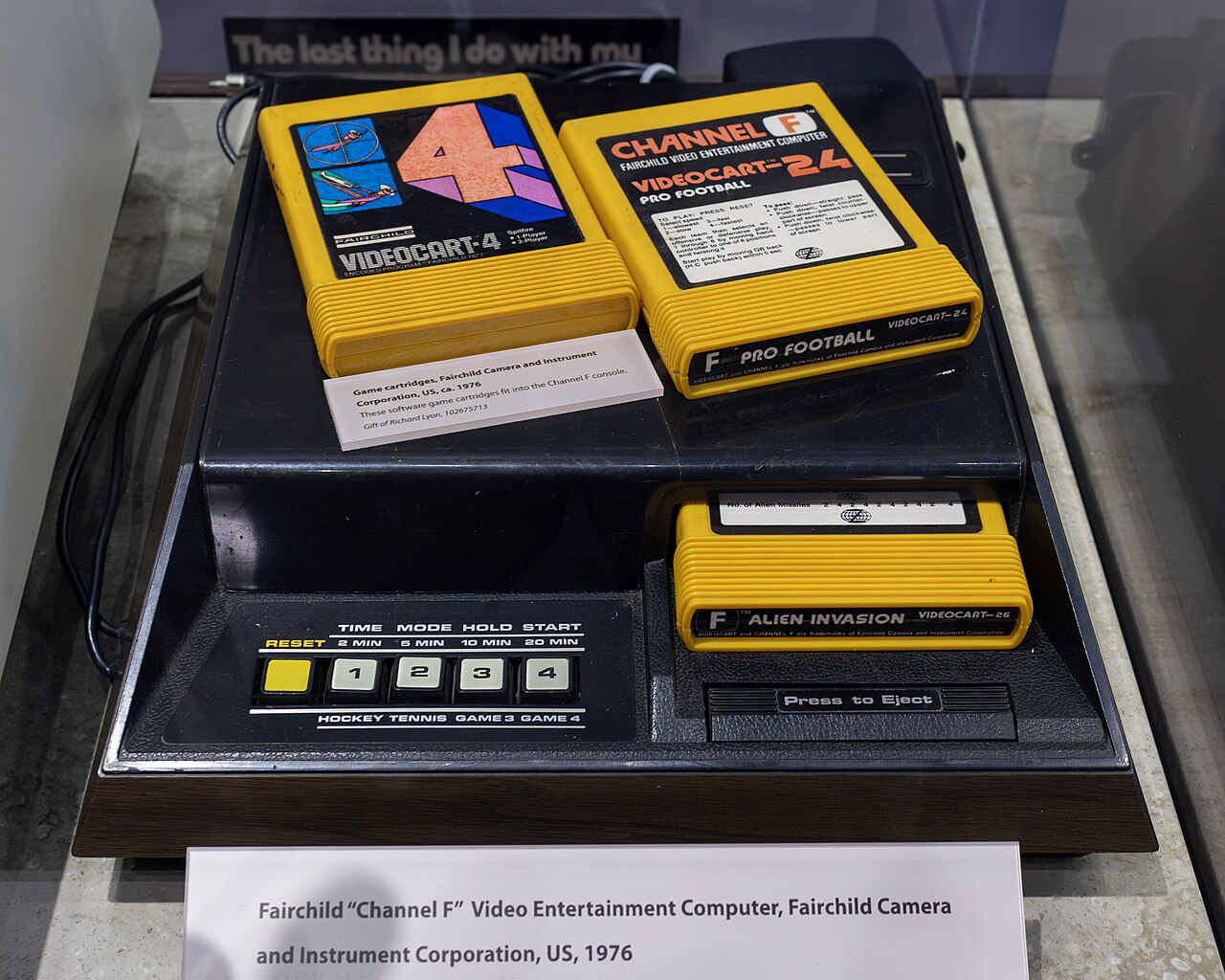
The Channel F’s library is small enough to hold in two hands – 26 official Videocarts across the Fairchild and Zircon years, plus the built-ins – and historically dense out of all proportion to its size. The launch wave established the genres the industry would live on: Drag Strip (drag racing), Spitfire (aerial duelling), Space War, Cat and Mouse mazes, a Hangman, blackjack and poker in the Casino carts, educational entries (Math Quiz I and II, because 1976 buyers were parents), and adaptations of the laboratory curiosities of the day (Dodge It, Torpedo). The graphics were what the F8 allowed – large, flat, primary-coloured shapes on a 128×64 field with a palette of eight – but the programming culture was real: Video Whizball (Videocart 21, 1978), a ricochet-arithmetic action-puzzle hybrid, is routinely cited as the library’s masterpiece and one of the first truly original console games, a design that could only have existed as software. The late carts show a platform finding ideas just as it ran out of road – Alien Invasion (Videocart 26, the rarest official release) closed the numbered series as the seventies ended. Every cartridge was a yellow plastic book with the game’s name on the spine, designed to shelve like a library rather than stack like toys – a packaging philosophy, software as literature, that the industry would spend decades relearning (it is, give or take, the way Switch cartridges pretend to be books today). The library’s smallness is precisely why the Channel F rewards the historian: this is the industry’s first catalogue, complete, and every genre instinct in it is visible at birth.
Jerry Lawson: The Engineer the Industry Forgot to Thank
The human centre of the Channel F story is Gerald Anderson “Jerry” Lawson (1940-2011), and his biography is the strongest evidence that the early games industry was stranger and more various than its official histories long admitted. A Queens-raised electronics obsessive who repaired televisions as a teenager and studied engineering at Queens College and City College, Lawson arrived at Fairchild in 1970 as one of the very few Black engineers in Silicon Valley, built an arcade game (Demolition Derby) in his garage to learn the trade, and joined the Homebrew Computer Club – in the same rooms as Jobs and Wozniak – while leading the engineering of Fairchild’s home console project. The cartridge system in particular is his: Lawson’s team solved the practical problems (a connector that survived children, ROMs cheap enough to sell) that turned “software on a card” from a lab idea into a product. After Fairchild he founded Videosoft, a development house that made games for the 2600 he had made possible, and spent later decades as a mentor and consultant. The industry’s public memory caught up late and then quickly: an IGDA honour in 2011, weeks before his death; his papers and oral history preserved at The Strong; a playable Google Doodle on his birthday in 2022 that introduced him to millions; and a permanent place, now, at the head of the cartridge story. The Channel F cannot be understood as a corporate artefact. It is one engineer’s argument – that games are software, that software is a product, that a home machine should pause when you ask it to – and the entire industry since has been a footnote agreeing with him.
Sixty-Four Bytes of RAM: The Machine on the Bench
The Channel F’s specifications are a lesson in how much of the future was built from how little. The F8 system at its heart spread the work across chips (a 3850 CPU with companion program-storage units doing address duty), and its working scratchpad memory amounted to 64 bytes – a figure so small that Channel F programming was an art of registers and nerve. The picture came from a 2KB framebuffer that software plotted pixel by pixel; there were no sprites, no tiles, no scrolling hardware, just a 128×64 field of addressable dots in a palette built from three base colours and their pairs, which is why the library looks the way it does: flat primary shapes, drawn fresh each frame, in a visual language closer to a light-show than to the sprite worlds coming behind it. Sound was software-buzzed tones through a speaker in the console body. The constraints produced the platform’s programming culture and its strange charms – games designed as geometry (Whizball’s bouncing arithmetic, Space War’s vectors-in-spirit) because geometry was what the machine could draw at speed. Every subsequent console’s hardware abundance is a reply to this austerity, and the cartridge ROM sizes tell the same story in numbers: Videocarts carried 2KB of program, occasionally more, in an industry that now complains about hundred-gigabyte installs. The Channel F’s engineers shipped the software-console idea with less memory than a modern appliance’s remote control. It is not the least of the reasons the machine belongs in museums – and in this site’s founding rank.
Selling the Future Into a Flood: 1976-77
The Channel F’s launch window was the worst and best imaginable. Worst, because Christmas 1976 was the peak of the dedicated-console flood – dozens of Pong variants from every electronics brand in America clogging shelves, a bubble already deflating into the industry’s forgotten first crash of 1977, when retailers burned by unsold dedicated machines viewed any game box with suspicion. Best, because the Channel F was the precise answer to the flood’s lesson: a machine whose games were not exhausted at purchase, sold through department and electronics stores with the library pitch front and centre – buy the system once, buy Videocarts forever, the record-player model applied to television games. Fairchild’s corporate story sealed the timing: the semiconductor industry was consolidating, Fairchild itself was acquired by Schlumberger in 1979, and a French oil-services conglomerate had even less appetite for the American toy wars than Fairchild’s chip men had – the Zircon sale belongs to that corporate weather as much as to Atari’s competition. What the Channel F never got was its Space Invaders moment, the single title that converts a platform from promising to inevitable; its catalogue, by the standards of 1976, was intelligent and various, but the killer app had not been invented for it yet, and by the time the category produced one, the category belonged to Atari. Platform history is full of these timings; the Channel F’s is merely the first, and the most forgivable – it is hard to have a killer app for an industry you have just invented and not yet staffed.
The numbering deserves its own note, because the whole industry copied it without noticing. Fairchild sold Videocarts as a numbered series – Videocart-1, -2, -3, spines aligned on the shelf like encyclopaedia volumes – and Atari’s first 2600 releases arrived, a year later, in numbered gatefold boxes of their own (01 Combat, 02 Air-Sea Battle, and on through the launch nine). The conceit – a library, growing by acquisition, each unit an instalment – taught the first generation of console owners to think of games as a collection rather than a purchase, a psychology the industry’s limited editions, season passes and platform libraries still farm. The Channel F’s yellow books were the first expression of it, and the most literal: a console that presented itself as a bookshelf, in a decade when games were still trying to look like furniture.
What It Was Like: The Console in the 1976 Living Room
The Channel F was dressed for its decade: a low, wide wedge in black and simulated woodgrain, designed to disappear into the furniture around the family television it depended on. The ritual of play was pure seventies – an RF switch box screwed to the TV’s antenna terminals, the set tuned to channel 3 or 4 (the “Channel” in the name was the television’s own), the controllers unclipped from their compartment in the console’s lid, cords unspooled across the carpet. The built-in games were the machine’s handshake: Hockey and Tennis variations, selected from the console’s front-panel buttons, with the players’ knobs doing the work joysticks hadn’t yet claimed. Sound beeped from the box itself, a small boarding-house piano of a speaker, while the television showed flat coloured shapes gliding with a smoothness hardwired Pong machines couldn’t match – software moved differently, and even in 1976 players could feel it without knowing why. Against the Magnavox Odyssey of 1972, whose “cartridges” merely selected circuits and whose graphics were three dots and a line behind plastic screen overlays, the Channel F was not an improvement but a different species: a computer, in the living room, four years before the home-computer era supposedly began. Owners who kept their systems – and the survival rate of the sturdy yellow Videocarts is remarkably high – kept the founding artefact of their hobby without knowing the term for it. The museum labels caught up with the attics eventually.
Eclipse, Zircon and the Long Tail
The Channel F’s commercial life was decided by a calendar: it had the future to itself for less than a year. Atari’s Video Computer System arrived in September 1977 with Warner’s money behind it, a cheaper path to market, and – once Space Invaders landed in 1980 – a gravitational pull the older machine’s modest catalogue could not resist. Fairchild, whose corporate heart was never in the toy business and whose semiconductor fortunes were themselves turbulent, exited in 1979, selling the Channel F line to Zircon International. Zircon relaunched the hardware as the Channel F System II (redesigned case, sound finally through the TV, detachable controllers), kept the Videocarts coming into the early eighties, and licensed the system abroad (SABA’s Videoplay in Germany, Luxor in Sweden, Grandstand in Britain) – a respectable afterlife that carried the platform to roughly 1983 and total sales in the low hundreds of thousands. The machine’s reputation in its own era – respectable pioneer, visibly outclassed – hardened into a footnote as the 2600’s legend grew, and the correction, driven by historians and by Lawson’s recognition, belongs to our era: emulation (MAME and the dedicated FreeChaF core) keeps the library playable, homebrew programmers still release new Videocarts into a scene the platform invented twice, and the museums (the Computer History Museum, The Strong, the Smithsonian’s orbit) display the yellow-spined books as founding documents. No console on this site’s shelves matters more per unit sold. The Channel F did not win the first console war. It invented the war, the weapons and the battlefield, and let everyone else fight over them.