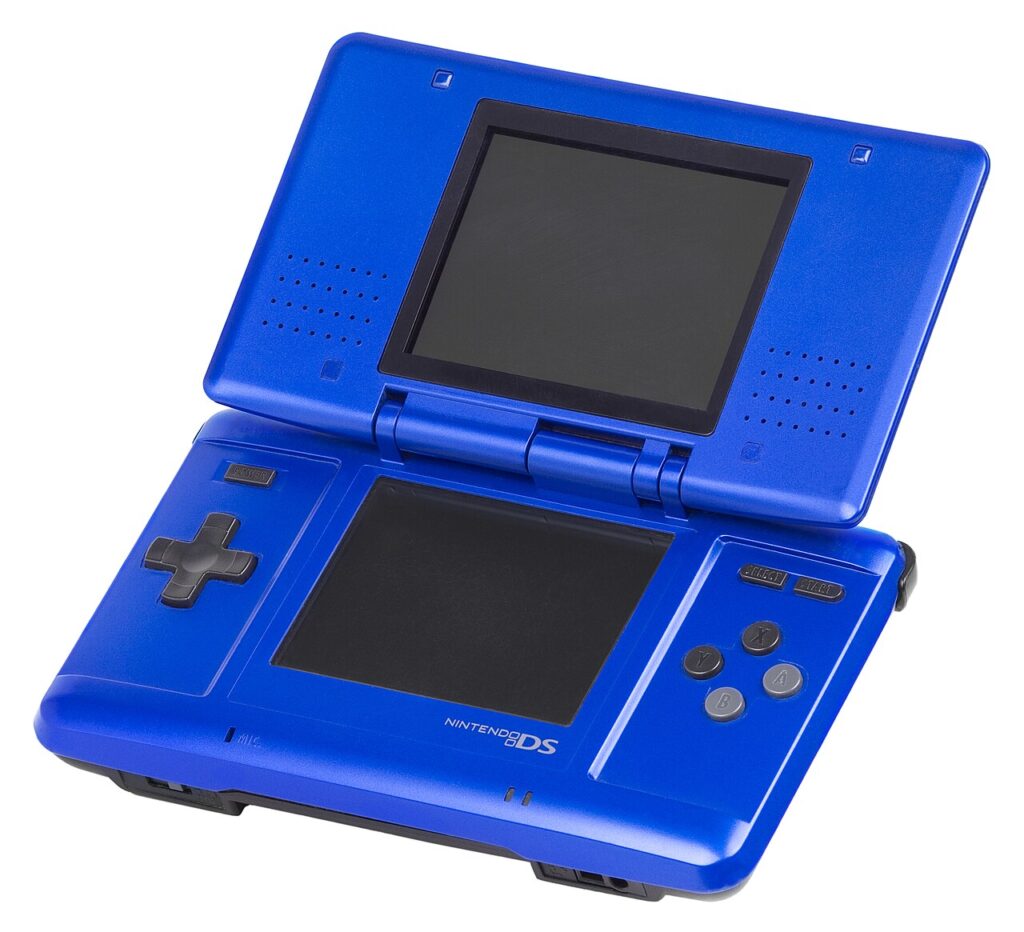
The Nintendo DS is the best-selling handheld ever made and the second-best-selling games machine of any kind, behind only the PlayStation 2 – and it achieved that with two small screens, a stylus, graphics a generation behind its rival, and a library deliberately aimed at people who did not play games. Announced as a mysterious “third pillar” beside the Game Boy Advance and GameCube, mocked by analysts who compared its specifications to the PlayStation Portable’s, the DS instead executed the most successful audience expansion in the industry’s history: Brain Age sold to grandparents, Nintendogs sold to everyone, and the DS Lite became a design object people bought twice. 154.02 million units later, its fingerprints are on every touchscreen you own. This is the complete story of the dual-screen revolution: how it was wagered, how it won, and how it changed what a games machine is for.
The Third Pillar: Iwata’s Wager and Reggie’s Debut
The DS began as crisis management disguised as a riddle. By 2003 Nintendo had lost the home-console war twice running, the GameCube was faltering, and Sony had announced the PSP – a handheld with PlayStation 2-class power aimed at the Game Boy’s flank. President Satoru Iwata’s answer, teased in January 2004 as a “third pillar” that was neither GameCube successor nor Game Boy replacement, confused the industry for months: a clamshell with two screens, one of them touch-sensitive, a stylus, a microphone, wireless connectivity, and processing power roughly of the Nintendo 64’s generation. The logic, which Iwata would spend years explaining in his “blue ocean” keynotes, was that competing on specifications was a losing game – the way to grow was to make games for the people the industry had stopped addressing. The reveal at E3 2004 doubled as another debut: Reggie Fils-Aimé’s first Nintendo press conference (“My name is Reggie. I’m about kickin’ ass, I’m about takin’ names”) introduced both the executive and the machine as articles of aggression. The DS launched in America on November 21, 2004, at $149 with a Metroid Prime Hunters demo bundled, and in Japan a fortnight later. The hardware was modest by design – dual ARM processors (a 67MHz ARM9 with a 33MHz ARM7, the latter doubling as the GBA-compatibility engine), 4MB of RAM, a Game Boy Advance slot under Slot-2 as a bridge for the faithful, and Wi-Fi built in before the word was furniture. PictoChat, a doodling chat program baked into the firmware, announced the philosophy: this was a communication device that played games, aimed at a public that did not yet know it wanted either.
Touch Generations: The Audience Arrives
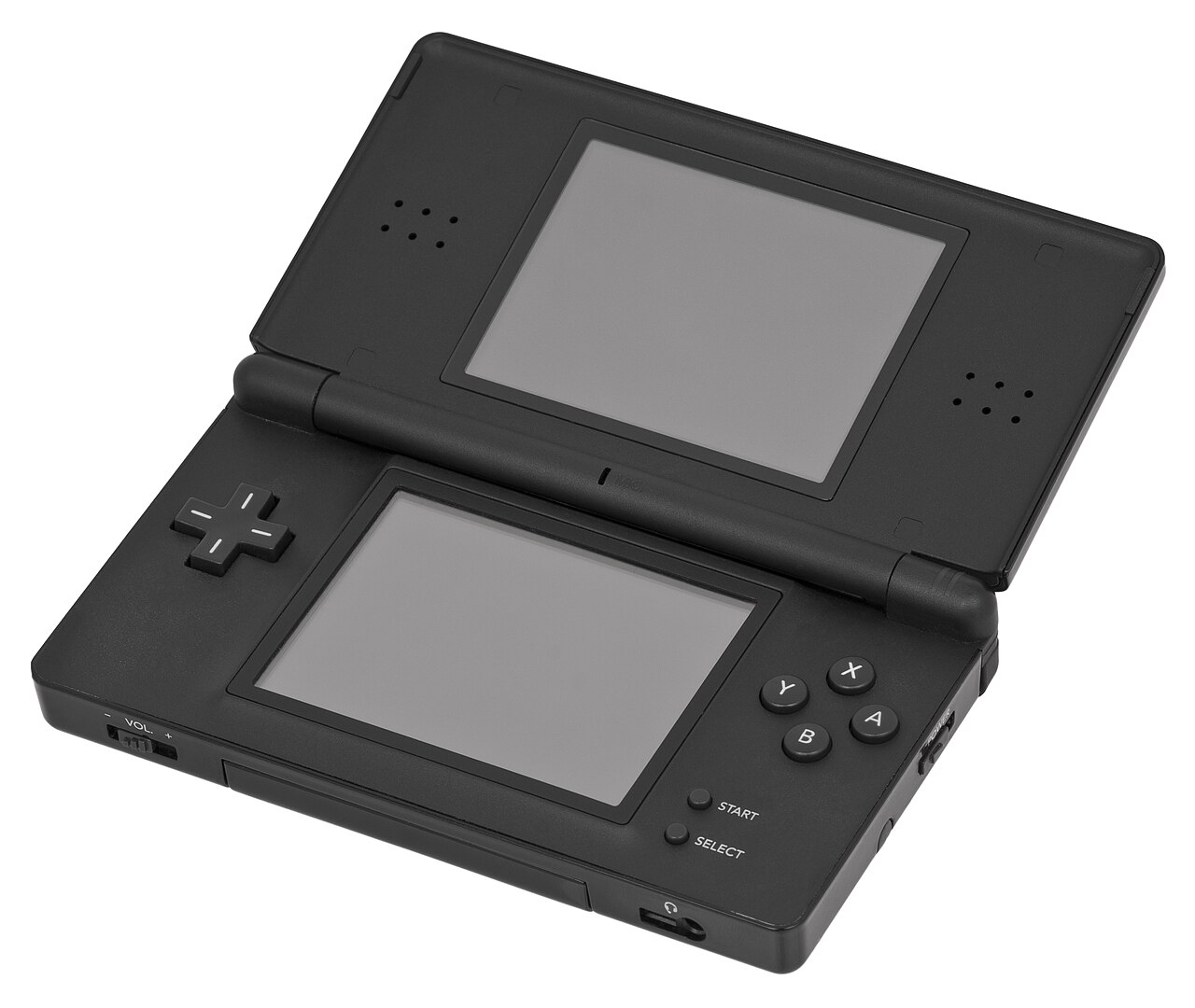
The expansion came in two waves, and the first was a puppy. Nintendogs (April 2005) – a pet simulator played entirely by stroking the touchscreen and calling into the microphone – sold first to the expected audience and then, unmistakably, beyond it: it became the DS’s first system-defining hit and, eventually, a 24-million seller. The second wave was a floating head. Brain Age (Brain Training in most territories), built on Professor Ryuta Kawashima’s neuroscience-lite exercises – read aloud, do arithmetic, have your “brain age” scolded down from 60 toward 20 – was released in Japan in May 2005 as a curiosity and became a national phenomenon: commuters, parents, grandparents, celebrities on variety shows, a software category (“non-games,” Touch Generations in Nintendo’s branding) invented around it. Nintendo’s Japanese charts through 2006 read like dispatches from another industry – Brain Age sequels, English-training software, dictionaries and cookbooks outselling adventures – and the pattern exported, slower but real, to the West. The DS Lite (March 2006 in Japan) completed the transformation: sleeker, brighter, glossier, a consumer-electronics fashion object that sold out for months, prompted public apologies for shortages, and made the two-per-household purchase a documented behaviour. The strategic meaning is hard to overstate: Nintendo had demonstrated that the games market could be enlarged sideways, with software no review aggregate knew how to score, on hardware the spec-sheet war had written off. The Wii, arriving that November on the same doctrine, was the DS’s philosophy scaled to the television.
The Canon: Two Screens, Fully Used
Beneath the phenomenon sat one of the great games libraries, and its best titles are unthinkable on one screen. The traditional spine was immense: New Super Mario Bros. (2006) revived 2D Mario after a decade and sold 30 million; Pokémon Diamond and Pearl took the series online (global Wi-Fi trading rewired the playground economy permanently) on the way to the generation that made Pokémon a handheld empire again; Mario Kart DS put Nintendo online properly for the first time; Animal Crossing: Wild World turned the second screen into the sky. The experiments are the DS’s signature, though: The Legend of Zelda: Phantom Hourglass conducted entirely by stylus, its map annotated by hand; The World Ends with You running simultaneous battles on both screens, one per hand; Elite Beat Agents and its Japanese Ouendan originals drumming rhythm out of touch; Etrian Odyssey reviving first-person dungeon crawling by having you draw the map yourself on the lower screen – the DS’s single most poetic use of its hardware; Hotel Dusk and Another Code building point-and-touch adventures; the Ace Attorney series finding its western life in DS ports (the objection heard round the world was first shouted into a microphone); Castlevania’s trilogy (Dawn of Sorrow, Portrait of Ruin, Order of Ecclesia) sustaining the Igavania line at its peak; and Grand Theft Auto: Chinatown Wars, a full-fat GTA engineered around the touchscreen, hot-wiring cars with a stylus. Add Advance Wars, Professor Layton’s slow-burn conquest of the West, Rhythm Heaven, Dragon Quest IX’s 4-million-selling Japanese valediction, and some 1,800 further titles, and the DS catalogue stands as the last great library of the dedicated handheld era – and the first of the touchscreen one.
Two Screens in the Bloodline: The Hardware in the Hand
The DS’s form was older than it looked. Nintendo had shipped dual-screen clamshells before – the Game & Watch Multi Screen series, beginning with Donkey Kong in 1982, put a game across two LCDs in a folding case a full twenty-two years earlier – and the DS is that toy’s direct descendant, a piece of Nintendo design DNA (like the Game Boy’s cross-key) resurfacing when the technology finally allowed it to carry a whole platform. The screens themselves were unremarkable panels, 256×192 apiece; the package around them was the engineering. The original 2004 model (“the Phat,” in the affectionate retrospective slang) was built like site equipment, all silvered plastic and survivability; the Lite traded some of that toughness for beauty, and its one notorious flaw – a hinge prone to cracking at the right shoulder, a defect so common it became a rite of passage – is the platform’s Red Ring in miniature, forgiven for the same reason (everything else worked, and the company quietly repaired its way out). Battery life was the specification nobody quoted and everybody felt: ten-plus hours against the PSP’s four, the arithmetic of modest chips and small screens, and in the field – schoolyards, trains, hospital wards – endurance beat horsepower daily. The stylus, a sliver of plastic slotted into the back, was lost by every owner at least once and replaced from the same universal spares economy as the Game & Watch’s battery covers before it. Nothing about the DS’s hardware was precious, which is the deepest reason 154 million could be built and sold: Nintendo engineered a machine cheap enough to be furniture and tough enough to be a toy, then aimed it at the entire species.
Friend Codes and Download Play: Nintendo Discovers the Internet
The DS dragged Nintendo, cautiously and on its own terms, online. The Nintendo Wi-Fi Connection launched in November 2005 with Mario Kart DS and scaled at a pace that startled the industry (Nintendo boasted a million unique connections in its first weeks, a take-up it compared favourably to Xbox Live’s first year), and its design philosophy was pure Iwata-era Nintendo: free, simple, and child-safe to a fault. The safety mechanism was the Friend Code – a 12-digit, per-game number exchanged out-of-band before two players could meet properly – which solved a genuine safeguarding problem by creating the era’s most mocked user experience, and which nonetheless underpinned real communities: Animal Crossing’s town visits, Pokémon’s global trading (the GTS let a child in Ohio trade with a stranger in Osaka, filtered through the game’s own systems), Tetris DS’s push battles. The local wireless mattered as much: Download Play, in which a single cartridge beamed a multiplayer game to up to seven other DSes, was the schoolyard superpower of the decade – one copy of Mario Kart, a busload of racers – and Nintendo industrialised the gesture with in-store Download Stations dispensing demos, the pre-app-store ritual of free software from a kiosk. PictoChat completed the social stack in the machine’s own hardware: a drawing chat room with a range of one classroom, through which a generation conducted its first text conversations, doodle by doodle, lights-out after lights-out. None of it resembled the open internet the PSP courted. All of it was designed to be safe for the audience the DS had just invented – and that audience showed up in the hundreds of millions.
Japan, the DS Nation
The DS’s deepest conquest was its home market, where for several years it was less a console than a national utility. The hardware records fell in sequence – the fastest-selling system in Japanese history to that point, ultimately past 30 million in Japan alone, a per-capita saturation no dedicated machine had achieved – and the software charts documented a genuine cultural shift: weeks in which the entire Japanese top ten was DS software, categories (kanji training, English study, electronic dictionaries, the 100 Classic Books collection) that belonged to stationery shops as much as game stores, and exam-preparation titles that made the DS a legitimate study tool in the eyes of the parents buying it. Schools and cram schools experimented with the machine in class; commuters treated it as reading matter; the Lite’s design language made it invisible as a games device in a briefcase. The phenomenon cooled later in the West than in Japan (the West’s DS arc ran closer to the Wii’s), but the template – a games machine as a general-purpose life appliance, sold through non-game retail to non-game buyers – was proven at a scale that reordered Nintendo’s strategy permanently and, in time, the whole industry’s sense of its own market. When the company’s next handheld stumbled at launch in 2011, it recovered by remembering the DS’s lessons in order: cut the price, feed the catalogue, and never again assume the audience is only the audience you have.
The Graveyard Around It, and the Harvest
The DS’s dominance is best measured by its surroundings. The era’s other handheld hopefuls form a neat graveyard: Nokia’s N-Gage, dying as the DS was born; the Gizmondo, whose 2005 launch collapsed into one of the decade’s great corporate scandals; the Tapwave Zodiac and the GP2X, admirable and invisible. The PSP, the only serious rival, was outsold two to one globally and reduced, in the end, to a different (and honourable) niche. The threat that finally thinned the DS’s casual empire came from outside the industry entirely: the iPhone (2007) and its App Store (2008) offered the DS’s expanded audience the same genres – puzzles, pets, brain games, hidden objects – at a dollar or free, on a device already in the pocket. Western DS software sales for the Touch Generations categories softened exactly as the App Store’s rose, and the DS’s final years leaned on its traditional spine (Pokémon’s Black and White, 2010-11, were the line’s last mega-events). There is no tragedy in the sequence, only succession: Nintendo invented the audience, trained it on touch, and watched a phone company harvest it. The DS’s own maker spent the next decade – 3DS austerity, Wii U humility, the Switch’s hybrid synthesis – working out how to sell dedicated hardware to a world the DS itself had converted to casual touch play. The student’s dilemma, authored by the teacher.
The Revisions, the R4 and the Long Sunset
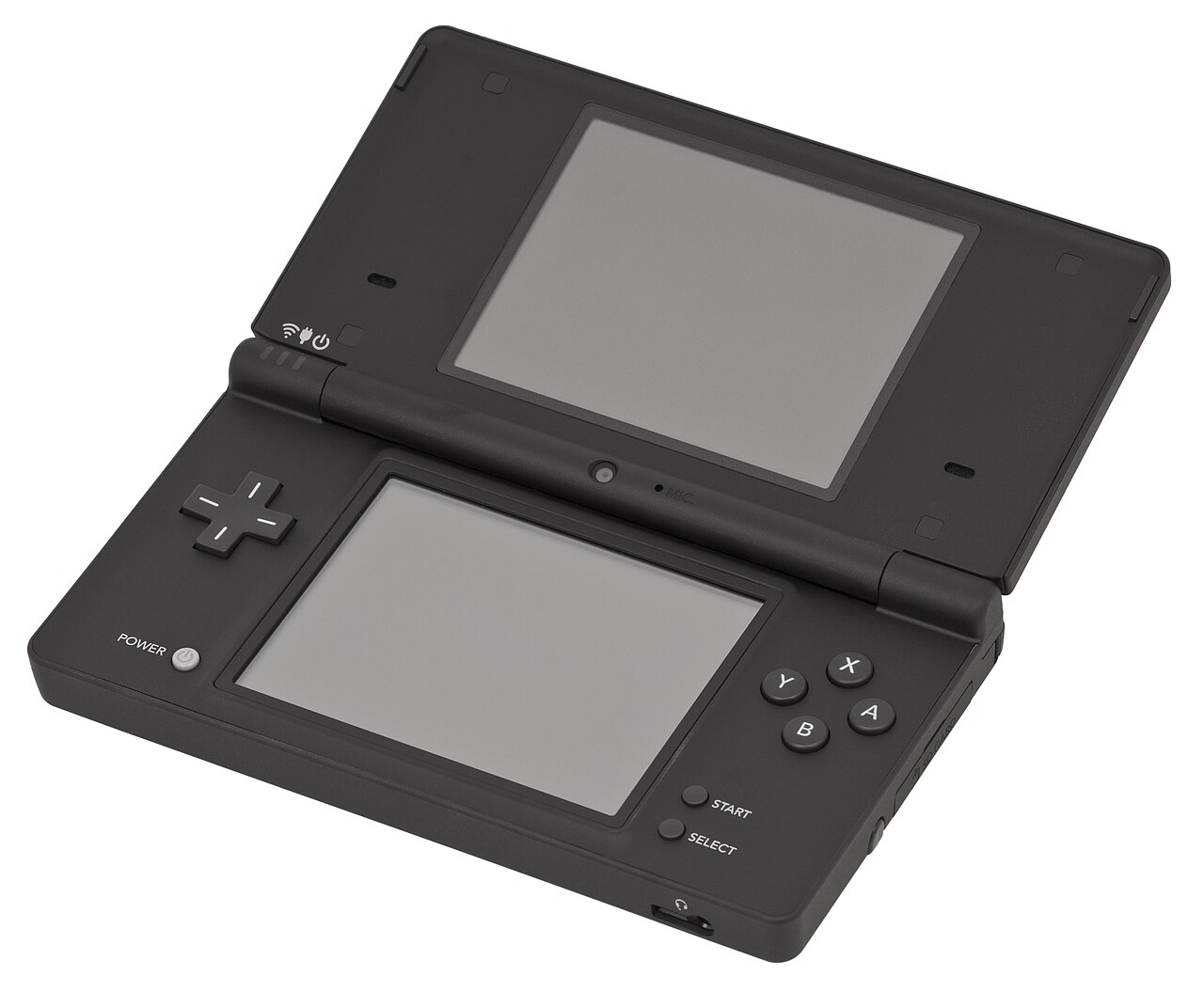
Nintendo iterated the line like the consumer product it had become. The DS Lite (2006) was the phenomenon’s engine; the DSi (2008) added cameras, an SD slot and a downloadable store (DSiWare) while deleting the GBA slot – the generational bridge burned in public, to grumbling that sales ignored; the DSi XL (2009) supersized the screens for older eyes and living-room sharing, an admission of who the audience now was. The shadow over the peak years was the flashcart: the R4 and its clones, cheap cartridges that ran downloaded ROMs from a microSD card, became a piracy epidemic significant enough to move software charts, draw lawsuits and raids across three continents, and permanently complicate the platform’s legacy – the same devices, in the long run, became the preservationist’s toolkit, a duality the PSP’s story on this site knows well. The end came gently: the 3DS succeeded the line in 2011, production wound down over the following years, and the final ledger – 154.02 million hardware units and nearly a billion games – installed the DS as Nintendo’s best-selling system ever, a title it holds still. It did this while being, for most of its life, the least powerful machine in its building: the refutation, at industrial scale, of the theory that hardware generations are won by hardware.
Afterlife: The Bridge to the Touchscreen World
The DS’s historical position is now clear: it is the bridge across which gaming walked from the Game Boy’s world to the phone’s. It trained a planetary audience in touch input, stylus play, dual-information displays and software-as-lifestyle three years before the iPhone; the App Store’s first decade of hits (pet sims, brain trainers, hidden-object adventures, touch adventures) is the DS catalogue’s echo. Nintendo’s own descendants carry the genes openly – the 3DS doubled down, the Wii U was a DS rebuilt around a television, the Switch’s tabletop-and-touch manners are pure Iwata-era doctrine. Preservation treats the platform with the respect its sales demand and its design complicates: dual screens and touch make the DS the hardest mainstream system to emulate faithfully (the community’s answer, from melonDS to original-hardware flashcart setups, is correspondingly devoted), and Nintendo’s own Wii U Virtual Console releases – DS games split between TV and GamePad – remain the most elegant official solution. The collector market prizes the Lite as an industrial-design classic and the library’s deep cuts climb steadily. Iwata called the DS a developer’s system and a third pillar; history’s verdict is grander. It was the machine that proved the audience for games was everyone, and then, quietly, handed that audience to the touchscreen century it had rehearsed them for.