At a glance: Falcon · Atari ST · Spectrum HoloByte / Mirrorsoft, 1988 · Flight simulation · Score: 8.0/10
Falcon did not want to be an arcade game wearing a flight suit. Spectrum HoloByte’s F-16 simulation arrived on the ST in 1988 with a manual the size of a novella, a cockpit modelled down to the warning lights, and a design philosophy that treated the player as a trainee pilot rather than a tourist. Its famous difficulty ladder — from Lieutenant, where the jet forgives, to Colonel, where the radar, the enemy and physics all conspire realistically — made it the simulation against which the ST measured all others. This is the machine’s definitive hardcore flight sim: demanding, detailed and, at its best settings, genuinely educational about why flying a Fighting Falcon is a profession.
The theatre is a squared map of enemy territory studded with the furniture of modern war: SAM sites that track you, MiGs that hunt you, bridges, factories, airfields and trains that all exist as targets with tactical meaning. Missions span the syllabus — air-to-air patrols, ground strikes, anti-armour work, deep interdiction — and a campaign thread ties sorties into a war you can be winning or losing. What Falcon understood, before the genre settled, is that a simulation lives in its systems: the radar modes you must actually learn, the radar-warning receiver whose chirps become a language, the HUD that is not decoration but the instrument your survival is read from.

The cockpit as the game
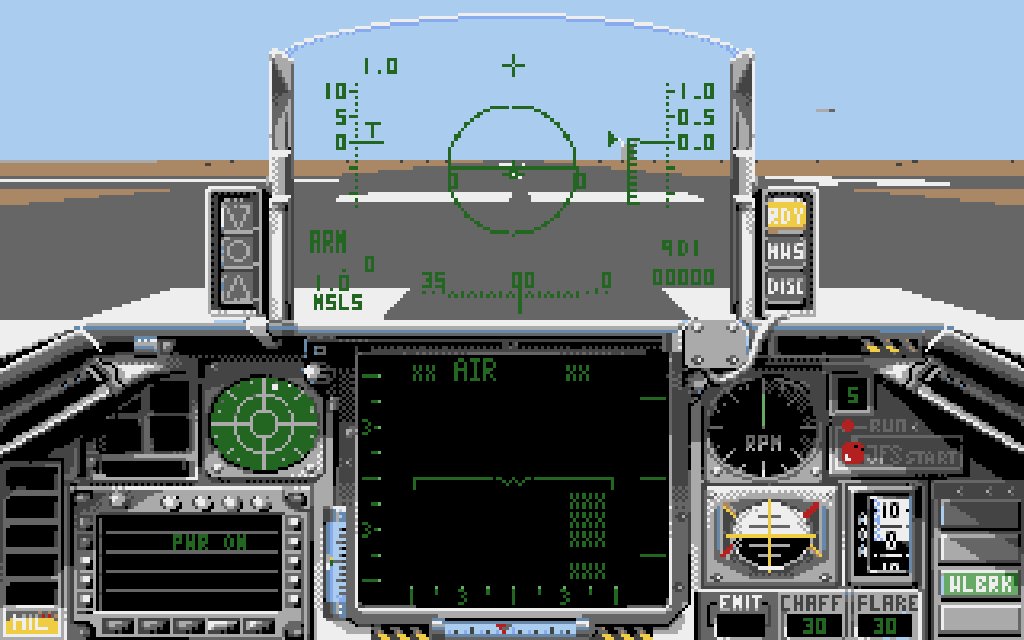
Sit in the ST version’s cockpit and the ambition is plain. The instrument panel wraps the lower screen in dials, tapes and threat displays that all work; the view out front is a fast, flat-shaded world of runways, rivers and target boxes that the ST’s processor pushes with real conviction. At Colonel level, with full realism, a successful mission — take off, navigate, manage the radar, evade a SAM that has your name, deliver ordnance, fight home, land a damaged jet — delivers a satisfaction no arcade cabinet of the era could approach. The game also pioneered the social side: head-to-head dogfighting by connecting two machines was a glimpse of the networked future, argued over in magazines for months.
Falcon’s cockpit is not a skin over a shooter. It is the game: a working instrument panel that happens to have a war attached.
The ST takes to it naturally. This was a machine whose owners bought joysticks with throttles drawn in the margins of notebooks, and Falcon’s keyboard-heavy systems management suits a computer with a proper keyboard in front of it — the famous keyboard overlay was furniture in thousands of bedrooms. Performance is the honest compromise: the 3D is swift in open sky and busier, slower, over target-rich ground, and the ground detail is sparse even by 1988’s forgiving standards. But the simulation’s integrity never depends on the scenery. It depends on the radar scope, and the radar scope is superb.

Patience, the entry fee
Let the warning be equally plain: Falcon’s learning curve is a vertical take-off. The manual is not recommended reading, it is the course, and a new pilot who skips it will die confused at Lieutenant and resentful at Captain. The MiGs at high realism are lethal in ways that can feel unfair until you understand the systems you neglected. Sound is perfunctory cockpit beepery, the campaign’s connective tissue is thin, and two mission disks’ worth of expansion content — Operation Counterstrike and Firefight — were needed to give the theatre its full depth. This is a game that respects you enormously and helps you barely at all, a very 1988 form of respect.
Its legacy on the platform is outsized. Falcon made the ST a simulation machine in the public mind, sat alongside the strategy epics in every serious owner’s library, and its sequels and descendants would define PC flight simulation for a decade. The ST original remains a complete, coherent artefact of the moment home computers grew cockpits with working instruments. Collectors note: the big Mirrorsoft box, the manual and the overlay are the edition to hunt — the game is only half itself without its paperwork.

A sim with a syllabus
Falcon’s rank structure deserves a moment of respect, because it is really a curriculum in disguise. At Lieutenant the jet is stable, the enemy obliging and the radar simplified: the game is teaching hands. At Captain the training wheels loosen — full weapons behaviour, credible opposition — and by Major and Colonel the syllabus turns serious: realistic radar modes with their clutter and limits, SAM networks that must be respected or suppressed, MiGs flown by an AI that uses energy and geometry rather than queues up to die. Nobody is forced up the ladder, and that is the elegance of it. The same disc is an arcade-leaning flying game for the casual owner and a professional-grade study aid for the obsessed, and the obsessed of 1988 included, by persistent report, actual student pilots who found the systems familiar enough to be useful.
The theatre rewards the education. A bridge is never just a bridge: it is the supply line to the factory whose tanks will otherwise reach your airfield by Thursday, and the campaign’s quiet arithmetic makes target selection a genuine staff job. Fly the mission, read the debrief, watch the front move. That connective tissue — thin by later standards, revolutionary beside the score-attack design of its contemporaries — is Falcon’s second legacy, after the cockpit itself. The ST version delivers the whole syllabus at a convincing clip, with the keyboard in front of you where a cockpit’s switch panels belong. It is a demanding, honourable piece of software, and its demands are the point.
A word, too, for the machine-specific pleasure of the thing. The ST’s keyboard — full-sized, in front of the pilot, where the mind expects a cockpit’s switch banks to be — turns Falcon’s systems management from a chore into a ritual: hands moving between stick and keys in patterns that, after twenty hours, feel like airmanship. The overlay card completes the liturgy. Plenty of simulations of the era were technically broader; few were as well seated in their hardware. This is why the ST version is remembered as a fixture of serious owners’ shelves rather than a port among ports — the computer and the simulation fit each other, down to the furniture. Buy the big box if you collect it. The manual is not packaging. It is half the aircraft, and the keyboard overlay is the other half of the cockpit’s furniture — a complete Falcon, paperwork and all, is one of the great big-box artefacts of the ST’s serious years.
Verdict
Falcon is the ST’s sternest teacher and one of its proudest achievements: a flight simulation of real systems depth, whose Colonel-level sorties still deliver the unique exhaustion of a mission flown properly. It will not entertain a dabbler, and it never pretended otherwise. For the player willing to learn the radar, read the manual and earn the rank, it offers something almost no other ST game attempts — mastery of a machine, simulated honestly. Wheels up, check six, and respect the SAMs.