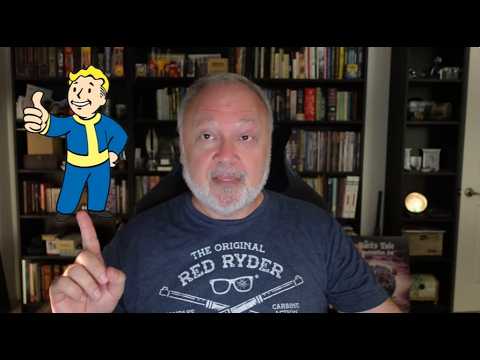
Even as Fallout has evolved into a mega-franchise with massively popular open-world games and TV show spin-offs, certain elements of the original 1997 RPG remain – things like the SPECIAL stat system and the iconic Vault Boy mascot. As it turns out, these two creations were very closely related.
Fallout was originally meant to use the Generic Universal Role-Playing System (GURPS), a tabletop RPG system published by Steve Jackson Games. In this iteration, Fallout had a bunch of different characteristics between skills, advantages, disadvantages, and quirks, all of which had to be rendered in a way the player could understand at a glance.
“For every single one of those characteristics, we had to make an icon, because the game used the icons when the skill or advantage or disadvantage was displayed,” OG Fallout lead Tim Cain explains in a new YouTube video. “We used an icon next to its name so that later on, if something happened related to that skill in places we didn’t have a lot of room for text, we could use the icon.”
The work of creating all those icons fell to an artist named Arlene Summers, whose contributions to this original version of Fallout have apparently gone largely uncredited for all these years. “I think there were over a hundred, maybe close to 200 when you summed up all the different things,” Cain says.
Cain was starting to lose his color vision around this time, so he encouraged Summers not to use color as a differentiator for the icons. It started to become more and more difficult to create icons that were distinct enough from each other to tell them apart at a glance – which was the whole point of the icons in the first place.
The solution came from art director Leonard Boyarsky. “Leonard had the idea that the skilldex – where we had the title and the description – instead of putting the icon there, we do a cartoon of somebody performing the action or looking like the attribute that was in question,” Cain explains. “He even referenced Monopoly, the rich uncle Pennybags, and he created it. He sketched it up and we all thought it was really cool.”
Artist George Almond further refined the Vault Boy design, and the job of actually drawing all the final Vault Boy icons fell to fellow artist Tramell Ray Isaac “He drew hundreds of these things,” Cain says. “If you’re going through Fallout, they appear in the skilldex. They’re all over the manual. They’re in the opening cinematic. And now, of course, it’s on mugs and bobbleheads and all kinds of things. It was a really creative thing he did.”
Famously, however, Vault Boy is part of why Fallout had to drop the GURPS system, as it was one of the key issues Steve Jackson himself took issue with. According to a 1998 PC Gamer feature, Jackson didn’t like the violence in the opening cinematic, the small-scale characters, or the Monopoly-inspired Vault Boy. Cain expands on those objections a bit in the video.
“Among other things that Steve Jackson Games didn’t like about Fallout was Vault Boy,” Cain says. “They specifically singled out Vault Boy as needing to be removed. They didn’t like it. We explained the Monopoly reference. They didn’t like it. They thought it tonally didn’t fit. Keep in mind, we already had done the cinematic and they didn’t like it there. There’s other things in the cinematic they didn’t like, but they didn’t like Vault Boy there either.”
Unwilling to accept these kinds of demands, the devs ditched GURPS in favor of their own home-grown stat system, and eventually, SPECIAL was born. So, in a way, Jackson’s objections to Fallout accidentally gave us two of the series’ most iconic legacies.
Where would the best Fallout games be without Vault Boy?