
Western players had met Marth and Roy in Super Smash Bros. Melee and wondered where on earth they came from. In 2003, Nintendo finally answered: Fire Emblem — released in Japan as Fire Emblem: The Blazing Blade, and simply as Fire Emblem in the West — became the series’ first English-language release, and it had to explain one of gaming’s most demanding genres to a brand-new audience without softening it. It succeeded completely. This is a strategy RPG of real consequence, where characters have names, faces and friendships, and where a mistake does not cost you a retry. It costs you the character, forever.
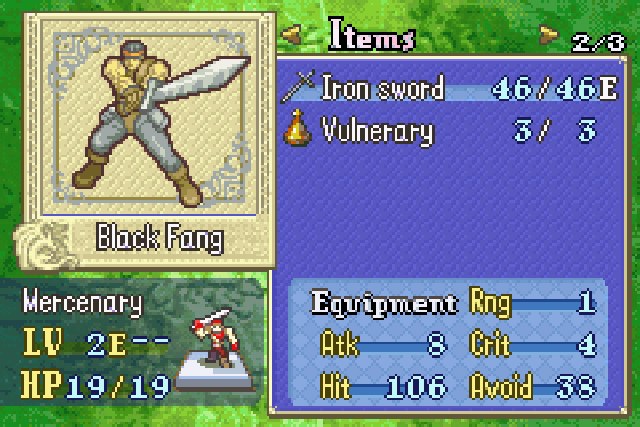
You are the tactician. They are the people.
The framing device is quietly brilliant: you, the player, are a travelling tactician found on the plains by Lyn, a young swordswoman of the Lorca tribe, and the army’s victories are quite literally your plans. The story unfolds in linked campaigns — Lyn’s tale, a ten-chapter prologue-quest to rescue her grandfather and claim her heritage, then the main campaign following Eliwood (Roy’s father, for the Melee-curious) and the axe-lord Hector through a continental war against the assassin guild Black Fang and the ancient evil behind it. Each campaign re-tunes the difficulty and perspective, and Hector’s version, unlocked after a first completion, retells the war with new chapters and a sterner edge — a reward structure that respects the player’s growing mastery.
What makes the stakes real is permadeath. Fallen units are gone — not benched, gone — taking their levels, their equipment and their unwritten futures with them. The game writes portraits, personalities and support conversations for dozens of recruits precisely so that losing one hurts: the reckless cavalier, the shy pegasus knight, the mercenary with a code. Players develop genuine attachment, and the legendary behaviour this produces — restarting a forty-minute chapter because a healer took a 2% critical hit — is not a flaw in the design. It is the design. Fire Emblem turns statistics into stories, and every veteran player remembers their losses by name.
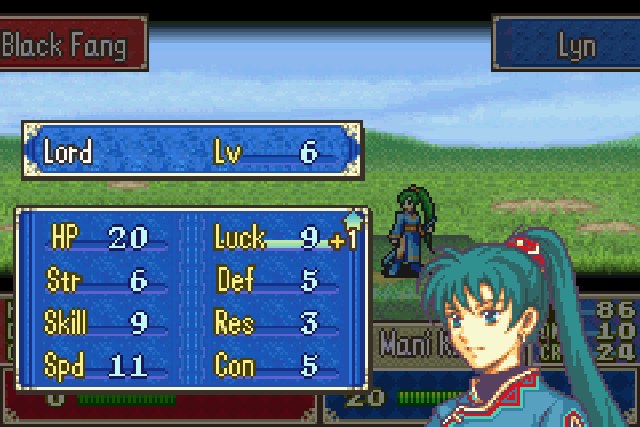
The triangle, the terrain, the tension
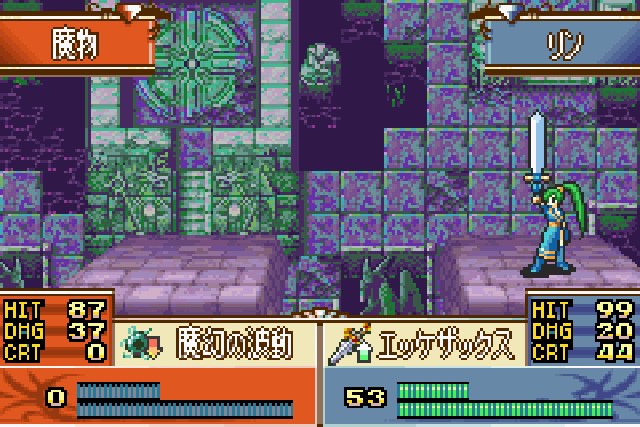
The systems are elegantly legible. Swords beat axes, axes beat lances, lances beat swords; bows strike from range but cannot counter up close; magic splits into anima, light and dark with its own triangle; pegasus knights soar over mountains and die to arrows; fog, forests, forts and thrones all bend the odds. Every unit promotes into an advanced class, weapon ranks grow with use, and supports — pairing units who fight side by side — unlock conversations that deepen the cast and buff their combat together. None of it is complicated to state, and all of it compounds into chapters that play like chess matches with heartbeats. The GBA presentation serves the clarity: crisp maps, bold unit sprites, and battle animations — swordmasters blurring into critical-hit flourishes — that remain some of the most satisfying sprite work on the system, all skippable for the impatient.
A welcome that respects you
Because this was the West’s first Fire Emblem, Lyn’s tale doubles as one of the finest tutorials in the genre — teaching movement, the weapon triangle, terrain and recruitment through story rather than manuals, then trusting you completely once Eliwood’s campaign begins. If the game has a fault, it is that early trust: Lyn’s chapters are heavily guided, and series veterans retracing them on replays must be patient. The difficulty, too, is honest rather than brutal by later standards — though a no-reset playthrough will still humble most players, and the ranking system grading your tactics, funds and survival gives perfectionists a mountain to climb. The localisation deserves special praise: witty, warm and characterful, it is a large part of why the West fell for this cast.
Supports, secrets and the long game
Depth in Fire Emblem hides in its relationships. The support system — units who fight adjacent build bonds across chapters, unlocking up to three ranked conversations per pair — is easy to play an entire campaign without fully exploiting, and it transforms a second playthrough. Supports are where the cast becomes a company: rivalries soften, backstories surface, a few pairs can even change the epilogue. Building them takes patience (bonds grow by standing together, turn after turn), which produces the series’ signature tactical-romantic dilemma: do you keep two units paired because the story demands it, or separate them because the map does? Add the hidden recruits (some chapters conceal characters behind specific visits, conversations or survival conditions), the gaiden chapters unlocked by performance, and a tactician ranking that scores your whole war, and Blazing Blade reveals itself as a game built to be replayed at higher standards of care.
It is also, not incidentally, a beautiful piece of GBA craft. The map sprites are clean and characterful, the portraits expressive, the critical-hit animations — a swordmaster’s after-images, a warrior’s spinning axe — staged like tiny action scenes, and the soundtrack (Yuka Tsujiyoko’s themes, arranged for the handheld) carries genuine martial melancholy. Weather rolls across maps, night palettes shift the mood, and villages burn if you are too slow to save them: consequence, again, made visible. For a first Western release, Nintendo and Intelligent Systems could have chosen something safer. They chose the real thing, and the audience they gambled on has been playing Fire Emblem ever since.
A note on the cast, because they carry the game: Eliwood is the rare RPG lord defined by decency rather than destiny — a diplomat’s son who would rather negotiate, which makes the war’s cost to him personal. Hector is his glorious opposite, a blunt axe of a man whose hidden depths power the game’s best scenes (and whose own campaign mode, with its rearranged chapters and additional story, is effectively a second game). Lyn, the West’s first Fire Emblem protagonist, remains a fan favourite for good reason — her arc from plains nomad to noblewoman who chooses her own loyalties gives the tutorial campaign an emotional spine. Around them orbits one of the series’ strongest supporting benches: the Christmas-coloured cavalier duo Sain and Kent, the pegasus sisters, the enigmatic dancer Nils, and villains — Nergal, and the Black Fang’s tragic assassins — with motives the script takes seriously. Permadeath hurts here because the writing did its job first.
One practical reassurance for the permadeath-wary: Blazing Blade is the friendliest possible introduction to the stakes it is famous for. Lyn’s campaign teaches at a stroll, Eliwood’s normal mode escalates honestly, save points are generous by chapter, and the game never hides the information a careful tactician needs — enemy ranges, weapon stats and hit percentages are all on the table. You will lose someone eventually, and you will feel it, and that feeling is the entire point the series has been making ever since: a tactics game in which the pieces have faces is a different, richer art form than one in which they do not. This is where that art form learned to speak English, and it spoke beautifully from its very first sentence.
Verdict
Fire Emblem on GBA — The Blazing Blade — is the game that carried a genre across an ocean: a demanding, humane strategy RPG whose permadeath, supports and immaculate tactical clarity created a fanbase that has never left. As a starting point for the series it remains close to ideal, and as a GBA strategy game only Advance Wars stands beside it — its own sibling, offering war without the funerals. This one makes you attend the funerals. That is its greatness.
Score: 9.0/10