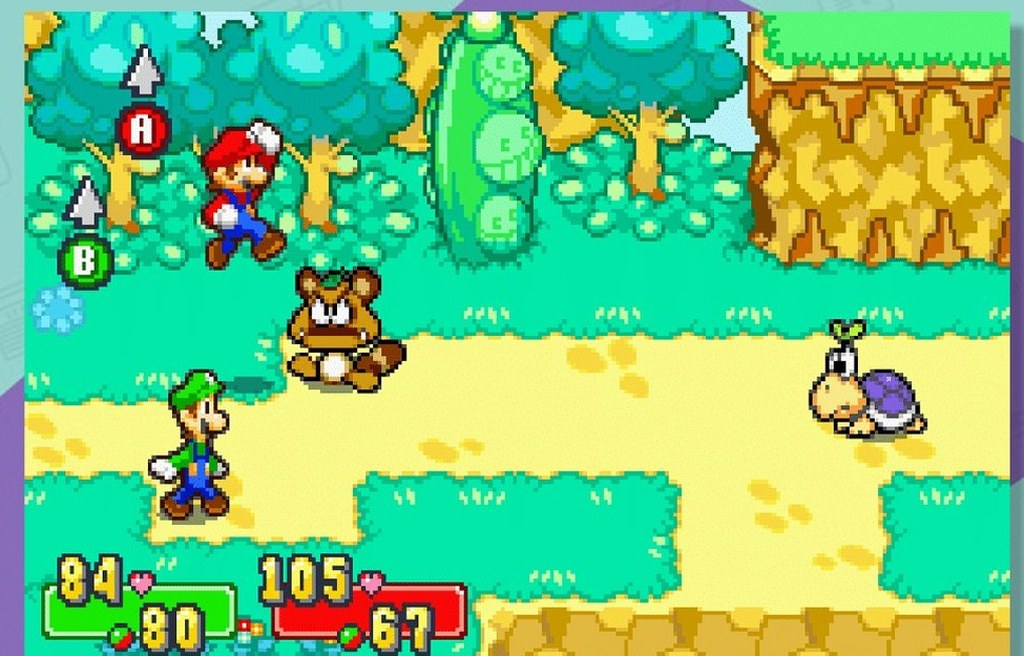
The Mario RPGs have always been Nintendo’s licence to be funny, but Superstar Saga is where the comedy became the whole design. Released in 2003 and developed by AlphaDream, Mario & Luigi: Superstar Saga sends the brothers to the Beanbean Kingdom to recover Princess Peach’s stolen voice — stolen, and replaced with explosive vocabulary, by the witch Cackletta and her magnificent henchman Fawful, a character who would steal every scene he entered for the next two decades of the series. It is the funniest game on the Game Boy Advance, and underneath the jokes sits one of the most inventive battle systems ever put in a handheld RPG.

Two brothers, one controller, zero downtime
Superstar Saga’s masterstroke is control. A is Mario, B is Luigi — always, everywhere. In the field, the brothers walk in file, jump independently, and gradually acquire paired abilities that turn traversal into a slapstick puzzle language: one brother flattened into a pancake to slip through gaps, one buried and tunnelling, the pair spinning like a helicopter or rolling as a single ball. Dungeons and towns are built around these gags, so exploration feels like a double act you are performing rather than a map you are crossing. Switching who leads changes which abilities you can use, and the game delights in separating the brothers purely so it can reunite them with style.
In battle, the same A/B split becomes a timing engine. Every attack is performed, not selected: jump attacks land harder with a well-timed second press, hammer swings charge to a sweet spot, and — the revolution — every enemy attack can be dodged or countered by jumping or hammering with the right brother at the right moment. A skilled player can finish fights untouched; a careless one watches Luigi get flattened by a telegraphed charge they saw coming. Battles are puzzles of tells and reflexes, which is why Superstar Saga’s combat has never dated the way menu-driven contemporaries have. Bros. Attacks push further still: spectacular paired special moves, unlocked and upgraded through play, that ask you to choreograph both brothers through button sequences — expensive in Bros. Points, devastating when performed cleanly, and endlessly satisfying to learn.

A kingdom with beans in its ears
The Beanbean Kingdom is a joy to inhabit — a coffee-obsessed mirror of the Mushroom Kingdom with its own queen, its own ancient disasters, the soda-blessed Chucklehuck Woods, a fashion-obsessed mountain hermit, and Prince Peasley, the most flamboyantly sparkling royal Nintendo had produced to that date. The writing (in a localisation that remains a series benchmark) is dense with jokes that land for children and adults simultaneously, and the game keeps finding excuses for pure silliness: posing for photos, working a beach resort’s plumbing, a mid-game sequence spent as a certain plumber in a barrel-based disguise. Underneath, Charles Martinet’s whoops and hollers for both brothers and Yoko Shimomura’s bouncy, unmistakable score give every scene its bounce. Shimomura’s battle themes alone justify the cartridge.

The honest smudges
Criticisms are few and specific. The adventure is on the shorter, easier side for genre veterans — the dodge-everything battle system means a sharp player may rarely feel threatened outside the final stretch, where the difficulty finally wakes up and arguably overcorrects. A late-game stretch of item-fetching across the map also pads where the rest of the game sprints. And a word for remake-curious readers: a Nintendo 3DS remake exists, but this original’s sprite work — expressive, squash-and-stretch animation that the remake’s style never quite matched — remains the version fans defend, and this review covers the GBA original on its own considerable merits.
The Beanbean difference, and why the original endures
It is worth pausing on how well Superstar Saga uses its setting. Mario RPGs before it largely stayed in the Mushroom Kingdom; AlphaDream built a neighbouring kingdom with its own ecology (beans, obviously, in everything from the currency-adjacent collectibles to the coffee-blending side system run by Professor E. Gadd, whose café lets you brew stat-boosting drinks from beans gathered across the map). Beanstar lore, the ancient Beanish civilisation, the subterranean pipe network staffed by helpful citizens — the game keeps inventing small systems and smaller jokes, and almost none of it is filler. Even its collectible loop, hunting beans and blending drinks, feeds back into character builds rather than a percentage counter.
As for versions: the 2017 Nintendo 3DS remake (Superstar Saga + Bowser’s Minions) adds a side mode and quality-of-life touches, and it is a perfectly good way to play. But this review is of the GBA original, and the original has defenders for concrete reasons — its sprite animation has a squash, stretch and comic timing that defined these characters’ personalities for a generation of players, its pacing is untouched by additions, and its soundtrack mix remains the reference version of Shimomura’s score. On the GBA it also sits in the strongest company imaginable: 2003’s handheld RPG shelf, next to Pokémon Ruby and Sapphire and Final Fantasy Tactics Advance, and it holds its own in that company by being the one you will finish smiling. Longevity note for completionists: post-game bean hunting, the Star Rank challenges and mastering every Bros. Attack’s advanced form stretch the cartridge well past its story — the advanced versions of Bros. Attacks, unlocked by repeated successful use, transform familiar specials into harder, stronger routines that reward exactly the mastery the battle system has been teaching you all along.
It is also, structurally, one of the best-paced RPGs on the system. The Beanbean map is compact and interconnected, dungeons are brisk puzzle-boxes rather than slogs, random encounters are visible and avoidable on the field (a mercy more RPGs of the era should have copied), and the game keeps rotating its gimmicks — a surfing mini-game on the coast, a mine-cart jaunt, a stint working at a cinema of all places — so that its twenty-odd hours never repeat a trick twice. Difficulty spikes exist (the final boss gauntlet is a genuine marathon that has ended many childhood runs), but the systems always give you the tools: guard with timing, heal with syrup, and let Luigi take the hit he was born to take. If the series that followed sometimes drowned its own formula in tutorials and gimmicks, the original’s confidence looks better every year: two buttons, two brothers, one witch, endless jokes.
A last note on audience, because Superstar Saga threads a needle modern family games still aim at: it is genuinely suitable for a young player’s first RPG — readable text, forgiving systems, a dodge mechanic that turns defence into play — while being written at a level of wit that gives adults their own, second game running in parallel. The jokes about fame, fandom and plumbing are aimed over children’s heads without ever excluding them from the room. That double address, effortless here, is the house style Pixar gets praised for, executed in sprites and beeps in 2003. It is why the cartridge stayed in families’ GBAs for years, passed between siblings like a favourite comic, and why its reputation has only grown as those children became the internet’s loudest nostalgists. They are right to be loud. This one is special.
Verdict
Mario & Luigi: Superstar Saga is the GBA’s funniest game and one of its best RPGs — a double act of timing-based battles, paired-brother puzzles and writing that has never stopped being quoted. It launched a beloved series at its near-best, and its original sprite incarnation remains essential. Fawful has chortles. So will you.
Score: 9.0/10