
The Game Boy Advance was the last Game Boy – and for a generation of players, the best one. Launched in 2001, it put a machine more powerful than a Super Nintendo in a $99.99 pocket slab, then spent nine years hosting two libraries at once: the SNES’s greatest hits, remade for the bus, and an original golden age of its own – Golden Sun, Advance Wars, WarioWare, Metroid Fusion, Fire Emblem’s Western debut, Pokemon’s third generation. It sold 81.5 million units across three bodies (the wide original, the clamshell SP, the jewellery-sized Micro), survived being replaced by its own successor for six years, and carried the Game Boy name to its retirement in 2010 with the name unblemished. It also shipped with the most famously unlit screen in history, which its fans forgave, modded, and eventually turned into a hobby of its own. This is the complete story of the 32-bit pocket rocket.
Project Atlantis and the Long Wait
Through the late 1990s, the games press chased a ghost: “Project Atlantis,” Nintendo’s rumoured 32-bit colour handheld, supposedly ready since 1996 and perpetually about to replace the ageing Game Boy. The ghost was real – Nintendo had prototyped exactly such a machine – but the company kept shelving it, first because the original Game Boy refused to stop selling (Pokemon saw to that), then because the stopgap Game Boy Color (1998) printed money of its own. When the Advance finally surfaced – unveiled in 1999, shown at Space World 2000 – its design was pure Nintendo philosophy, the late Gunpei Yokoi’s “lateral thinking with withered technology” applied one last time: a 32-bit ARM7TDMI processor at 16.78 MHz (a cheap, cool, phone-grade chip), a 240×160 reflective colour LCD, no backlight, two AA batteries good for fifteen hours, and full backward compatibility with a decade of Game Boy and Game Boy Color cartridges through a hardware switch in the cartridge slot. At $99.99 in Japan (March 21, 2001) and North America (June 11, 2001), it undercut every prediction and sold out its launch allocations; Nintendo moved nearly three million units in its first months. The horizontal “wide” body – designed to be held like a tiny SNES pad – announced the intent: this was a home console that happened to have a screen attached, shrunk to pocket size.
The Screen Problem
And then everyone took it outside, or under a lamp, or anywhere at all, and squinted. The GBA’s reflective display was legendarily dim – readable in direct sunlight, murky almost everywhere else, its gorgeous palette of 32,768 colours rendered as varying shades of dusk. The decision was deliberate: backlights in 2001 ate batteries and budgets, and Nintendo chose fifteen hours of play over visibility. The market’s verdict was a thousand worm-lights, magnifiers, and eventually the Afterburner – a third-party front-light kit that required opening the console and soldering, sold by the tens of thousands to owners literally voiding warranties to see Castlevania: Circle of the Moon’s gothic gloom. The Afterburner is the GBA’s defining accessory because it proved the demand Nintendo had declined to meet, and the company’s eventual answer – two years and a redesign later – reshaped the product line. It also seeded a culture: GBA modding, born in those solder-and-pray kits, never stopped, and today’s IPS-screen reshell scene is its direct descendant. The screen was the GBA’s original sin and, in the long run, one of its most productive flaws.

Launch: The Handheld That Sold Like a Home Console
The launch numbers rewrote the record book. In Japan the Advance sold through its first shipment in days; in North America it became, by NPD’s reckoning, the fastest-selling game system in the country’s history to that point, moving more than a million units in its first month at a price some retailers immediately discounted below ninety dollars to win the stampede. The launch library understood the assignment: Super Mario Advance repackaged the oddball Super Mario Bros. 2 with a modern sheen and topped the charts; F-Zero: Maximum Velocity proved the Mode 7-style racing was smoother than the SNES original; Castlevania: Circle of the Moon gave the early adopters their hardcore showpiece (and, being nearly invisible on that screen, their first Afterburner sales pitch); Tony Hawk’s Pro Skater 2 arrived as the port nobody believed until they played it. Within eighteen months the installed base was so large that the GBA was effectively the industry’s second console market – the place 2D development, licensed games and experimental budgets went to be profitable while the home-console war burned money in 3D. Nintendo had set out to replace the Game Boy eventually. Instead it had built, almost by accident, the last dedicated 2D platform the big industry would ever fully support – and everybody, from Capcom to Camelot to a generation of kids reading by worm-light, knew it.
Two Libraries at Once: The Ports and the Golden Age
The GBA’s catalogue strategy offended purists and delighted everyone else. Nintendo and its partners ported the SNES canon wholesale – the Super Mario Advance series, A Link to the Past with a new Four Swords multiplayer mode, the Donkey Kong Country trilogy, Final Fantasy I, II, IV, V and VI, Breath of Fire, Tales of Phantasia – and the ports doubled as preservation: for younger players, the GBA was the SNES. But the originals were better still. Camelot’s Golden Sun (2001) pushed pseudo-3D spectacle from the little ARM chip and became the system’s signature RPG. Intelligent Systems’ Advance Wars (2001) perfected turn-based strategy for the hardware – and its sequel team-mate, Fire Emblem, finally crossed the Pacific in 2003 after Melee’s Marth and Roy created Western demand, opening a franchise. WarioWare, Inc. (2003) invented the five-second microgame. Metroid returned twice, in Fusion’s haunted linearity and Zero Mission’s remake-as-reimagining. Castlevania got three gothic gems, Aria of Sorrow chief among them. Mario Kart: Super Circuit, The Minish Cap (Capcom’s Zelda, and a great one), Mario & Luigi: Superstar Saga, rhythm (Rhythm Tengoku, Japan-only), strategy (Tactics Ogre, Final Fantasy Tactics Advance), and Pokemon’s Ruby and Sapphire (2002-03), which rebuilt the series for the new hardware and sold sixteen million copies. By 2004 the GBA had arguably the deepest handheld library ever assembled to that date – and it was still only halfway through its life.
The Pokemon Engine and the Cartridge Economy
Every Nintendo handheld has a Pokemon generation, and the arrangement is less a partnership than a power plant. Ruby and Sapphire (Japan 2002, West 2003) rebuilt the series on the new hardware – 2v2 battles, abilities, natures, weather, a tropical Hoenn of surf and volcanic ash – and sold 16.2 million copies, the platform’s best; FireRed and LeafGreen (2004) remade the Kanto originals as the definitive versions and sold twelve million more; Emerald (2005) polished the formula a third time. Around that gravity well the whole economy orbited: Mario Kart: Super Circuit shifted nine million, the Mario Advance remakes four to five million apiece, and third parties from Capcom (Mega Man Battle Network’s six-deep run) to Konami and Square Enix treated the GBA as a second front in the 2D war the home consoles had abandoned. The cartridge economy had a shadow side, too: the GBA was the first Nintendo handheld to face mass flash-cart piracy, with devices like the Flash Advance linker letting a PC write downloaded ROMs to rewritable cartridges – an arms race Nintendo fought with lawsuits while the same hardware quietly enabled the homebrew and translation scenes that would later define the platform’s afterlife. The little grey Game Pak was, all at once, a product, a piracy vector and a development kit; the industry has been negotiating those three identities ever since.
The Clamshell Fix: SP and Micro
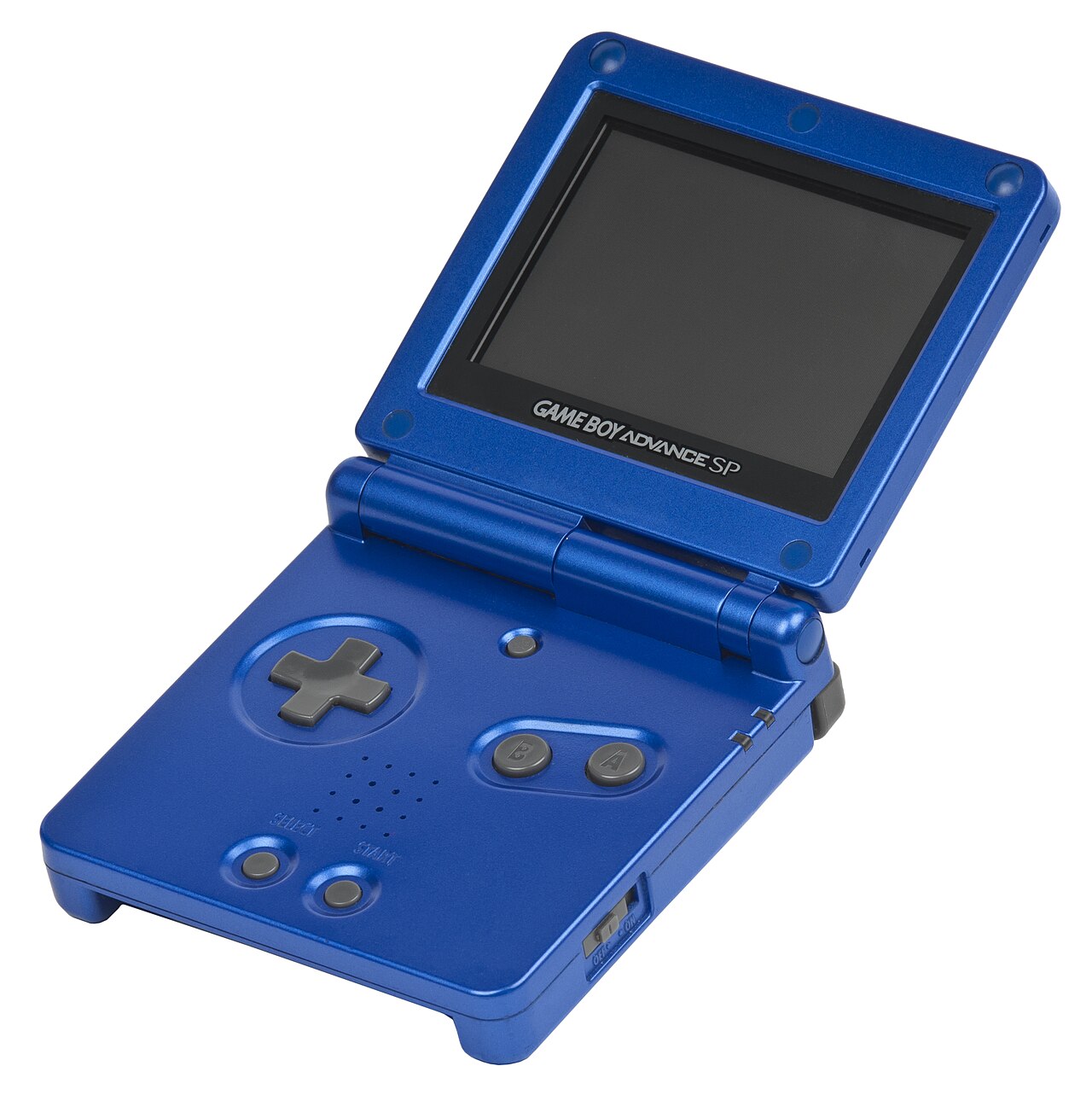
In February 2003 Nintendo shipped the apology. The Game Boy Advance SP folded the machine into a laptop-style clamshell the size of a makeup compact: front-lit screen (the AGS-001), a rechargeable lithium-ion battery replacing the AAs, a protected display that closed like a book, at the same $99.99. It was an instant design icon and a commercial monster – the SP would outsell the original model, 43.5 million to 41.6 million – and in 2005 North America quietly got the AGS-101 revision, a true backlit screen (“brighter screen with backlight” said the box, in the understatement of the decade) that finally showed the library as its artists had drawn it. Then, in September 2005, Nintendo went the other direction entirely: the Game Boy Micro, a sliver of anodised aluminium barely wider than its own cartridge, with swappable fashion faceplates, the sharpest screen of the three, and – heresy – no backward compatibility with Game Boy cartridges. The Micro sold modestly (about 2.4 million) as a style object, but it reads now as a design manifesto: Nintendo experimenting with the handheld as jewellery a decade before limited-edition hardware drops were an industry. Three bodies, three philosophies, one library: the GBA is the only Nintendo platform that got to be all of them.
Cables, Cards and the GameCube Bridge
The GBA was also Nintendo’s most connectable machine before Wi-Fi. The GameCube-Game Boy Advance link cable turned the handheld into a controller, a private second screen and a content key: Final Fantasy Crystal Chronicles and The Legend of Zelda: Four Swords Adventures built entire multiplayer designs around one GameCube and four GBAs; Pac-Man Vs. (Miyamoto’s asymmetric gem, bundled and beloved) hid the maze from the ghosts; Pokemon Colosseum traded with the cartridges. The Game Boy Player (2003) inverted the arrangement, snapping under a GameCube to play the entire Game Boy family on a television – the Super Game Boy concept perfected, and still the connoisseur’s way to run the library. Around the edges clustered the experiments: the e-Reader, a card-swipe attachment that loaded games and content from dot-coded trading cards (a hit of novelty in Japan, a commercial shrug in the West); the Wireless Adapter, bundled with Pokemon FireRed and LeafGreen in 2004, Nintendo’s first local wireless play; the Play-Yan media cartridge in Japan. Most of it was commercially marginal and all of it was R&D: the DS’s wireless, the Wii’s second-screen flirtations and ultimately the Switch’s whole identity are standing on GBA-era prototypes.

The Third Pillar That Outlived the Story
In November 2004 Nintendo launched the DS with a GBA slot in its belly and an official fiction: the DS was a “third pillar,” not a successor, and the Game Boy line would continue. The fiction was insurance – if the two-screen experiment failed, the Advance would carry on – and like most insurance it went unclaimed but not unused. The GBA kept selling in the millions alongside its replacement, powered by Pokemon (Emerald in 2005, and the FireRed/LeafGreen remakes that remain fan canon) and a budget back catalogue, while developers in Japan produced late masterpieces the West mostly met through imports and fan translations – most famously Mother 3 (2006), which Nintendo declined to localise and fans translated anyway in one of the medium’s landmark volunteer efforts. Production wound down around 2010, by which time the family had sold 81.51 million units – the last machines ever to carry the Game Boy name. The DS dropped the branding, the 3DS and Switch folded the handheld line into the hybrid era, and the Game Boy name itself became heritage: twenty-one years, three platforms, roughly 200 million units, an unbroken reign from 1989 to the GBA’s quiet retirement.
Squeezing the ARM: The Developers’ Machine
Technically, the GBA rewarded the same virtues as the SNES it resembled: a fast-for-its-class CPU, hardware rotation and scaling modes inherited from Mode 7 thinking, a generous sprite engine, and sound that mixed a proper programmable synth with the Game Boy’s old square-wave channels – which is why its best music (Golden Sun’s Motoi Sakuraba score, Aria of Sorrow’s Michiru Yamane arrangements) still gets orchestral covers. The virtuoso acts became legend. Vicarious Visions turned Tony Hawk’s Pro Skater 2 into an isometric marvel that played like the console game; a genuine port of Doom (2001) ran id’s shooter on a handheld when that still sounded like a hoax; Golden Sun’s battle scenes faked 3D depth with layered scaling sprites; F-Zero: Maximum Velocity launched the system with Mode 7 racing smoother than the SNES original. Even the platform’s oddest commercial experiment – Game Boy Advance Video (2004), full cartoon episodes compressed onto cartridges at resolutions that made eyes water – proved the point: if it could be made of pixels and patience, someone shipped it on a Game Pak. Developers loved the machine’s honesty. What you programmed was what the ARM executed, the documentation was good, the installed base was enormous, and a small team could still finish a game that mattered – the exact conditions, not coincidentally, of the SNES era it spent its life honouring.
Afterlife: The Screen, Fixed at Last
The GBA’s second life has been unusually hands-on. Nintendo’s own reissues were selective but pointed: the Wii U Virtual Console (from 2014) ran GBA games with widely praised emulation, and Nintendo Switch Online + Expansion Pack brought the library to the Switch in 2023 with online multiplayer for games designed around a link cable. The fan ecosystem did the rest. The Analogue Pocket (2021) – FPGA hardware playing original cartridges on a 1600×1440 screen – turned GBA collecting into a premium hobby overnight, EverDrive flash carts kept original hardware fed, and emulator mGBA set the accuracy standard the hardware mods chase. Those mods are the afterlife’s centre of gravity: drop-in IPS backlit screens, CNC aluminium shells, USB-C batteries and HDMI-out kits – the community systematically rebuilding the GBA into the machine its screen always deserved to be, twenty years on. Fan translations finished the library’s unfinished business (Mother 3 above all, and a continuing procession of Japan-only RPGs), and the prototype archaeologists keep finding its might-have-beens. A console whose fans spent its life fixing its screen was never going to be allowed to die in the dark.
Legacy: The Last Game Boy
The Advance’s legacy is double. As a library, it is the bridge between the 2D golden age and everything since: the machine where the SNES canon was preserved in aspic and where handheld-original design – Advance Wars, WarioWare, Golden Sun – proved portable games could be the main event rather than the compromise. As an industry object, it closed the Game Boy story on a peak, proved Nintendo could iterate hardware mid-generation into new form factors (the SP-to-DS hinge lineage is direct), and left the template – cheap silicon, absurd battery life, backward compatibility, one great Pokemon generation – that Nintendo’s handheld empire ran on until the Switch merged the lines. Every “definitive” way to play it today, from FPGA to IPS-modded originals, is an argument about which of its three bodies was the real one. The library, at least, never had to choose.