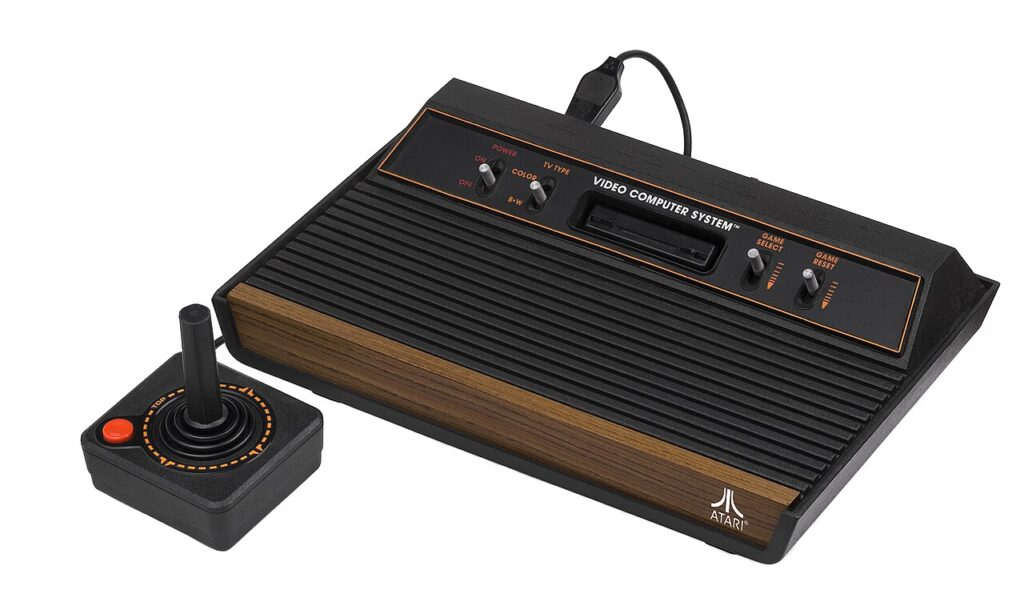
Every console war, every launch-day queue, every third-party logo parade before a title screen – all of it starts here, in a wood-grained box with six switches and a single button. The Atari 2600 (born the Video Computer System, codename “Stella”) did not invent the programmable console – Fairchild’s Channel F beat it to cartridges by a year – but it is the machine that turned the idea into an industry: roughly 30 million sold across an astonishing fifteen-year production life, the first arcade licence, the first third-party publisher, the first famous Easter egg, the first great boom, and the first great crash. It also refused to die. The 2600 was still being manufactured in 1992, outliving its successor’s successor, and its homebrew scene in 2026 ships new cartridges every month. This is the complete story of the machine that started it all – and never quite stopped.
1977: Stella Gets Her Groove
Atari in 1976 was the company Nolan Bushnell built on Pong, freshly sold to Warner Communications for $28 million because Bushnell needed capital for exactly this: a machine that would not be obsolete the Christmas after it launched. Dedicated consoles died with their built-in games; the VCS would play whatever you plugged into it. Engineer Joe Decuir prototyped the hardware around the MOS 6507 CPU, Jay Miner designed the TIA – the Television Interface Adaptor chip that generated picture and sound together, in real time, with no framebuffer at all – and the whole project ran under the codename Stella, reportedly borrowed from Decuir’s bicycle. The launch, in September 1977, was nearly a fumble: manufacturing problems and the collapsing dedicated-console market (retailers were drowning in unsold Pong clones) meant the VCS’s first Christmas was modest, nine launch cartridges deep, with Combat – two biplanes, two tanks, endless arguments – in the box. The machine cost $199, dressed its switches in fake wood and its difficulty toggles in mystery, and waited for a killer app. It got one from outer space. Taito’s Space Invaders, licensed by Atari in the first arcade-to-home deal of its kind and converted by Rick Mauer, arrived in 1980 and quadrupled VCS sales almost overnight. The lesson – that one game could sell the hardware it ran on – became the industry’s founding business model.

The Boom: Activision, Easter Eggs and the Arcade at Home
Success rearranged Atari’s politics, and the politics invented the modern games industry. In 1979 four Atari programmers – David Crane, Larry Kaplan, Alan Miller and Bob Whitehead – asked for royalties and credit, were told by Atari’s president that they were no more essential than the assembly-line staff, and left to found Activision: the first third-party game publisher. Atari sued; the settlement let Activision live, and with it the entire concept that a console was a platform other companies could build on. Crane’s Pitfall! (1982) – a jungle, a swinging vine, 255 screens generated from a polynomial counter because there was no memory to store them – sold four million copies and showed what the wheezing hardware could do in genius hands. The credit fight left another artefact: Warren Robinett, denied a byline on Adventure (1979), hid one instead – a single-pixel key to a single-pixel door to a room that read “Created by Warren Robinett.” It is usually called the first Easter egg in games, and Atari, once a kid found it, decided it was a feature. Meanwhile the arcade licences piled up – Asteroids, Missile Command, Defender, Berzerk – and the VCS, renamed the Atari 2600 in November 1982 to sit beside the new 5200, was selling in the millions. At its 1982 peak, Atari was the fastest-growing company in American history to that point, and the 2600 was the reason.

The Rivals Arrive: Intellivision, Coleco and the Clone Wars
Being first meant being hunted. Mattel’s Intellivision (1979) attacked the 2600 where it lived – better graphics, George Plimpton sneering in television ads that the comparison wasn’t close – and sold in the millions to sports fans especially. Coleco’s ColecoVision (1982) attacked harder, bundling a near-arcade-perfect Donkey Kong and selling an Expansion Module that played 2600 cartridges outright: the competitor’s library as a bullet point on your box. Atari sued Coleco for patent infringement and then, in the settlement that defined the era’s pragmatism, licensed them instead – Coleco paid royalties per module, and the 2600’s catalogue became so universal that even its rivals had to support it. Coleco then cloned the machine itself as the Gemini. The deeper significance of the fight was invisible at the time: a games library had become a standard, like a record format, and the company that controlled the standard collected rent from everyone – friend, rival and clone alike. Nintendo’s Seal of Quality, its lockout chip, its entire legal posture toward the NES a few years later, is this lesson learned by the company that watched Atari learn it first, too late and too loosely. The 2600 didn’t just have competitors. It had an ecosystem – the first one – with all the chaos that word implies.
Pac-Man, E.T. and the Crash of 1983
The fall was as fast as the rise, and Atari authored most of it. Confident beyond reason, it manufactured 12 million copies of the Pac-Man conversion in 1982 – more cartridges than there were consoles to play them – and the conversion itself, Tod Frye’s heroic solo effort squeezed into 4K and strangled by schedule, flickered and stumbled its way into legend as the port that wasn’t good enough. Then E.T. the Extra-Terrestrial: negotiated for a reported $20-25 million in rights, coded by Howard Scott Warshaw (of Yars’ Revenge, the 2600’s best-selling original game) in about five weeks to hit Christmas. E.T. actually sold around 2.7 million copies – a hit by any sane measure – but Atari had made roughly four million and bet the season on more. The returns met a market already drowning in shovelware from dozens of would-be Activisions, retailers lost faith and shelf space, home computers undercut the consoles, and in 1983 the North American industry collapsed from about $3.2 billion to about $100 million by 1985. Warner posted a $536 million loss in a single quarter of 1983 and sold Atari’s consumer division to Jack Tramiel in July 1984. The famous coda – truckloads of unsold cartridges buried in Alamogordo, New Mexico – was dismissed as urban legend for thirty years, then dug up on camera in 2014: E.T. cartridges, in the desert, exactly where the story said. The crash is usually told as the 2600’s death. It was closer to a near-death – because the machine had one more act, priced under fifty bucks.
Racing the Beam: Programming the Impossible
To understand the 2600’s second life you have to understand its beautiful poverty. The TIA chip has no memory of the picture: it draws each scanline as the television’s electron beam crosses it, and the programmer must feed it new instructions in the gap – “racing the beam” is not a metaphor, it is the job description. The whole system has 128 bytes of RAM. Not kilobytes: bytes. A cartridge began at 2K or 4K of ROM and a display kernel that counted cycles the way a safecracker counts tumblers. Everything players remember as style was a workaround wearing a costume: the symmetrical playfields, the reused sprites, the flicker when more than two objects shared a line. And the masters kept finding headroom – bankswitching schemes that paged in 8K, 16K, eventually 32K of ROM; Pitfall II’s custom DPC chip adding music voices; Starpath’s Supercharger loading games from cassette with 6K of RAM to spend. David Crane’s Dragster, Kaboom!’s paddle precision, Warshaw’s Yars’ Revenge with its encrypted “neutral zone” shimmer, Demon Attack from Imagic, the sublime minimalism of Adventure’s square-duck dragons: the 2600 library is a masterclass in constraint as an artistic medium, and it is why programmers still describe the machine the way poets describe the sonnet form.

The Fifty-Dollar Resurrection and the Long Goodbye
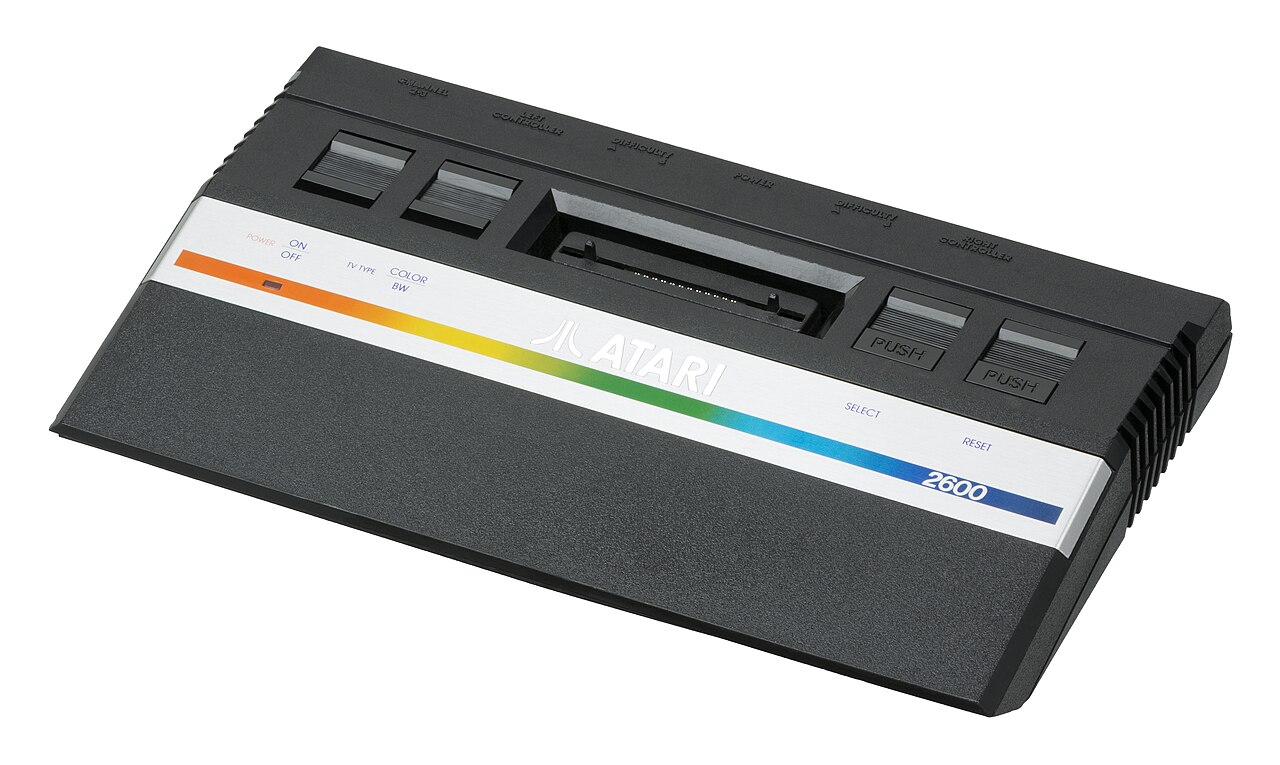
Nintendo’s NES resurrected the American industry in 1985 on the 2600’s grave, supposedly. But under Tramiel, Atari Corp. relaunched the old machine in 1986 as the Atari 2600 Jr – a slim, black, rainbow-striped redesign consciously echoing the 7800 – with a slogan that wrote itself: “The fun is back! The 2600 is under 50 bucks – $49.99!” It sold. For years. New-old games appeared (some, like Secret Quest and Fatal Run, remarkably late and remarkably good), the back catalogue trickled on in budget bins, and the 2600’s production line, which had paused mid-decade, kept running until January 1, 1992 – fifteen years after launch, into the era of the Super Nintendo and the CD-ROM. Lifetime sales are usually put around 30 million units and more than 500 official cartridges, with the machine’s final form – a budget console for families who couldn’t stretch to 16 bits – being in its way as radical as its first: it invented the second-life, price-cut afterlife that every successful console since, from the PS2’s long tail to the NES Classic’s nostalgia box, has imitated. Atari itself kept dying and being reborn – Hasbro, Infogrames, bankruptcy in 2013, and a modern revival under Wade Rosen that treats the 2600 as a living platform: the Atari 2600+ (2023), an HDMI machine that plays original cartridges with a faithfully recreated CX40, would have been science fiction to the men who buried E.T. It was also, in retrospect, inevitable.
The Immortal Machine: Homebrew and the Scene That Won’t Stop
When the original hardware finally left the catalogue, the 2600 simply changed mediums. The plug-and-play era – a joystick-shaped TV game in 2002, then the Flashback series from 2004 onward – put the library into supermarket checkouts by the million, each iteration selling the same decades-old games to buyers who remembered them and, quietly, to a generation meeting Pitfall Harry for the first time. The early Flashbacks were imperfect (the first was, notoriously, different hardware wearing 2600 clothes) but the economics were undeniable: the back catalogue had become an annuity. Atari’s own modern era doubled down – the Atari VCS of 2021 was a PC in a 2600 Jr overcoat, licensed handhelds and mini-consoles recycle the library endlessly, and the 2600+ put real cartridges back on electronics-store shelves. No other console’s commercial afterlife has lasted longer than its life. The Jr’s slogan turned out to be a prophecy with a longer fuse than anyone billed: the fun came back, and then simply never left again.
Plenty of consoles are remembered. The 2600 is still programmed. Its modern homebrew scene – centred on AtariAge’s forums and store, on the batari Basic and assembly communities, and on the Harmony flash cartridge that lets original hardware run anything – produces new boxed cartridges every year: arcade conversions the 1980s never got, sequels to classics, and originals that would have been retail hits in 1982. Lost prototypes surface and get finished – Dan Kitchen’s Keystone Cannonball, shelved in the crash era, finally shipped four decades later to acclaim. Multi-game “Companion” volumes document the scene in print; fan programmers teach the machine in hackerspaces, racing the beam on hardware older than their parents. The scene exists because the 2600 hits a sweet spot no later console quite repeats: it is simple enough that one person can hold the whole machine in their head, and constrained enough that doing so remains an art. Add the FPGA and emulation ecosystem, the 2600+ and 7800+ hardware lines, Atari’s own 50th-anniversary archaeology, and a collector market where a boxed Air Raid changes hands like a painting, and the picture completes itself. The 2600 was the first console built to outlive its games. Nobody in 1977 imagined it would also outlive its company, its crash, its century – and counting.
The Canon: Twenty-Five Cents’ Worth of Forever
What did the machine actually play like at its best? Start with the pack-in: Combat’s tank-and-biplane duels remain pure two-player design, twenty-seven game variations from two kilobytes. Space Invaders and Asteroids proved home conversions could headline a system; Missile Command’s three-base juggling act translated nuclear dread into trackball-free tension; Adventure invented the action-adventure’s grammar – items, keys, coloured kingdoms, a bat with no respect for property – inside 4K. Activision’s catalogue is the honour roll: Pitfall! and its sequel, River Raid’s endless scrolling river (Carol Shaw, one of the industry’s first women designers, and the game Germany briefly banned for minors), Kaboom!’s escalating paddle panic, H.E.R.O.’s helicopter-hat rescue opera, Frostbite’s ice-block hopping. Yars’ Revenge remains the best-selling original game on the system and the strangest: a fly, a cannon, a shield made of the enemy. Imagic’s Demon Attack out-Phoenix’d Phoenix. And the late masters closed the book in style: Ms. Pac-Man’s conversion, by General Computer Corporation, so much better than the original Pac-Man port it read as an apology, and Solaris (1986) – a full space-opera strategy epic squeezed onto the Jr-era hardware by Doug Neubauer, a programmer who had started on the machine when it was still called Stella. No 2600 library list settles anything; that is rather the point of a catalogue this broad built from this little. Every one of these games fits in less storage than the icon image on a modern web page – a fact that could fairly be printed on the box of every hundred-gigabyte download since.
Legacy: The Template
Strip the nostalgia away and the 2600’s legacy is structural. It established that a console is a platform: that third parties, licensing, royalties and certification – the whole constitution Nintendo would later enforce with a lockout chip and a seal of quality – are how this industry organises itself, for better (Activision exists) and worse (the 1983 flood exists too). It proved a game could sell hardware, that programmers were authors worth crediting even when they had to hide the credit, and that a machine’s constraints could be its character. Its failures wrote the industry’s safety manual: control your manufacturing, respect your retailers, never make more Pac-Man cartridges than there are people to play them. And its shape – wood grain giving way to black plastic, one stick and one button giving way to everything since – is the silhouette the entire hobby recognises. The Smithsonian keeps one. So do several million attics. Somewhere tonight a new cartridge for it is being soldered, playtested or argued about in a forum thread – which is more than can be said for most of the machines that replaced it. The one that started it all is, by the evidence of its release schedule this year, not finished yet.