
At a glance: Gex · 3DO · Crystal Dynamics, 1995 · Platformer · Score: 8.5/10
Most platform heroes of the 16-bit era were silent. Gex arrived on the 3DO in 1995 with a voice, an attitude and a stand-up routine — a wisecracking gecko voiced by comedian Dana Gould, sucked into a television dimension and forced to fight his way out through levels built from every channel imaginable. It sounds like a gimmick in search of a game. What Crystal Dynamics actually built was one of the finest 2D platformers of its generation, on any system: beautifully animated, generously sized, and funny in a way games had rarely managed before or have often managed since.
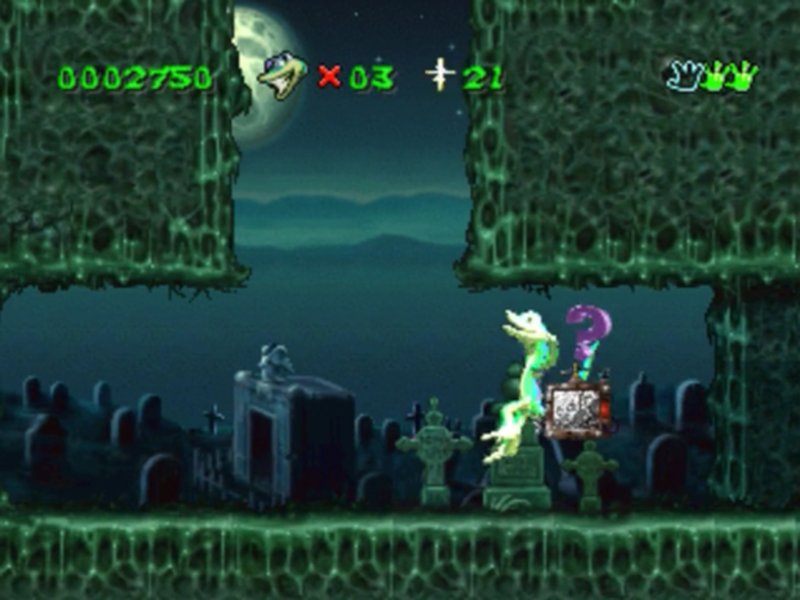
The setup is pure Saturday morning. Gex, a TV addict whose diet is pure cable, swallows a fly that turns out to be a transmitter for Rez, the lord of the Media Dimension, who wants the gecko as his new mascot. Gex refuses, obviously, and the rescue attempt becomes a tour through themed worlds — a graveyard of horror clichés, a kung-fu channel, a cartoon jungle, a prehistoric world and a nightmare dimension — each one a loving, detailed pastiche of its genre.
A gecko built for the job
What makes Gex more than a mascot with jokes is how completely the moveset serves the theme. Gex is a gecko, so he climbs: walls, ceilings, backgrounds, any surface the level designers marked as sticky. Whole sections of levels are built vertically, or upside down, and the camera swings with an ease that most 2D platformers of the period never attempted. His tail whips enemies, his tongue snatches flies — the game’s health and power-up system — from across the screen, and he can spit fire and ice when suitably fed. Everything is animated with a squash-and-stretch elasticity that still looks expensive.

The levels are large and genuinely exploratory. Each hides remote controls — the collectibles that open new areas — behind secret walls, ceiling routes and bonus games. This is not a sprint-to-the-flagpole platformer; it rewards the player who prods at scenery, and its save system, via passwords and the 3DO’s memory, respects the size of the adventure. The difficulty is honest, too. The graveyard’s later stages and the jungle’s spike work will test anyone, but checkpoints are fair and lives are earnable.
The voice that launched a thousand quotes
Then there is the commentary. Gex talks constantly — hundreds of one-liners, impressions and asides, triggered by levels, enemies and situations, riffing on everything from Star Trek to 1970s cop shows. In 1995, this was revolutionary: a platform hero with a writer’s room. Inevitably, repetition creeps in over a long session, and a handful of jokes have aged the way milk does. But the sheer hit rate is remarkable, and the performance gives the game a personality no sprite alone could carry. The 3DO original is where the voice lives most naturally — this is the version the character was created for, before the ports spread him around.
Gex proved a platformer could have a script, a star and a sense of humour — and that the jokes worked best when the game underneath them was this good.
Television as a toybox
The channel-surfing structure keeps the game visually fresh far longer than most of its rivals. One moment you are dodging chainsaw killers among the tombstones, the next you are in a chop-socky world of throwing stars and sumo wrestlers, then a cartoon world that plays by cartoon rules. Bosses cap each world with the same inventiveness — a flatulent giant, a morphing Rez lieutenant — and the between-world hub, a giant remote-strewn TV landscape, is charming in itself. The soundtrack adapts per channel, all twanging guitars and horror-organ stings, and the whole production has a polish that screamed money well spent.
Small criticisms survive. The camera, for all its ambition, occasionally loses a fast-moving Gex at a screen edge. Some one-liners repeat too often in the longer levels, and the password system is a period nuisance next to a proper save. None of it dents the whole. When the platform wars of the 1990s are tallied, the 3DO’s exclusive library is usually treated as a footnote — but its best game is a platformer that stands comparison with anything the SNES or Mega Drive produced in 1995, and beats most of them for character.

Craft in every channel
Look closer at the level design and the craft keeps showing. The horror world teaches climbing on safe surfaces before asking for it over spikes. The kung-fu world introduces its throwing-star hazards in rehearsal spaces before combining them with moving platforms. Secrets are signposted the fair way — a suspiciously blank wall, a ceiling that begs to be walked on — so discovery feels earned rather than googled. This is Crystal Dynamics, the studio that would go on to Legacy of Kain and the modern Tomb Raider games, learning its trade in public, and the fingerprints of that ambition are everywhere: in the parallax, in the spot effects, in bosses that change tactics mid-fight.
The audio deserves equal billing with the voice. Each world has its own musical identity, from horror-organ bombast to mock-oriental strings, and the sound effects — the tongue’s wet snap, the tail’s whip-crack, the television static between worlds — are mixed like a cartoon short. Gould’s performance sits inside that mix rather than on top of it, which is why the comedy lands as character rather than commentary track. Plenty of later games bolted celebrity voices onto silent designs; Gex was written, from the first sketch, as a performance, and the writing team stocked it with the kind of deep-cut references that reward the TV-soaked audience it depicts.
Historically, the game matters beyond its console. Gex sold the 3DO to people the racers and FMV titles could not reach, proved Crystal Dynamics could originate a character rather than license one, and carried the platformer forward into the CD era without surrendering to polygons or video gimmicks. That the character’s later 3D adventures never quite matched this debut says less about them than about how complete the original feels. On a system remembered mostly for its price tag, Gex is the game that feels like it belonged to everyone.
The definitive edition question
A word on versions, since Gex went everywhere after this. The PlayStation and Saturn ports are good games and made the character famous, but they are translations of a 3DO original: this is the edition built first, voiced fullest and drawn for the hardware it runs on, with the complete complement of Gould’s recorded lines and none of the compromises that porting imposed. When the character was revived for modern collections, it was this original that anchored the package — the industry quietly agreeing with the collectors about which Gex is the real one. On the 3DO shelf, it has no rival as the system’s mascot; in the platform genre’s history, it has few rivals anywhere from its year.
One more channel
Completionists should know the game rewards the full sweep: every remote found opens the way to the final confrontation with Rez at full strength, and the bonus stages — little genre parodies inside the parody — are where Crystal Dynamics hid some of its best animation. The road to one hundred percent is long, fair and funny, which is more than most mascot platformers of any era can claim.
Verdict
Gex is the 3DO’s mascot moment done right: a big, beautiful, funny platformer built around a character who earns his catchphrases with level design that keeps surprising you. The ports that followed spread his fame, but the original remains the definitive edition — the one with the full voice, the full colour and all the remote controls in the right places. Score: 8.5/10