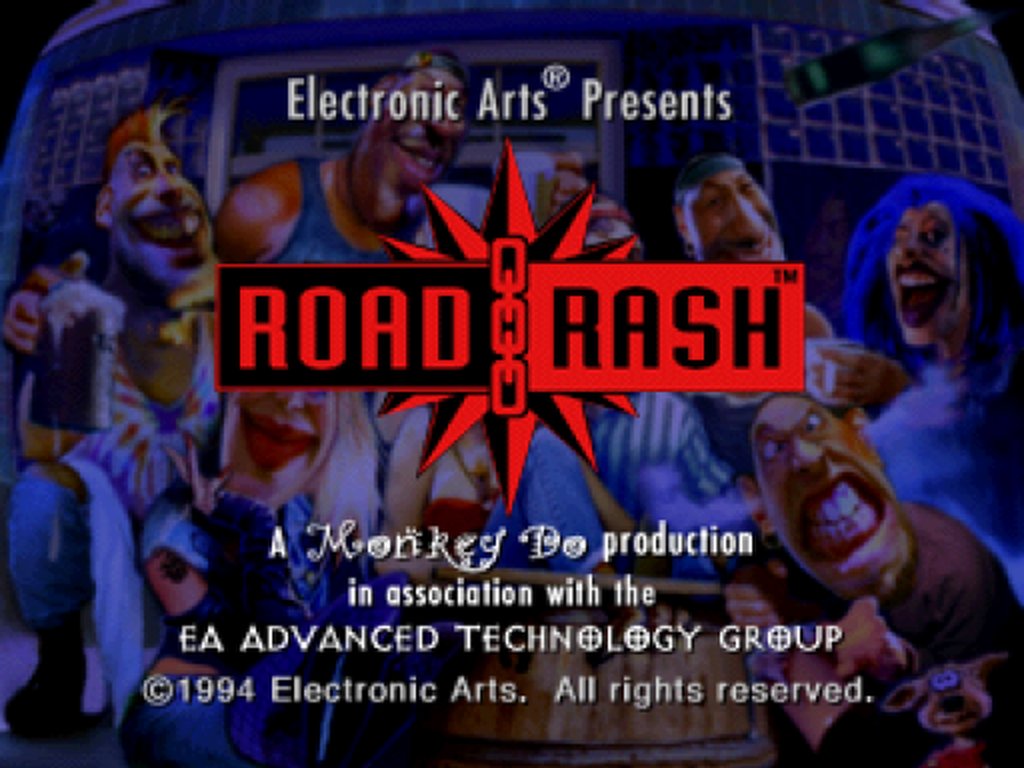
At a glance: Road Rash · 3DO · Monkey Do / Electronic Arts, 1994 · Combat racing · Score: 9.0/10
The Mega Drive Road Rash games were brilliant thugs: flat sprites, scaling roads and the simple joy of punching a man off a motorcycle at 140 mph. The 3DO version, released in 1994, is what happened when that thug won the lottery. Rebuilt from the ground up with textured 3D scenery, digitised riders, a licensed soundtrack of real grunge bands and full-motion video between races, it is less a port than a coronation — the version of Road Rash that every other version, before and since, is measured against.
The formula is untouched, and wisely so. Fifteen riders, five California locales, one rule: finish in the top four by any means available. Punch them, kick them, steal a chain or a club mid-fight and return the favour. Cars come the other way. Police take an interest. Your bike takes damage, your wallet takes the repair bill, and the whole glorious mess is held together by handling that is arcade-simple and endlessly expressive — lean, weave, brake late, and use the traffic as a weapon.
California, rendered properly
The transformation begins with the roads. The City, the Coast, the Peninsula, Napa Valley and the Sierra Nevadas are proper 3D environments now: buildings with texture and signage, bridges, tunnels, harbour fronts, traffic that includes trucks you really do not want to meet on a crest. Draw distance was a genuine wow in 1994, and the sense of speed — helped by a rider model with weight, whose body shifts and flails convincingly — holds up startlingly well. Come off at speed and your Rash-er tumbles, slides, and then has to run back to his bike on foot while the pack streams past. It is still funny. It is still agony.

The fighting deepened with the graphics. Riders have health and style now; some are brawlers who come looking for you, others are racers who would rather be left alone, and the pre-race FMV and bar-room scenes give the cast — Axle, Bose Jefferson, the terrifying Milwaukee Jon — actual personalities. Landing a clean kick that sends a rival into an oncoming car remains one of the great cheap thrills of the 16-to-32-bit transition, and the game knows it: replays and result scenes milk every incident.
Soundgarden in your helmet
Then there is the soundtrack, the feature that defined the package. Soundgarden’s “Rusty Cage” and “Superunknown”, Monster Magnet, Paw, Hammerbox, Swervedriver — a real early-nineties alternative rock compilation, woven through menus and race results, with the races themselves carried by engine noise and a snarling original score. For a generation of players this disc was a music discovery engine as much as a game. Between races, grainy FMV clips of bikers goofing for the camera sold the lifestyle with a wink. It all added up to something new: a game with the production values of a record release.
Plenty of games have licensed music. Road Rash on 3DO felt like the music had licensed the game — and the racing was good enough to deserve it.

The long road
Progression runs on money and nerve. Qualify, earn, repair, and save toward the superbikes — the Diablo and its rivals — while the fields get faster and meaner across five levels of competition. The structure can grind: prize money is tight, a written-off bike hurts, and the police fines are pure cruelty. But the grind is the game’s texture. Every new bike feels earned, every qualification scraped at the last corner feels personal, and the difficulty curve — particularly the faster classes on the narrow Sierra roads — is expertly judged.
Faults? The frame rate dips when the scenery and pack collide, a few FMV scenes repeat, and two-player support is conspicuously absent — a real loss for a game built on grudges. A modern player will also note the rubber-band AI doing its quiet work. None of it matters much against the whole. This is the complete realisation of a beloved idea, executed with money, taste and total confidence.

Why this version won
It is worth being precise about why this edition, and not the perfectly good PlayStation and Saturn conversions that followed, holds the crown. The 3DO game was built for CD from the first line of code: the video, the licensed soundtrack, the textured scenery and the digitised riders are one production, not a cartridge game with extras bolted on. The ports inherited its assets but never its occasion — the sense of a scrappy series suddenly handed a blockbuster budget and using every cent of it on screen. Play them back to back and the 3DO original still feels like the main event.
The structure rewards study. Each of the five locales changes character as the classes rise: the City’s wide boulevards become slaloms of delivery vans, the Coast’s sweepers turn into blind-commitment tests, and the Sierra’s narrow ribbon — the best road in the game — becomes a knife fight at 160 mph. Rival riders develop grudges across a season; the man you kicked into a mailbox in level two will be waiting for you in level four, faster and angrier. Damage, fines and repair costs create a little economy of spite that keeps every result meaningful long after the novelty of the violence fades.
And the violence, it should be said, is perfectly pitched. Road Rash was never a gore game — it is a cartoon of fists and boots, Road Runner physics in leathers, where the worst fate is a long run back to your bike and a repair bill. That tone is why the game charms rather than repels, and why its multi-generational appeal survives: everyone understands the comedy of a bully meeting a lamppost. The 3DO version polished that comedy until it gleamed, then handed it a Soundgarden soundtrack.
A note on the opposition
The rival riders repay attention, because they are where the game’s personality lives between the FMV scenes. Each of the named Rashers has a temperament the AI actually expresses: the opportunists who only swing when you are busy, the grudge-holders who will abandon a podium to settle a score, the cowards whose brake lights are the sweetest sight in the game. Racing a field of temperaments rather than a field of lap times changes how a season feels — you learn the cast the way you learn a works football league, and the late-game fields, faster and meaner, feel like promotions into worse company. It is character design smuggled into a racing game, a full year before the genre decided characters were a feature worth marketing.
The version question, settled
Later riders can choose the PlayStation and Saturn editions, which are respectable, or the PC conversion, which is convenient. The 3DO disc remains the reference for a simple reason: it is the one the production was built around, soundtrack, video and all, and the one whose presentation the others were measured against on release. On the system’s shelf it shares the racing crown with The Need for Speed — the two games together making the strangest and strongest one-two punch any console of the era could offer a driving fan.
Verdict
Ask veterans to name the best Road Rash and the argument ends here. The 3DO version took a scrappy sprite brawler and gave it real roads, real music and real menace, without losing a drop of the original’s spite. It remains the system’s essential racer alongside The Need for Speed — the yob to that game’s gentleman — and one of the great console racers of its decade. Score: 9.0/10