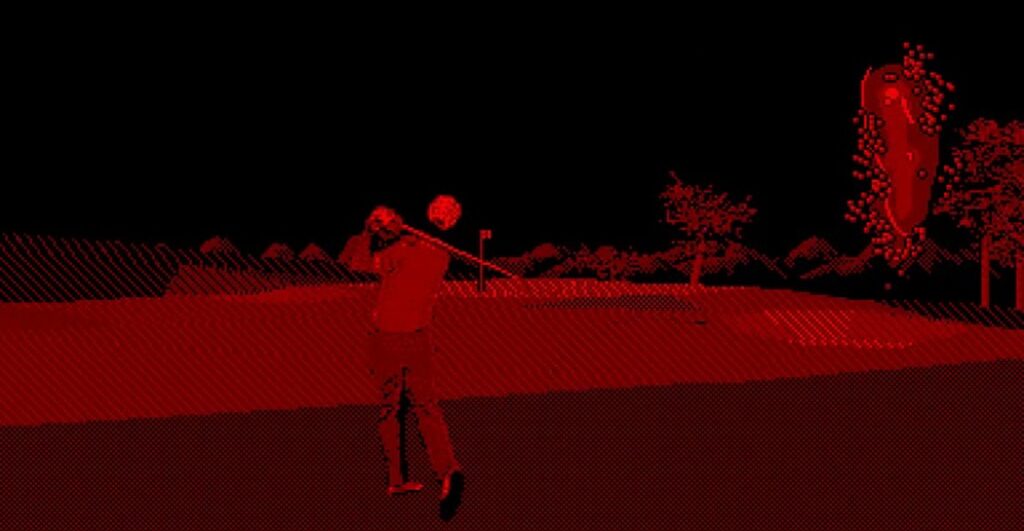
T&E Soft built its name on golf — the company behind some of Japan’s most respected golf simulations — and its Virtual Boy Golf, released in 1995 as Virtual Golf in Japan, is exactly the game that pedigree predicts: careful, complete and almost aggressively sensible. It is also a natural experiment in what stereoscopic depth does for a genre. Golf is a game about reading terrain: the rise of a fairway, the fall of a green, the true distance to a pin standing in apparent space. The Virtual Boy could show those things. The question Golf answers is whether showing them is enough.
The package is respectable. There are two full 18-hole courses — the easier Papillon Golf & Country Club and the sterner Birdie Try — a tournament mode, match and stroke play, and a thorough club-selection and shot system with wind, lie and spin all in play. The swing is a familiar three-press meter, power then accuracy, and the depth earns its keep twice: on the drive, where the fairway’s contours read as landscape rather than contour lines, and on the green, where putting — video golf’s historic weakness — becomes a genuine read of slope and distance. Putting in Golf is, without exaggeration, the best putting any portable golf game offered in 1995.
The red rough
The problems are pace and palette. A full round is a long session by Virtual Boy standards, and while the game sensibly allows its tournament to be taken in sittings, the machine’s comfort limits sit awkwardly on an 18-hole structure. The courses, rendered in the system’s reds, struggle to distinguish fairway, rough and green at a glance — the depth tells you the shape of the land but the monochrome palette mumbles about its texture, and bunker edges and water hazards can be genuinely hard to parse until you have learned each hole by heart.
Presentation is T&E functional: clean menus, a capable overhead map, minimal music that knows to stay out of the way, and ball-flight views that use the depth well as your shot sails out into the black. The computer opponents in tournament play are scoreboards rather than personalities. Everything is adequate, and adequacy, over 36 holes, is both the review and the criticism.

A sim in a novelty’s house
Golf’s odd historical position is that it is the library’s most conventional game: a serious simulation that happened to ship on the least serious hardware Nintendo ever made. It neither exploits the depth for spectacle nor ignores it; it simply uses it the way a tool is used, and is better — measurably, on the greens — for it. In a catalogue of tech demos and arcade miniatures, there is something admirable about its plainness.
For collectors it is also among the more affordable North American releases, which makes it the library’s easiest recommendation as a curiosity: the full T&E treatment, at pocket-money prices, on the strangest golf platform ever sold. Just bring the patience the game assumes. It was built for golfers, and in 1995 golfers were the one audience the Virtual Boy never found.

Two courses, honestly built
The courses repay description. Papillon, the friendlier of the two, is a resort course in the classic video-golf mould: wide fairways, water placed to punish greed rather than competence, greens that accept a well-judged approach. Birdie Try is the examination — narrower landing zones, wind that matters, greens whose slopes (and here the stereoscopic putting read becomes a genuine competitive advantage) conceal their intentions until the ball is rolling. Thirty-six holes is, by Virtual Boy standards, a mountain of content, and T&E Soft’s hole design holds its standard across both courses. This is not a demo of golf. It is a golf game, with a golf game’s full complement of ways to ruin a round.
The shot system holds up its end. The three-press meter is the era’s standard grammar, but the inputs around it — stance, club selection informed by lie, spin applied deliberately rather than decoratively — give good players levers that bad players can ignore until the second course teaches them otherwise. The overhead map is honest, the wind is readable, and the game never cheats you with hidden information. It simply presents golf’s eternal problem — the next shot is always a decision — in a medium that could finally show you the ground the decision was about.
The T&E Soft story
Context sharpens the appreciation. T&E Soft was simultaneously building Red Alarm — the library’s most ambitious action game — and this, its most conventional one, for the same launch window. The same company that drew space in wireframes drew fairways in shaded red contours, and the common thread is a respect for the display’s real capabilities: both games are built from what the Virtual Boy could show clearly, rather than what it could be forced to attempt. T&E’s golf lineage ran from the PC era through the celebrated Pebble Beach and Waialae games, and Golf is that lineage’s quiet last chapter on Nintendo hardware — a specialist studio doing its specialist thing, well, on the least likely machine imaginable.
Its modern reputation suffers from the library’s hierarchy of cool: nobody’s Virtual Boy story leads with the golf game. But players who collect to play keep rediscovering it, because a well-made golf game is a well-made golf game in any decade, and this one has a putting system its contemporaries could not match. The red rough, it turns out, was worth visiting.
A closing thought on audience: Golf is the Virtual Boy title that most plainly addresses an adult player — patient, systemic, indifferent to spectacle — on a machine the market had decided was a toy. That mismatch explains its sales and its obscurity, but it also explains its survival value: golf games do not date the way arcade novelties date, because the underlying problem (read the ground, choose the shot, execute) is permanent. T&E Soft solved that problem competently in a dimension no golf game had used before. If the Virtual Boy had found the audience this game was built for, the library’s story — and perhaps the machine’s — would read very differently.
A word, too, for the game’s restraint in its own defence. T&E Soft could have chased the Virtual Boy’s novelty market with mascot golfers, fantasy courses and depth gimmicks, and the fact that it did none of those things — that it shipped a straight simulation for grown-ups on the strangest toy of the decade — reads in hindsight as integrity rather than missed opportunity. The audience for it was small because the platform’s audience was small and young; the game itself commits no crime beyond punctuality. Players who meet it now, with the library complete around it, tend to rank it higher than the magazines of 1995 did. Time, as usual, has been the fairer reviewer.
Verdict
Competent where it should be excellent and excellent exactly where the hardware helps — on the greens, reading real slopes in real depth. Golf is a good game of golf, and on the Virtual Boy that is a stranger sentence than it sounds.
Golf — 6.5/10. T&E Soft’s steady hands, the Virtual Boy’s honest depth. The best putting of its portable era, wrapped in its most patient game.