
At a glance: Gravity Rush · PS Vita · Japan Studio (Project Siren), 2012 · Action-adventure · Score: 9.0/10
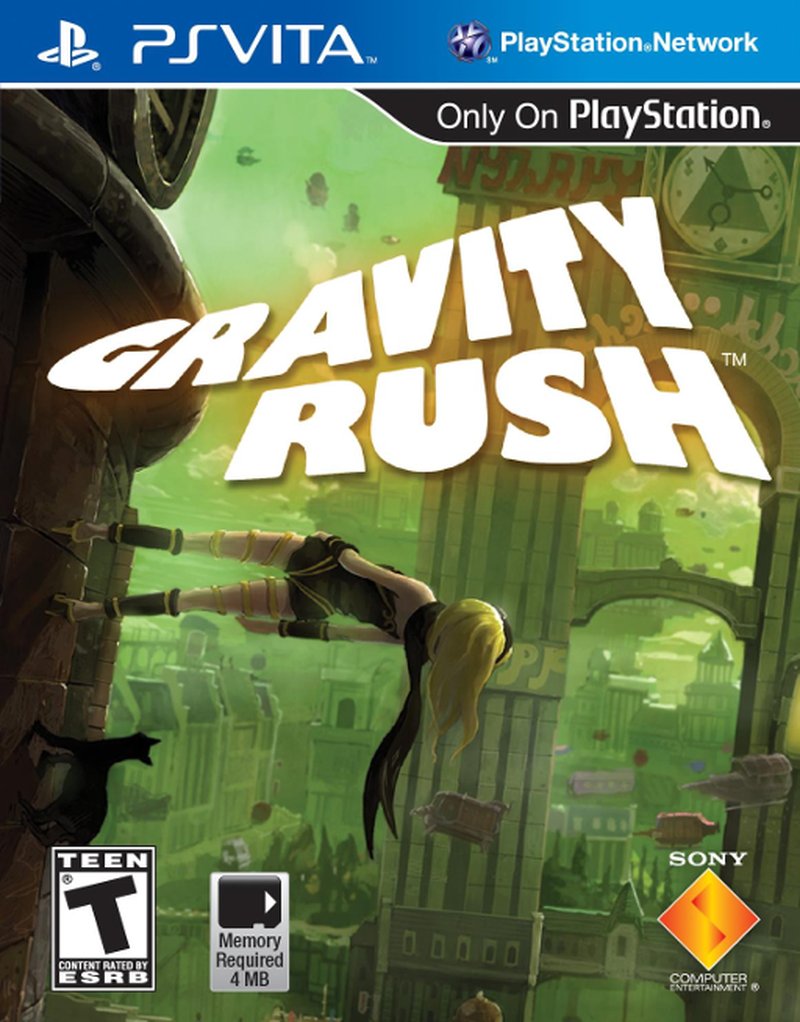
Gravity Rush begins with a girl falling out of the sky, and it never really stops falling — gloriously. Kat wakes in the floating city of Hekseville with no memory, a cat named Dusty, and the ability to point gravity in any direction she likes. Hold a trigger, aim at a rooftop, a wall, the underside of the city itself, and fall towards it. What sounds like a gimmick is, within an hour, the most joyful traversal system on the Vita: a game built entirely around the sensation of controlled plummeting, wrapped in a bande dessinée art style of watercolour skies and impossible architecture, scored like a French film. This was the Vita’s first true system-seller, made by Keiichiro Toyama’s team after Silent Hill and Siren, and it still feels like a dispatch from a braver industry.
Hekseville is the star as much as Kat. Built in districts around a colossal central pillar, above an abyss and below a sky full of drifting islands, it is a city designed to be fallen through rather than walked around. Story missions, challenge races, side tales delivered in comic-panel cutscenes and hundreds of collectible gems (which upgrade Kat’s health, attacks and gravity gauge) fill a map that keeps revealing new districts, each with its own palette and mood — the red-light warmth of the entertainment quarter, the crumbling residential sprawl below. Combat, against the blobby Nevi monsters that infest the city’s edges, mixes ground combos with the Gravity Kick: launch into the air, aim at a Nevi’s glowing core, and let falling do the fighting. It is simple, occasionally scrappy, and redeemed entirely by momentum.
Falling, perfected — mostly
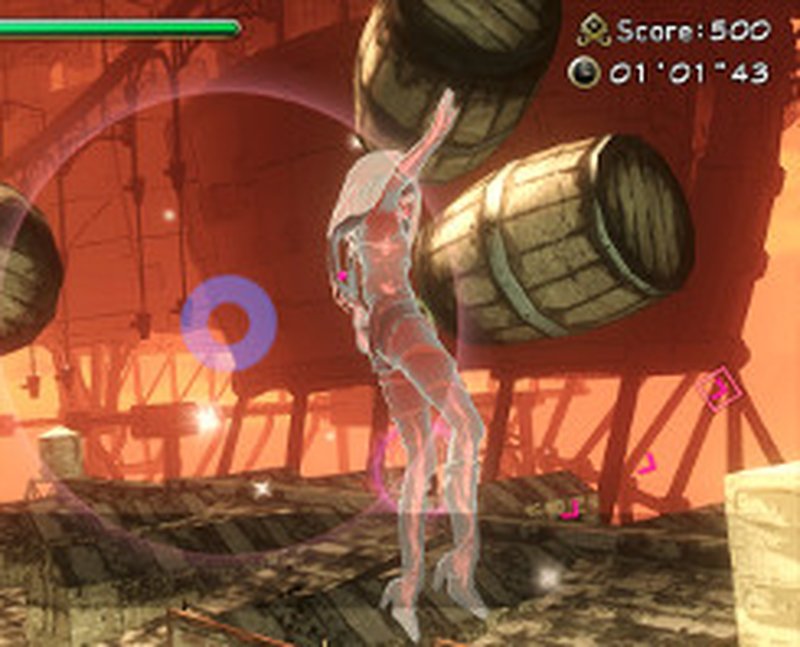
The controls deserve a paragraph of their own, because Gravity Rush is one of the few games to make a handheld’s gyroscope genuinely essential. You aim Kat’s falls by tilting the Vita itself, fine-tuning with the right stick, and the combination is intuitive in a way touch controls on the platform rarely were. The sliding dodge on the touchscreen and the stasis field — which lets Kat hurl debris, benches and unlucky Nevi at her enemies — round out a kit that grows steadily across the campaign. Where it wobbles is precision: late-game challenges demand delicate landings the camera doesn’t always support, and a couple of boss fights reduce the sublime falling to circling a weak point. The frame rate, admirable in the open city, can dip when the Nevi swarm. These are launch-window blemishes on a 2012 game doing something no other handheld game attempted.
Plenty of games let you fly. Gravity Rush is the only one that understands falling is better — falling is flying with commitment.
The Vita version is the original and, in the ways that matter, still the most characterful. The later console remaster is cleaner and faster, but it cannot recreate tilting the whole world in your hands, and the OLED screen flatters the game’s inks and washes beautifully: Hekseville’s sunsets, all peach and lavender, are a standing argument for the 1000 model. The comic-panel storytelling, read on the Vita’s screen, feels like a graphic novel that learned to move. Portability suits the structure, too — missions and challenges come in satisfying ten-minute bursts, though good luck putting it down mid-district.
Story, charm and loose ends
Kat herself carries the narrative: amnesiac heroines are a cliché, but her optimism, her odd-couple bickering with the cynical Raven, and her day-job detours (she spends one memorable stretch as a maid, and another delivering newspapers) make her one of PlayStation’s most likeable leads. The plot, involving gravity storms, lost children, a creator god or two and the city’s military politics, is deliberately dreamlike and ends with threads dangling — some picked up by its sequel, some never resolved at all. Players who need tidy endings should consider themselves warned. Everyone else gets a world so confident in its atmosphere that the mysteries feel like invitations rather than cheats, and a downloadable trio of costume-and-mission packs (Maid, Spy and Military) that are well worth the small asking price while the store lasts.

The Toyama touch
It is worth pausing on who made this, because Gravity Rush’s oddness has a pedigree. Keiichiro Toyama created Silent Hill, then built Siren — horror games about ordinary people in warped places — and Gravity Rush carries that DNA in its lightest possible form: a city with something wrong at its heart, time behaving strangely, godlike children, an atmosphere of beautiful unease beneath the watercolour cheer. The Nevi are Siren’s monsters reimagined as ink blots; Hekseville’s lower districts, where the lost and forgotten accumulate, have a melancholy no focus group would approve. That tension — a joyful movement system in a quietly sad world — is why the game endures in memory while cleaner, bigger contemporaries fade. The manga-inflected French text that drifts through its signage, the accordion-and-strings soundtrack by Kohei Tanaka (recorded with a warmth that flatters headphones), and Kat’s diary-like narration all pull in the same direction: this is an auteur game smuggled out as a launch title.
Practically, the Vita original also remains the cheapest way in: the cartridge is common, the downloadable version complete with its costume DLC, and a full playthrough runs a satisfying eighteen to twenty-five hours with challenges and collectibles. The challenge races deserve a special mention — they are where the falling system is truly examined, and chasing gold medals through Hekseville’s checkpoints teaches routes through the city you will use for the rest of the game. Master the slide, the stasis throw and the mid-fall kick redirection, and Gravity Rush transforms from charming to virtuosic. Few launch titles reward mastery so gracefully; fewer still are this content to be strange.
The downloadable episodes and challenge packs deserve their footnote too: the Spy Pack’s noir-flavoured missions, the Maid Pack’s cheerful absurdity and the Military Pack’s sterner tests round out a package that, complete, easily passes twenty-five hours. And Kat’s story continued — a sequel took her to bigger skies on PS4 — but the sequel’s scale came at the cost of this game’s hand-held intimacy, its tilt controls and its graphic-novel hush. First-time players sometimes ask where to begin with Gravity Rush. The answer this collection will keep giving is: here, on the machine whose gyroscope the whole design was dreaming about, in the city where a girl learned to fall upwards.
One small, telling detail: Gravity Rush was among the first Vita games to understand the screenshot. Its photo mode — an in-game camera Kat can pose with, filters and all — turned Hekseville into a postcard factory years before photo modes became standard, and the community duly filled memory cards with sunsets. It speaks to the confidence of the art team: they built a city they knew players would want to frame. Many of us still have those cards, and those sunsets, and no intention of deleting either.
Verdict
Gravity Rush is the Vita’s most original game: a falling simulator wearing an action game’s clothes, set in the most beautiful city Sony ever built for a handheld. Its combat is merely good and its story proudly unfinished, but its core sensation — tilt, aim, fall, soar — has never been matched on any portable since. On the hardware it was designed for, with the gyroscope in your hands and that OLED sky burning, it remains a 9-out-of-10 argument that the Vita deserved better. Play it here first.