
For its first two years, the Apple IIGS was a superb machine waiting for its operating system to catch up. It shipped in 1986 with a Finder-like desktop borrowed in spirit from the Mac, a patchwork of launchers and ProDOS 16 — software that showed the mouse-driven future without quite delivering it. Then, in 1988, Apple shipped GS/OS, and the IIGS became the computer it had always claimed to be: a true, modern, graphical operating system with a file-system architecture so well designed that its ideas ended up, years later, inside the Mac’s own. This is the story of the system software the GS deserved — and of the strange, slow, dignified peak it reached in System 6.
GS/OS’s foundational idea was the File System Translator. Where other systems hard-wired their disc formats, GS/OS treated file systems as plug-ins: ProDOS volumes, AppleShare network volumes, DOS 3.3 discs, even foreign formats could all appear on the same desktop, opened by the same Finder, because the OS translated between them underneath every application. In 1988 this was not a refinement; it was a revelation, and Mac users of the era — stuck with a far less flexible file world — noticed. Add device drivers as loadable modules, a proper print architecture, AppleTalk networking, and a desktop that behaved like a professional tool, and the IIGS had an operating system that reviewers of the day measured against the Mac’s and, in specific respects, found superior.

The long road to System 6
The system’s evolution was a study in a platform maturing in public. GS/OS’s early releases (1988–89) established the architecture. System 5 added speed and polish. System 6.0, in 1992, was the summit: a Finder of genuine sophistication, with file comments, smart folder views and a find function that searched a hard drive the way modern users expect; new file system translators, including HFS — which meant the GS could mount and read Macintosh volumes, an act of interoperability that said everything about where the engineering loyalty inside Apple still lived; improved AppleTalk; and a set of bundled tools, from the Teach text editor to a media controller, that made a stock GS feel complete.
The tragedy in the timeline is that System 6 arrived in 1992 — the year Apple discontinued the IIGS itself. The machine’s finest software was published as its obituary was being drafted, and the GS community received it accordingly: as a vindication, a parting gift, and a platform to hold onto. They were right to. System 6.0.1, the final official release, is a genuinely excellent operating system by the standards of its day — stable, networked, file-system fluent — and the community’s later stewardship (including the community-maintained System 6.0.x updates of the 2010s, which added bug fixes and modern touches with Apple’s blessing-by-silence) has kept it not merely alive but current in the ways that matter to its users.

What it felt like to use
Numbers and architectures undersell the experience. A IIGS booting GS/OS from a hard drive presented a desktop that was, simply, home: colour icons on a patterned desktop, windows that stacked and scrolled with assurance, a trash can, menus that behaved. Schoolchildren who learned computing on it — and there were a great many, in the GS’s long education twilight — learned the graphical interface on a system whose fundamentals were the same ones the professional world was converging on. Programmers got a real API, a real toolbox inherited from the Mac’s design language, and in the GS/OS era the machine’s serious software flowered: word processors, desktop publishers, telecommunications, and the whole late shareware scene ran under the Finder like citizens rather than squatters.
GS/OS was the IIGS keeping its promise: a file-system architecture the Mac would envy, a Finder of real sophistication, and a peak that arrived the year the machine was cancelled.
Honesty requires the footnote the community always adds: GS/OS wanted memory and storage the base machine did not have. A floppy-only, 512K IIGS could boot it, after a fashion, but the system’s natural home was a hard drive and a megabyte or more — which is to say, GS/OS fully flowered on the machines of committed owners, and its reputation among casual users suffered for the hardware gap. The modern resolution of that irony is total: today’s GS, with solid-state storage and generous RAM, runs System 6 the way its engineers dreamed it would run, which is one reason the machine’s present-day scene is built almost entirely on it.
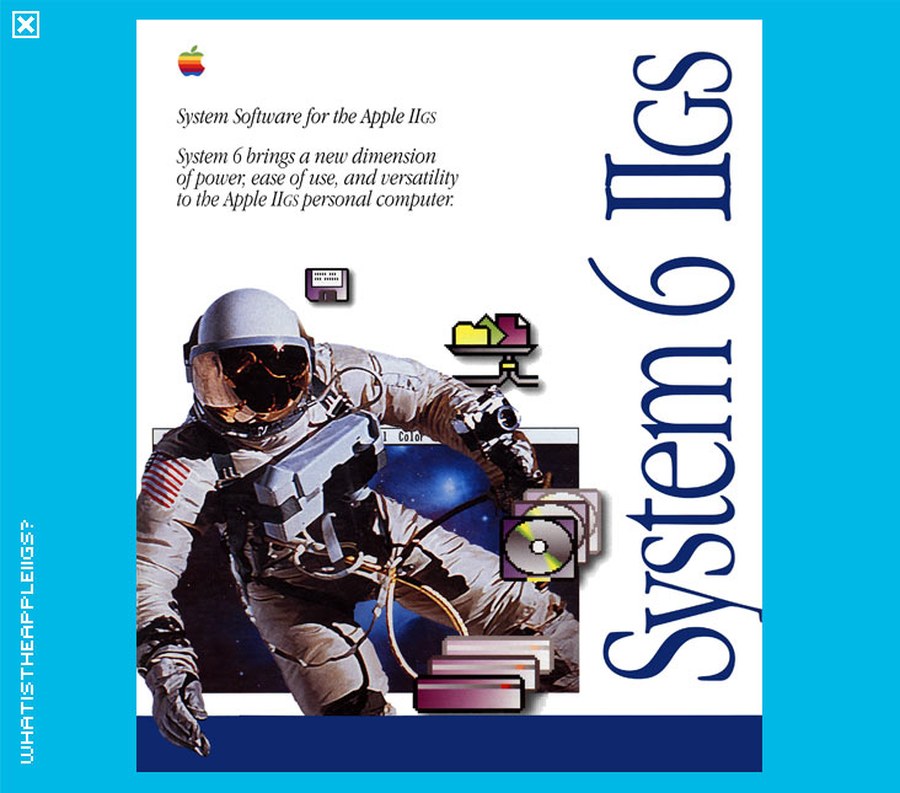
The toolbox inheritance
Underneath the Finder sat the other half of GS/OS’s claim on history: a programmer’s toolbox consciously modelled on the Macintosh’s — window, menu, control, QuickDraw-style graphics managers, sound tools that spoke to the Ensoniq natively — so that a generation of developers could write Mac-like software for the Apple II’s heir, in its own idiom. The consequences filled the late library: the word processors, paint programs, desktop publishers and telecommunications suites that made the GS a working machine into the nineties all stand on those APIs, and the era’s great shareware — the Finder utilities, the desk accessories, the menu-bar clocks that every platform war eventually produces — exists because GS/OS gave tinkerers a real system to extend. Operating systems are judged, in the end, by what strangers build on them. By that measure GS/OS was a success its parent company never properly celebrated.
Historians of Apple will recognise the deeper pattern in GS/OS’s story: some of the company’s most interesting engineering of the era happened on the platform it was neglecting, built by people who knew the work was excellent and shipped it anyway. GS/OS is the largest single proof. It deserves its place in the company’s system-software history not as a footnote to the Mac but as a parallel achievement — the road Apple’s operating systems also took, down in the Apple II wing, where for four years the future had two addresses and the quieter one was sometimes ahead.
Use it for a week and the verdict writes itself: this is a system that trusts its user with the whole machine, and repays the trust.
The legacy
GS/OS’s legacy runs in two directions. Inward: it is the living system of the IIGS today, the desktop every modern GS boots, the platform the Total Replay generation of software assumes. Outward: its file-system translator architecture prefigured the plug-in file systems that became standard practice, and historians of the Mac have long noted the traffic of ideas — and engineers — between the GS/OS world and the Mac’s own system software. The IIGS was Apple’s bridge machine, and GS/OS was the bridge’s finest span: proof that the company which invented the mainstream GUI could build its most flexible early operating system for the machine it was busy forgetting.
A practical postscript for the curious: GS/OS is also the easiest of the classic graphical systems to experience today, since the archive’s prepared System 6 boot images run in emulation or drop straight onto modern storage, Finder and all. Spend one evening in it — organising files, opening Teach documents, mounting a Mac volume for the quiet thrill of the interoperability — and the reviews of 1992 stop reading like nostalgia. They read like measurements.
The GS deserved it. In the end, against the odds of corporate history, it got it.