At a glance: Dungeon Master · Atari ST · FTL Games, 1987 · Real-time dungeon crawler · Score: 9.5/10
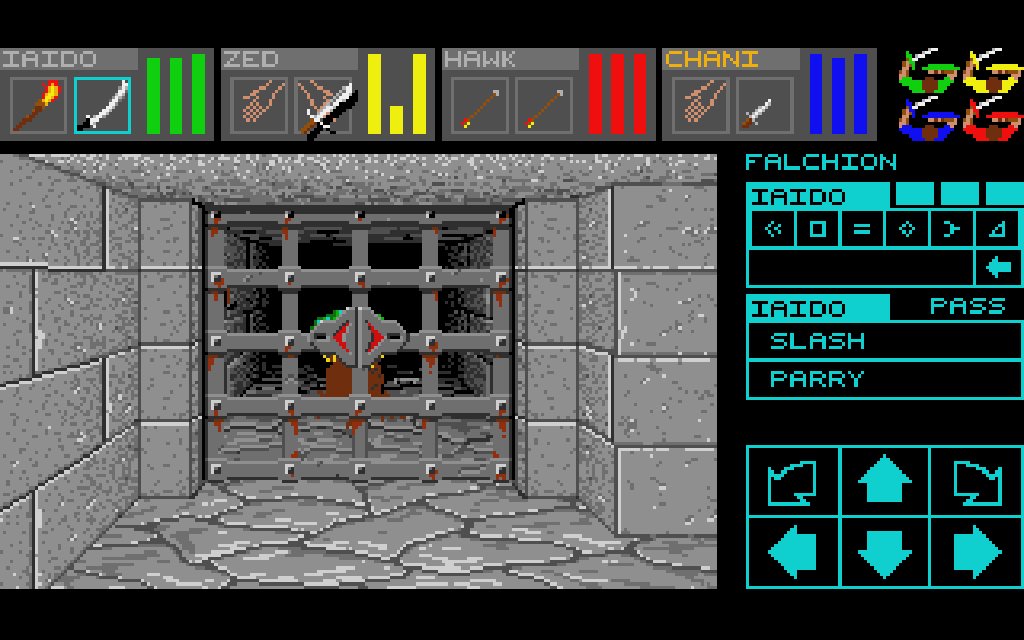
Every genre has a before and an after, and for the computer role-playing game the dividing line is a grey-brick corridor on the Atari ST in December 1987. Dungeon Master did not merely improve on the turn-based, graph-paper crawlers that came before it — it abolished their terms entirely. No turns. No text parser. No waiting while the computer thought. Instead: a first-person dungeon rendered in real time, monsters that hunted while you dithered, and a mouse-driven interface so instinctive that within minutes your hand stopped translating and simply reached. It was the ST’s first true system-seller, the game that moved hardware off shelves, and — this is the part that still startles — it plays beautifully today.
The premise is elegantly thin. You are the unseen apprentice of the Grey Lord, sent into Mount Chaos to resurrect up to four champions from mirrors on the dungeon’s first level, then descend fourteen floors to recover the Firestaff and face Lord Chaos himself. Character creation is really character curation: the twenty-four frozen heroes each carry a blend of the four classes — fighter, ninja, priest, wizard — and choosing your party is the game’s first and most consequential decision. There are no experience points in the usual ledger sense. Skills grow by use: swing a sword to become a swordsman, cast fireballs to become a wizard, throw things down corridors to train a ninja arm. It remains one of the most natural progression systems ever designed.
A dungeon that breathes
What FTL understood, years before the industry caught up, is that atmosphere is a mechanic. The dungeon exists whether you watch it or not. Doors grind, pits wait, and the famous mummy shuffling around a corner arrives with a sound cue that still raises neck hairs. Light is a resource — torches burn down, and darkness in Dungeon Master is total. Food and water are resources. Sleep is a resource, and resting in the wrong corridor is an invitation. The real-time pressure transforms every puzzle: a riddle that would be leisurely in a turn-based game becomes a negotiation with your own supplies while something clatters toward you in the dark.
Dungeon Master is the rare revolutionary that never needed its revolution explained: you moved the mouse, the world moved with you, and RPGs were never turn-based in the heart again.
The spell system deserves its own monument. Rather than picking Fireball from a menu, you assemble runes — power, element, form, alignment — into combinations the game never lists. Discovery is the curriculum. Players kept handwritten rune charts beside their STs like spellbooks of their own, and a miscast in a corridor fight was a lesson paid for in party members. Combined with physics that let you kill monsters with doors, drop them down pits and hear them land, the game rewards the kind of lateral thinking modern immersive sims proudly advertise as innovation. FTL were there in 1987, on a machine with half a megabyte of memory.
The ST version specifically
This is the original, and it matters. Dungeon Master was written for the ST first — Doug Bell, Dennis Walker and the FTL team building directly on the machine’s strengths: the mouse as a native limb of the interface, digitised sound effects that were startling in 1987, and a snappy pace that keeps the whole dungeon feeling wired. Later ports spread the gospel widely, and some added frills, but the ST release is the text the others translate. Played on real hardware, with the mouse ball rolling under your palm and the drive clicking as the next stretch of corridor loads, the game’s tactility is intact: this is a dungeon you operate with your hands — clicking levers, throwing bones through grates, feeding champions by dragging food to a mouth on the portrait panel.
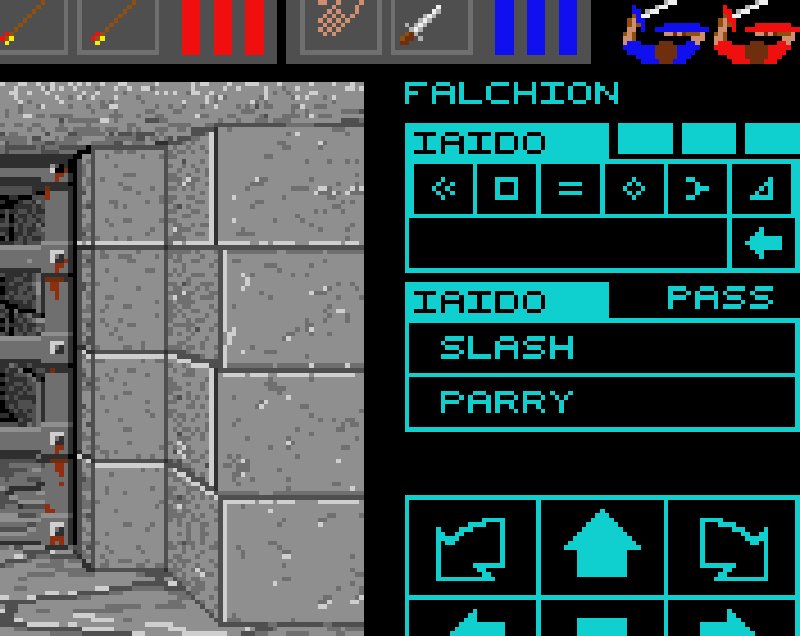
Honest flaws? The hunger and thirst clocks can feel like nagging on a first descent, the later levels lean hard on pit-and-switch puzzles that demand mapping discipline, and the final confrontation is more endurance test than duel. The graphics, all sixteen colours of them, ask your imagination to meet them halfway — though the monster design, from the leathery mummies to the rockpile creatures that split when struck, gives it plenty to work with. None of it dims the achievement. The interface alone — inventory as a backpack you can see, combat as clicks on weapon icons with cooldowns you feel — is a masterclass that games twice its size still study.
The community it created
Dungeon Master’s afterlife is as remarkable as the game. It was the ST’s best-selling title of its era, the pack-in argument for a megabyte upgrade in many a household, and it spawned both an official expansion, Chaos Strikes Back, that treated veterans with open contempt and remains a badge of honour to finish, and a diaspora of clones and successors that continues to this day. Players mapped its fourteen levels by hand and traded the maps like scripture; the rune system was reverse-engineered by communities who treated the game as a text to be studied. Modern source ports and the game’s meticulously documented internals — the ST original’s code has been read about as closely as any of its decade — mean the dungeon is permanently open.
There is also the matter of how it plays in company. Dungeon Master was a spectator sport in 1988: the mouse-driver played, the room navigated, argued over champions and shouted warnings the player could not yet see. That social shape — one pair of hands, several brains, a shared map on graph paper — is written into the game’s difficulty and its joys, and it survives intact. Returning to it now, what surprises is not the primitiveness but the completeness of the simulation’s manners: monsters that flee, doors that crush, torches that gutter. FTL sweated details the player might never consciously notice, and the noticing, thirty years later, is the pleasure. The dungeon rewards the attentive the way a good novel rewards a re-reader, which is another way of saying it was built like literature and plays like a world.
One more element deserves naming before the verdict, because newcomers always ask about it: the champions. The choice of whom to resurrect is a design statement in itself. Take the balanced legends and the early game is kind; take the specialists and you are composing an argument — a glass wizard behind two walls of fighter, a ninja raised from nothing by an hour of throwing practice in a safe corridor. The mirrors make the party yours before the dungeon has taken anything from you, and the game’s systems honour the composition for fourteen levels. Players still debate the definitive four the way football fans debate a World XI, which is another way of saying FTL built a roster with a culture attached. Few RPGs before or since have made character selection feel like the first chapter of the story rather than its paperwork.
Verdict
Dungeon Master is not a museum piece that happens to be playable; it is a living game whose systems — real-time pressure, skill-by-use growth, rune-built magic, physics as a weapon — still generate stories no script wrote. Every first-person crawler since, from Eye of the Beholder to Grimrock, walks a corridor FTL dug. On the ST, where it was born and where the mouse interface feels like an extension of the machine itself, it remains the platform’s defining RPG and one of the most influential games ever made. Fourteen floors down, in the dark, with the torch burning low: essential then, essential now.