
At a glance: Hangman (Videocart-18) · Channel F · Fairchild, 1978 · Word game · Score: 7.0/10
Hangman is the oldest game in this library — centuries older than the console, played on paper, blackboards and the margins of schoolbooks long before Fairchild’s programmers drew it in light. Videocart-18, released in November 1978, is therefore a test of execution rather than invention, and it passes the test the way the Channel F passed most parlour examinations: with text. The machine’s native fluency — letters drawn as easily as bricks or cards — makes it the natural home for a word game, and Fairchild’s version arrives fully furnished: 160 words built into the cartridge, room for players to enter up to 30 words of their own, and a gallows that assembles, body part by body part, across six incorrect guesses. Video Games magazine, surveying the field in 1983, delivered the verdict that still stands: “Hangman has more variety than other video hangman games and a better visual display than most.”
The 160 built-in words are the cartridge’s expected furniture. The 30 custom words are its genius. A hangman game with only a fixed dictionary is a single-player literacy test; a hangman game where a player can enter a word — any word, a name, an in-joke, the dog’s name, a word chosen precisely because a spouse will never guess the vowel pattern — becomes a parlour weapon. Videocart-18 is quietly a two-player game in its best mode: one human sets the trap, the other walks into it letter by letter, and the television merely keeps the gallows and the score. In 1978, user-generated content was not a marketing phrase; here it is, thirty words deep, in a word game.

Six wrong letters
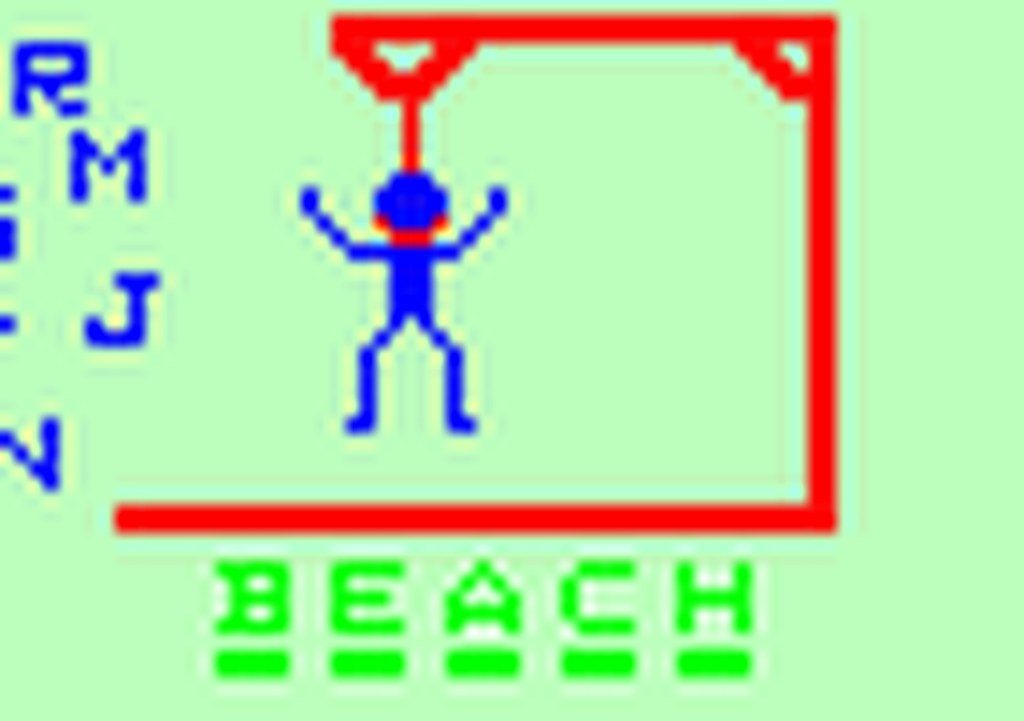
The structure is the schoolbook’s, faithfully kept. Each correct guess fills its letters into the word wherever they belong — the machine’s text handling again making a virtue look effortless — and each miss adds a component to the hanging man, six misses being all the mercy the gallows offers. That count matters: six is a tight budget against a 160-word dictionary that does not care about your feelings, tight enough that the endgame of a long word becomes a genuine calculation about which letters remain probable and which body part is next. The Channel F beeper keeps the mood; the alphabet is entered and tracked through the console’s controls without the cryptic fog that clouded some of the library’s card tables — a word game cannot afford an input mystery, and this one, happily, does not have one.
It is worth pausing on the visual-display compliment, because it identifies the cartridge’s real achievement. Hangman had been programmed for nearly every machine of the era, and on most of them the word, the used letters and the figure competed for a display that resented text. On the Channel F, all three sit in the framebuffer comfortably, large and clear, because this is the one console of 1978 that thought in characters. “A better visual display than most” is a modest phrase for the machine’s constitutional advantage, and Videocart-18 is among its cleanest demonstrations.

The parlour standard
What Hangman does not do is reinvent its game, and the score reflects the honesty of the exercise: this is a flawless rendition of a pastime whose depth is the depth of vocabulary itself. Solo players will cycle the built-in dictionary in an evening and find the challenge thinning; the cartridge’s long life lives in the custom-word mode, which requires a second human with a talent for cruelty. There is also a period irony worth savouring — SABA’s German edition of this very cartridge shipped with a German word list, making Videocart-18 one of the library’s small proofs that the Channel F, for all its American biography, had a European life its home market rarely noticed.
One hundred and sixty words built in, thirty of your own cruel ones on top, and the clearest letters on any console of its day: Hangman is the parlour game done properly.
Set beside its shelf-mates, Hangman is the library’s philosophy in miniature. The Channel F could not out-draw the arcade machines arriving around it; it could out-write them, out-count them, and out-host them — and a game of hangman, family gathered, custom words loaded with malice, is hosting of a high order. It is not the cartridge that sells the console. It is the cartridge still in the console at Christmas, which in the long accounting of a game library is its own form of victory.
Designed to be shared
One more quality separates this Hangman from the era’s many solitary word games, and it deserves its moment before the verdict: the cartridge understands that hangman is a social ritual, and it equips the ritual properly. The custom-word allowance is the headline, but the whole presentation serves the room — the word displayed large enough for spectators to follow, the used letters tracked visibly so the audience can play along in their heads, the gallows assembling in full view like a scoreboard of doom. A Channel F at a family gathering in 1979, running Videocart-18 with a word chosen by an uncle of legendary cruelty, was performing the exact function modern party games are engineered to perform, with 1978 technology and no fanfare. The critics who praised its variety and display were, without quite saying so, praising a piece of social design. It is also why the cartridge outlasted flashier shelf-mates in actual households: the games a family plays together are the games a console is remembered for, and hangman — ancient, portable, infinitely re-wordable — was always going to be played by any household that owned it. Fairchild’s programmers simply gave the old ritual the best television it had ever had.
The cartridge’s afterlife carries one more footnote worth the space: the SABA edition’s German word list means Videocart-18 was, for German households, a different game wearing the same number — same gallows, same mechanics, an entirely different dictionary of doom. Localised software was a rarity anywhere in 1978 and almost unheard of on the American consoles; that the Channel F’s European licensees bothered tells you something about how seriously the platform was taken in the markets its home country had stopped watching. The man hangs in every language, it turns out, and the letters matter in all of them.
Sessions, in practice, organise themselves: the built-in dictionary for warming up, the custom words for the main event, the alphabet exhausted one dignity at a time. It is as much game as the ritual has ever needed, on the one machine of its decade that could present the ritual flawlessly. The gallows is crude. The letters are perfect. The man, as ever, awaits your vowels.
The verdict
Hangman is exactly what it promises: the definitive home version of its ancient game for its era, with the largest vocabulary, the best display and the inspired custom-word option that turns it into a two-player duel of wits. It invents nothing and executes everything. On a console built for words, that is praise enough — six wrong letters, and the man drops; bring a friend and a dictionary of grudges.
Score: 7.0/10 — The era’s best video hangman: 160 built-in words, 30 of your own, and letters drawn the way only this console could.