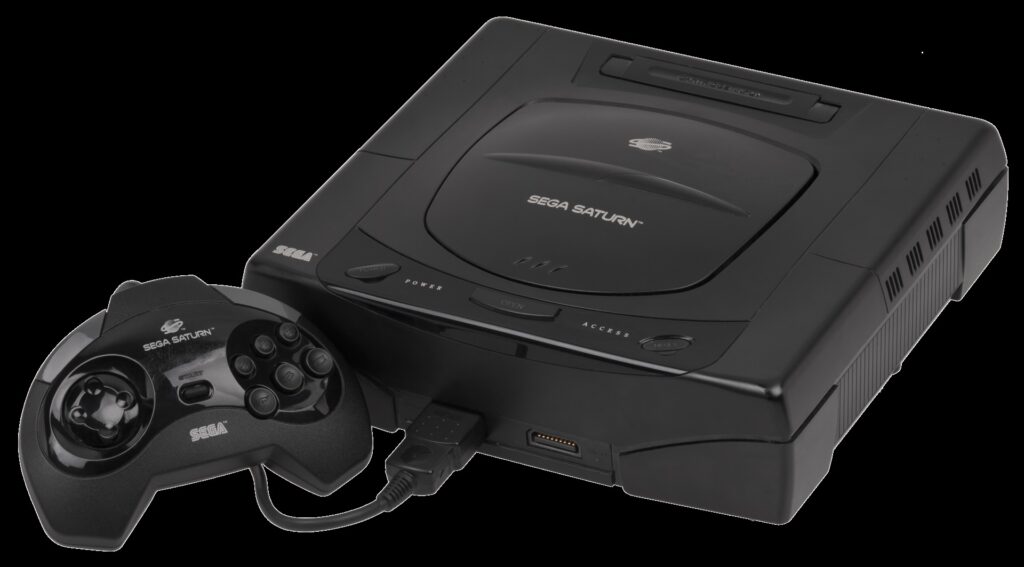
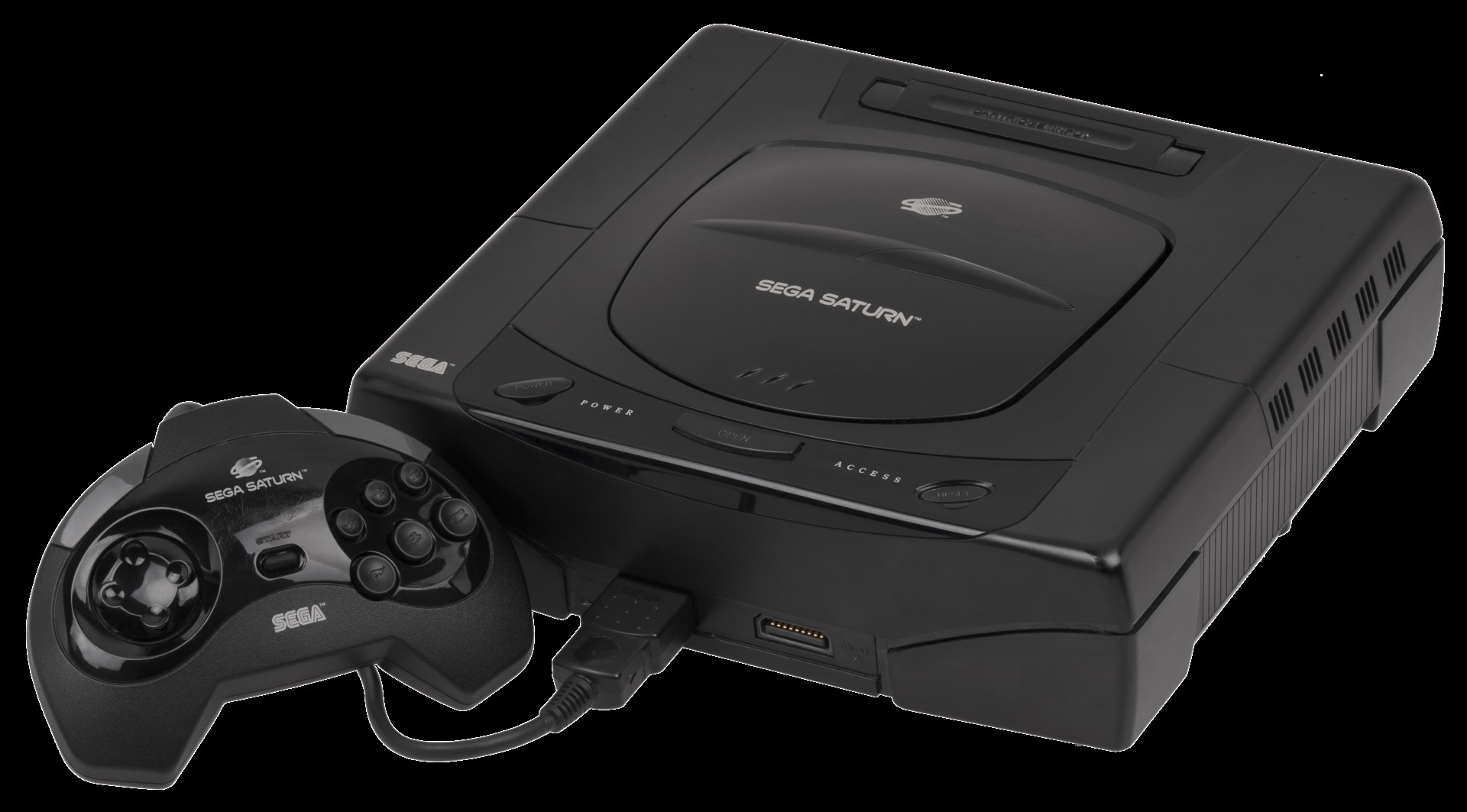
The North American Model 1 Saturn. Rhea was built for 20-pin-drive machines like this one; its sister board, Phoebe, covers the 21-pin models. Photo: Evan-Amos, public domain, via Wikimedia Commons.
If your Saturn’s laser is dying — and after thirty years, plenty are — a Sega Saturn optical drive emulator is the fix that removes the moving parts from the equation entirely. Rhea and Phoebe were the first of their kind: two small boards from Polish engineer Deunan Knute, the creator of the Dreamcast’s GDEmu, that physically replace the Saturn’s CD drive and load games from an SD card instead. When they appeared in 2015 at €130, they turned a console famous for fragile optics into one that boots from solid state.
One Board, Two Saturns
The pair exists because Sega never settled on one drive. Saturns with a 20-pin CD drive take the Rhea; machines with a 21-pin drive take the Phoebe. Everything else about them is shared: the board drops into the space the optical drive occupied, connects with the original ribbon arrangement, and reads disc images from a FAT32-formatted SD card. Supported formats are CDI, CCD/IMG/SUB, MDS/MDF and ISO — notably not BIN/CUE, which means some ripping workflows need a conversion step before a game will boot.
Installation is honest work rather than plug-and-play magic. The drive comes out, the board goes in, and the ribbon cable’s orientation matters — get it backwards and the console will simply ignore its new heart until you open it up again. Deunan’s documentation was always plain about which Saturn revisions each board suits, and checking your machine’s drive before ordering was, and remains, step one. Sensible owners keep the removed drive safe in a box rather than binning it: an ODE install is reversible, and an original drive is part of the console’s history even when it no longer reads discs.
It also helps to remember where these boards came from. Deunan had already proven the concept on the Dreamcast, where the GDEmu turned a console with a notoriously failure-prone GD-ROM drive into a card-loading machine. The Saturn was the harder, needier patient — a console with two drive revisions, an enormous import library, and flagship games whose prices were climbing into territory where spinning the original disc felt reckless.
What a Sega Saturn Optical Drive Emulator Changes
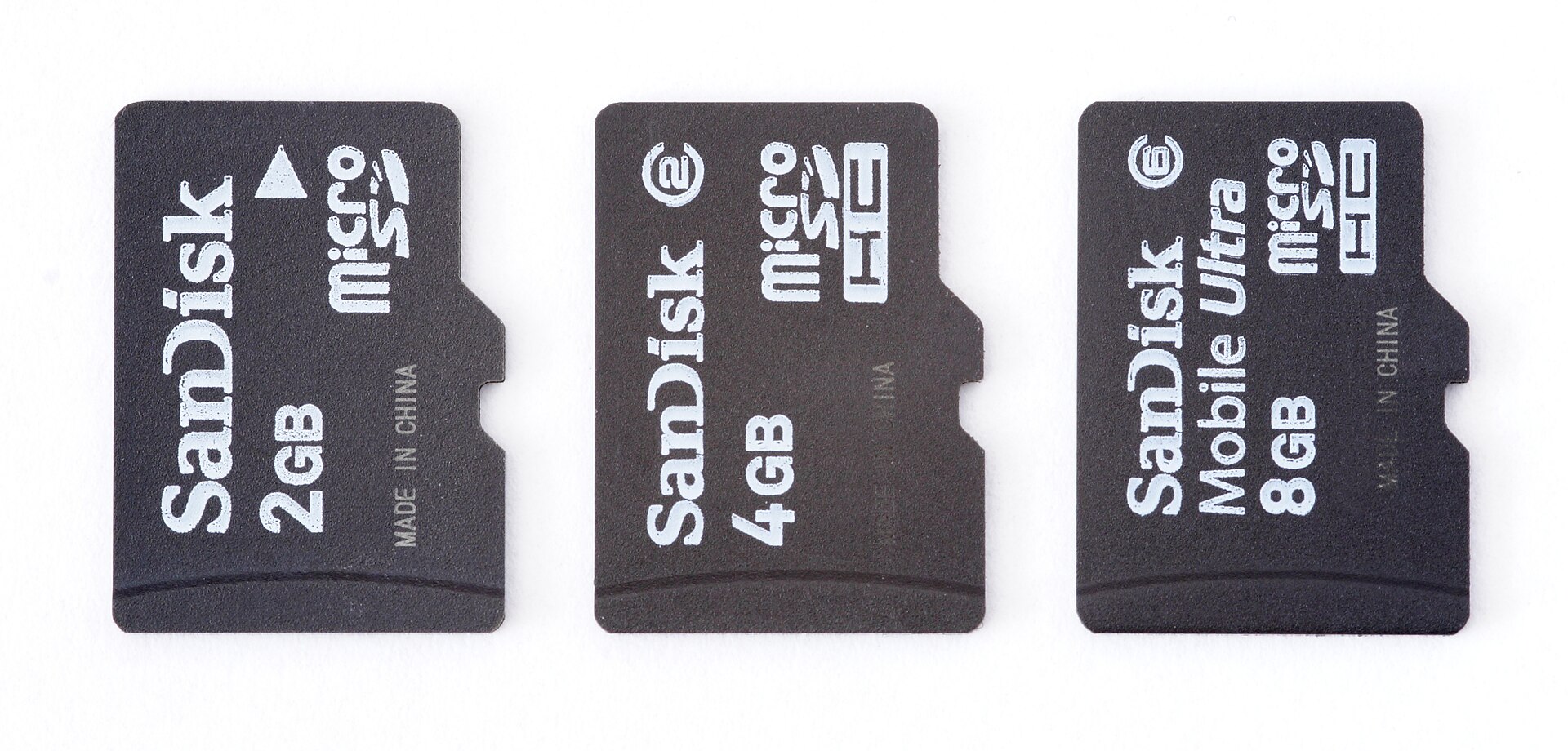
Three microSD cards. A Rhea or Phoebe feeds a Saturn its whole library from a card like these, with no laser to wear out. Photo: Afrank99, CC BY-SA 3.0, via Wikimedia Commons.
The daily difference is silence and speed. No seek noise, no grinding, no discs failing to be recognised on the third attempt. A simple boot menu lists the images on the card, and the Saturn loads them as if a disc were spinning — because as far as the console knows, one is. Compatibility earned these boards their reputation: across a decade of use, the community’s verdict is that game compatibility is effectively total, with no known titles refusing to run. For a console whose library includes expensive rarities, loading from card also means the shelf copies stay on the shelf, handled by their edges on birthdays only.
There are quieter benefits, too. Load times shrink where the original drive used to hunt. Multi-disc games stop being an exercise in disc-swapping dread. And a Saturn fitted with an ODE becomes a machine you can lend, demo and actually use at full tilt without a background worry about the laser’s remaining hours. The mod asks nothing of the console’s character, either: from the television’s side of the cable, it is still a Saturn, playing Saturn games exactly as they played in 1995.
Context helps explain why these boards mattered here. We covered the original Rhea announcement when Deunan revealed the project, and his Dreamcast equivalent stands reviewed in our GDEmu hardware review. The Saturn boards applied a proven idea to the machine that needed it most.
The Catch: €130 and a Waiting List
None of it came easily. Deunan built the boards in limited batches, sold them direct for €130, and opened ordering windows that closed as quickly as they appeared — the economics of one skilled person making precision hardware by hand. Scarcity did what scarcity does: resale prices climbed, clones appeared, and the wider modern ODE market, with rival Saturn solutions and polished alternatives, grew up in the space Rhea and Phoebe proved existed. If you find one for sale today, verify which of the two boards it is and which drive your Saturn carries before money moves; a Phoebe in a 20-pin machine helps nobody.
Living With One
Day-to-day ownership is undramatic, which is the highest praise a hardware mod can earn. The card is prepared on a computer — format it FAT32, copy images across, keep the naming tidy — and the community built menu tooling over the years that tidies libraries into clean lists. There is no region ceremony and no disc ritual: power on, pick a game, play. Owners swapping between an ODE Saturn and a stock one notice the other difference immediately, which is weight of worry. A stock Saturn session carries a tiny background calculation about the laser. An ODE session does not.
The economics have shifted since 2015, and honesty requires noting it. At €130 new, Rhea and Phoebe were cheaper than a handful of the Saturn’s headline games. On the second-hand market they now change hands for considerably more, and the modern buyer should weigh them against the newer Saturn ODE options that followed in their wake — some cheaper, some slicker, all standing on the ground these two boards cleared. What the originals still offer is the thing they always offered: a decade-long track record of simply working, documented by a community that has run them daily for years. In preservation hardware, boring reliability compounds like interest.
One honest trade-off remains. An ODE Saturn has no drive, and some owners feel the absence — the whir and clunk of a real disc is part of the ritual, and a modded machine cannot play a disc you hand it. The community’s answer is the two-Saturn household: one console kept stock for discs and ceremony, one fitted with Rhea or Phoebe for daily duty. That the recommended setup involves owning the same console twice says a lot about both the Saturn and the boards that feed it.
Why They Still Matter
Judged a decade on, Rhea and Phoebe are best understood as preservation hardware. They arrived when the Saturn aftermarket needed them most, carried a reputation for total compatibility that every later rival has had to match, and kept thousands of consoles in daily use whose drives would otherwise have ended them. As a first draft of the Saturn ODE idea, they turned out to be a remarkably final one — and the Saturn scene has run on SD cards ever since.