
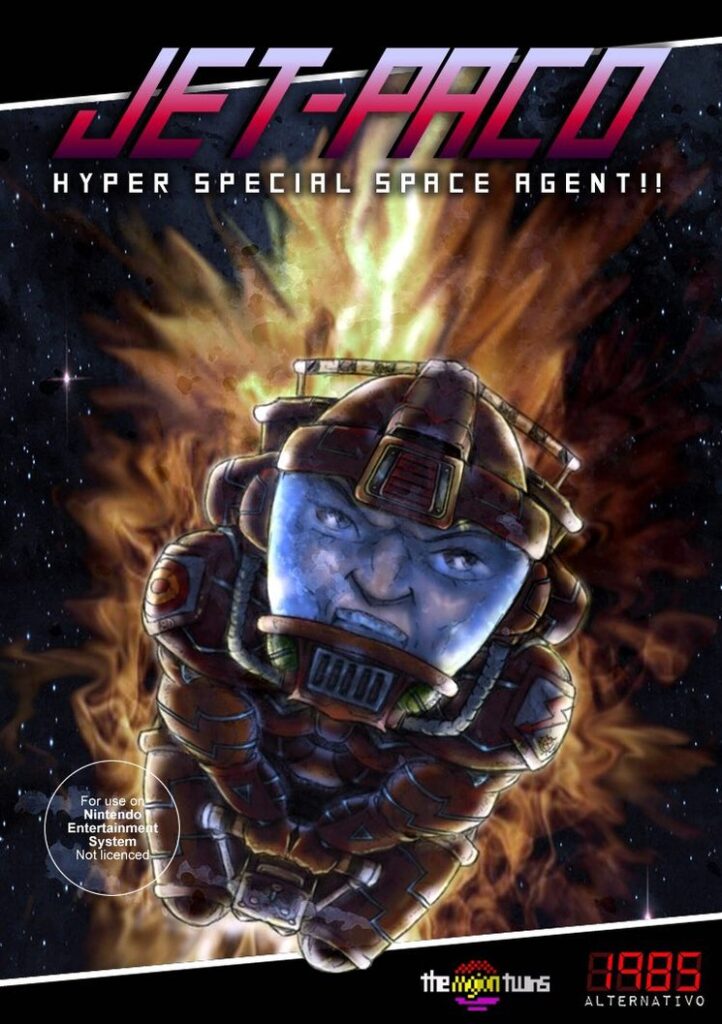
Most homebrew stories follow a familiar arc: a small team releases a game free of charge, the community applauds, and everyone moves on. Jet Paco refused to stop at the applause. In September 2015 the Spanish group The Mojon Twins and their publishing partners took a jetpack platformer that players could already obtain for nothing, and asked the public to fund something gloriously unnecessary — the same game, on a real NES cartridge, in a box, with a manual. This is the story of that campaign, what the game actually is, and what happened once the asking stopped.
First, a correction to the original stub
Our 2015 stub described Jet Paco as a brand-new NES game the Mojon Twins had released at the start of that year. That is only half the story, and the missing half matters. Jet Paco began life as a ZX Spectrum title, included on the group’s Mojon Twins Covertape #2 in 2013. The NES edition of early 2015 — full title Jet-Paco: Hyper Special Space Agent — was a conversion of that Spectrum original to Nintendo’s hardware. The distinction is not pedantry: the Mojon Twins built their reputation in Spain’s stubbornly alive Spectrum scene, and Jet Paco is a Spectrum design wearing NES clothes, with all the single-screen, precision-jump character that implies.
Twenty crystals, no weapon, one jetpack
You play Paco Rebollez, an astronaut employed to gather energonia crystals — twenty of them per mission — from the drifting hulk of an abandoned spaceship, where the stones have been scattered through a maze of interconnected single-screen rooms. Paco’s special suit vents an invisible thermonuclear flame from, as the authors cheerfully explain, the seat of his trousers. Hold the B button to thrust upward; feather it to hover; drift sideways with the pad. Fuel is unlimited, so the challenge is purely one of control.
And control is genuinely the whole game. Paco carries no weapon and cannot attack anything. The ship’s hazards and wandering enemies move in fixed, irregular patterns, and every room becomes a small negotiation between momentum and masonry: rise too eagerly and you kiss a hazard, tap too timidly and you sink into one. You begin with ten lives and earn no more, which sounds generous until the later rooms start spending them. The head-up display keeps a running count of crystals still outstanding, and two missions, selectable from the title screen, offer different layouts to strip-mine. It is a design from the Jetpac lineage — Ultimate’s 1983 Spectrum classic is the obvious ancestor, right down to the collect-and-return structure — filtered through a decade of Mojon Twins covertape economy: small map, tight rules, jokes in the manual.
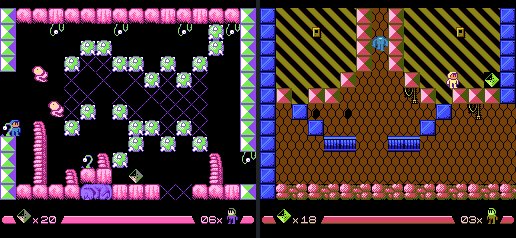
Jet Paco in play on the NES, from the crowdfunding campaign’s own screenshots: single-screen rooms, a jetpack, and crystals to gather, with the crystal count and lives tracked along the bottom. Source: 1985 Alternativo / Verkami campaign page.
The campaign: cartridges as a group project
The physical edition was not a Mojon Twins solo operation. The crowdfunding ran on Verkami, the Spanish platform, under publisher 1985 Alternativo — the physical-games label connected to the Fase Bonus retro community — with the Mojon Twins as creators. The money was earmarked for unglamorous, essential things: newly manufactured NES cartridge shells from a purpose-made injection mould, printed boxes, manuals and stickers, and circuit boards designed by collaborator Doragasu, christened Mojo-NES in honour of the team whose games would debut on them. Production, the campaign stressed, would be handled in Spain so the group could watch the quality themselves.
Rewards climbed from a name in the game’s thanks list, through cartridge-only copies, to complete boxed editions, signed copies, and one delirious top tier offering a personalised version of the game with the backer’s own likeness sprite-swapped in as protagonist. Backers could also claim a surprise NES homebrew cartridge from another developer, and — in a neat bit of cross-format housekeeping — physical Spectrum editions of older Mojon Twins titles Uwol: Quest for Money and Goku Mal. Mid-campaign, the organisers bolted on a sibling project: a NES conversion of the group’s Sgt. Helmet – Training Day, offered in parallel tiers, so the mould and boards would earn their keep twice.
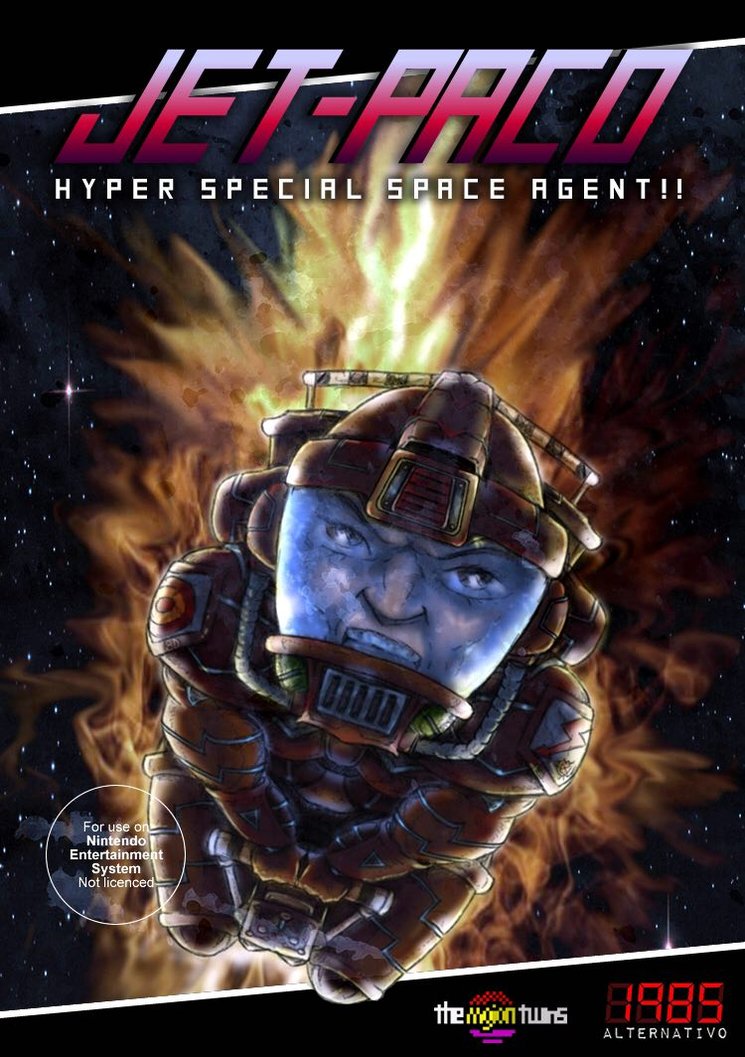
The physical edition’s cover art for Jet-Paco: Hyper Special Space Agent, drawn for the boxed cartridge release. Source: 1985 Alternativo / Verkami campaign page.
Hindsight: funded, stretched, shipped
Hindsight. Anyone who followed the campaign in September 2015 was backing a plan; what follows is the outcome, which the original stub could not know. The campaign succeeded — by the organisers’ own updates, the funding target was reached in what they described as record time, and the stretch goals fell one after another. A second goal upgraded the surprise cartridge to a complete boxed edition; a third, set at €6,700, added a free complete copy of Another World for Game Boy Advance to backers taking all three NES cartridges. A campaign update announced, in the team’s own words, that every goal had been achieved.
Production updates then did the boring, beautiful work of proving it was real: test boards running, final Mojo-NES boards photographed and finished around the New Year, the first injection-moulded shells shown off, names collected for the manuals. The schedule slipped a few weeks past the optimistic December target — the updates are frank about festive-season delays — but in a final update titled, in translation, “Jet-Paco shipments have begun,” the team announced that games were leaving that morning and that all orders would be completed within the week. The cartridges shipped. In an era when crowdfunded retro hardware routinely evaporated, a €-denominated campaign for a freeware jetpack game delivered boxes to doorsteps.
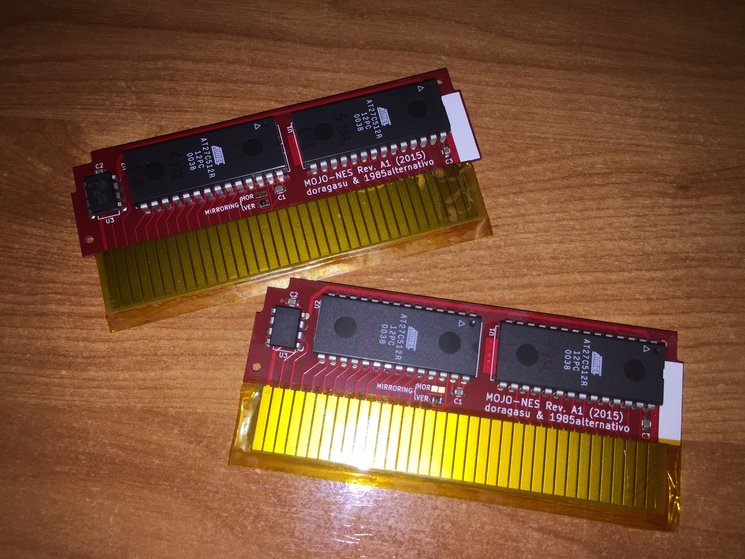
The finished Mojo-NES circuit boards, photographed by the campaign team once production was complete. Source: 1985 Alternativo / Verkami campaign updates.
Hindsight: Paco kept flying
Hindsight. The character refused to retire. A reworked, expanded edition, Jet Paco & Jet Puri, arrived in 2020 for Sega’s SG-1000, adding a third mission and a second playable character — Paco’s sibling Puri, who had first appeared in a 2017 Mojon Twins NES compilation. Then, in 2023, the Mojon Twins released a fresh Amstrad CPC edition of Jet Paco, with selectable characters and three levels, prompting their own announcement to joke that yes, they really had now released this game on everything. The 2015 NES cartridge, meanwhile, has become the kind of object preservation lists track carefully: the crowd-funded cartridge edition is documented as a distinct, undumped variant, precisely because its backers received something the free release was not.
Why this one mattered
Strip away the jetpack jokes and the campaign is a tidy case study in what crowdfunding was supposed to be. The game existed and was free; nobody was funding a promise of software. What backers bought was manufacturing — moulds, boards, print — plus the right to hold a homebrew artefact that behaved, in every material respect, like the commercial releases of 1988. The Mojon Twins got a production line they could reuse, 1985 Alternativo got a flagship NES release, and a few hundred players got a grey cartridge that Spanish coders, Spanish boards and Spanish plastic had conspired to produce, twenty-six years after the NES’s European launch.
Paco’s brief was to collect twenty crystals and retire on the proceeds. It took a few hundred strangers on the internet to give him the same courtesy in real life: a proper cartridge, a box to keep it in, and a shelf to retire to.