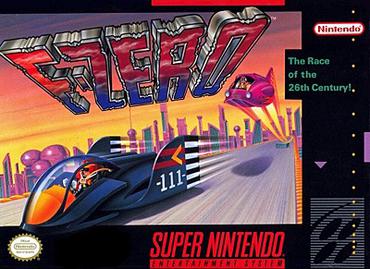
Every console war needs an impossible stunt, and in March 2015 the Mega Drive got a beauty. F-Zero — Nintendo’s futuristic racer, the Super Nintendo launch game built specifically to show off the Mode 7 graphics trick the Mega Drive famously lacked — appeared to be running on Sega’s machine. The project was called G-Zero, and it came from gasega68k, an assembly programmer already respected on the SpritesMind forums for bending the Mega Drive into shapes its designers never intended. This site covered it at the time as a homebrew port of F-Zero speeding onto the Mega Drive. With a decade of hindsight, the first job of this look-back is to be precise about what G-Zero actually was, because the truth is both less and more than a port.
First, the Honest Correction
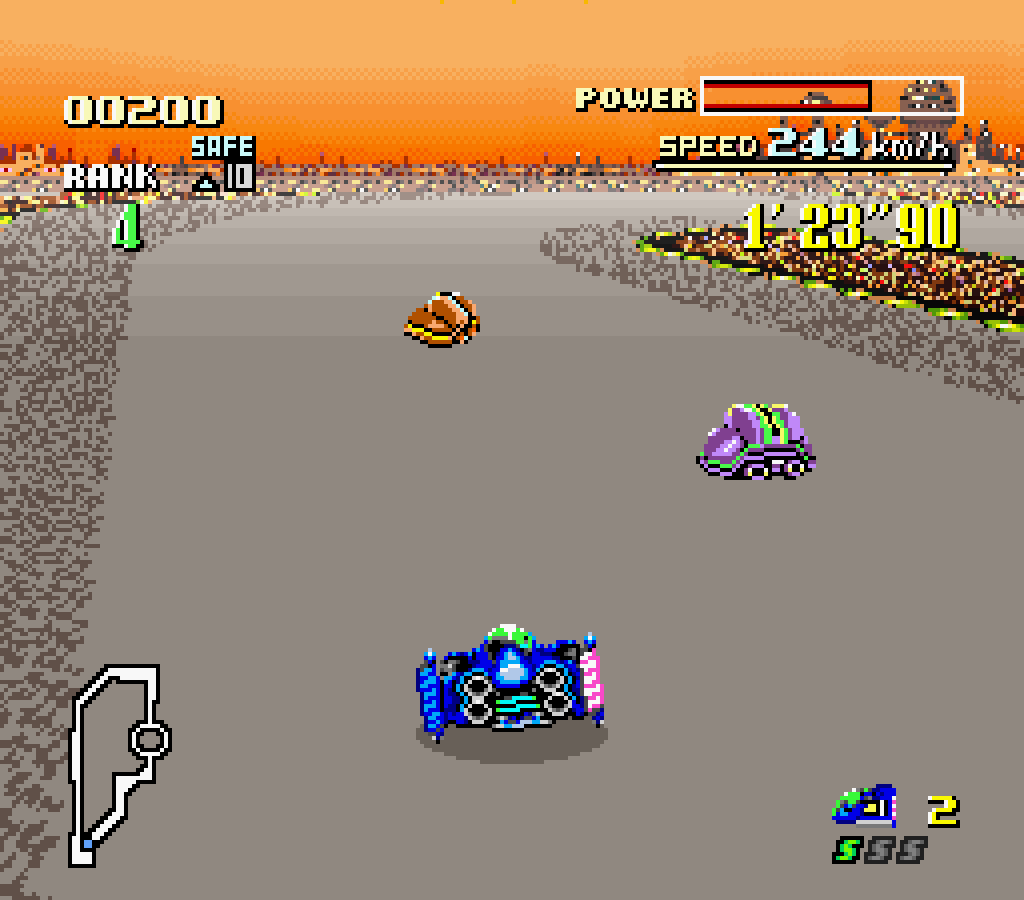
G-Zero was never a finished port of F-Zero, and it was never released as a complete game. What gasega68k built and showed in 2015 was a work-in-progress technical demonstration: a recreation of F-Zero’s Mode 7-style racing — the rotating, scaling ground plane, the hover cars, the sweep of a futuristic circuit unrolling beneath you — running on Mega Drive hardware, with the compromises that required plainly visible if you knew where to look. There were no fifteen tracks, no Grand Prix structure, no finished rival AI waiting to take you through a league. Judged as a product, it did not exist. Judged as a proof — that the single most cited hardware advantage of the SNES over the Mega Drive could be faked in software — it was close to miraculous, and that is the correct frame for everything that follows.
The Problem: a Floor That Will Not Turn
Mode 7 was one of the SNES graphics modes, and its party trick was elegant: take one background layer and rotate and scale it freely, per scanline, so a flat map could be laid back into perspective and spun around a vehicle. F-Zero, Pilotwings and Super Mario Kart were all built on that single capability. The Mega Drive’s video chip could scroll its background planes smoothly in any direction, but it had no hardware for rotation or scaling at all. Ask it to turn the floor and the honest answer was no. For the whole 16-bit era, that no was treated as final — one of the clean, factual reasons the SNES was considered graphically richer, whatever Sega’s marketing said about blast processing.
gasega68k’s answer was to stop asking the video chip. In his own forum explanation, quoted by Kotaku at the time, he described using a block of external RAM — 64KB of cartridge SRAM, accessed in word mode — as a virtual map, a 256-by-256 tile space held outside the console’s normal video memory. As the view moved, fresh tiles were uploaded in 8-by-8 blocks, in much the same spirit as ordinary scrolling, except that the tiles being assembled described a rotated, scaled surface: the 68000 processor computed, in software, the floor that Nintendo’s hardware produced for free. It is a beautifully sideways solution, and it came with a caveat gasega68k stated himself: that first version would not work on ordinary flash cartridges, because they did not support the word-wide SRAM access the trick depended on. The celebrated 2015 demo, in other words, was not quite the stock-hardware miracle later retellings sometimes made it — it leaned on extra RAM in the cartridge, a perfectly legitimate technique with a long commercial history, but a detail worth recording accurately.
The Price of the Trick
Contemporary coverage, Nintendo Life’s March 2015 report among it, was honest about the trade-offs, and they were substantial. The track tiles were rendered at half the resolution of the SNES original. The action ran at half the frame rate. Look at footage of G-Zero beside the real F-Zero and you can see the grain of the compromise: the ground is chunkier, the motion less liquid. But you can also see the thing that matters — it moves like F-Zero. The perspective is right. The rotation is smooth and continuous. The unmistakable sensation of the SNES’s flagship effect is present and correct on a machine that, on paper, cannot do it at all. Half resolution and half frame rate is not a failure state; it is the visible cost sheet of a programmer buying an impossible feature with the only currency available, which was raw processor effort and his own ingenuity.
The Programmer Behind It
G-Zero was not a lucky one-off. gasega68k had spent years on the SpritesMind forums — the home of Mega Drive development — systematically attacking the console’s supposed limits. He produced a conversion of Wolfenstein 3D for the base machine, a first-person shooter on hardware with no more business running one than it had rotating a racetrack. He produced Star Fox-style 3D experiments. And he kept returning to the Mode 7 problem across multiple demos, refining the technique in public, in front of an audience of fellow programmers who understood exactly how hard it was. That public, iterative quality is the demoscene’s great gift to retro hardware: the knowledge did not stay locked in one person’s project. The techniques were posted, explained and argued over, and they fed directly back into what the whole community believed the Mega Drive could do.
The story even has a second act that fixes the first version’s asterisk. Years later, gasega68k revisited G-Zero with a new build that abandoned the external cartridge RAM entirely, instead carving its virtual map out of 16KB of the console’s own main RAM. The map shrank to 128-by-128 and the floor grew more pixelated — the cost again, honestly declared — but the payoff was twofold: the demo now ran on completely standard hardware, exactly as a real cartridge could have in 1991, and the freed memory opened the door to a two-player split-screen versus mode, something even Nintendo’s original never offered. A programmer returning to his own famous trick to remove its one compromise is about as demoscene an ending as a story can have.
Why a Demo Deserved the Headlines
It is worth asking why an unfinished demo of another company’s game, on a console two decades old, travelled as far as it did in 2015 — far enough to be covered by Nintendo-focused outlets with a mixture of admiration and disbelief. Part of it is simple console-war nostalgia: F-Zero on a Mega Drive presses the same button as Sonic on a Nintendo machine, a small violation of the natural order. But the deeper appeal is that G-Zero was an argument, made in running code, about how hardware limits actually work. The Mega Drive could not do Mode 7 the way the SNES did it. What gasega68k demonstrated is that “the hardware can’t do it” often really means “the hardware can’t do it the obvious way, at full quality, for free” — which is a very different claim, and one that gifted programmers have been cheerfully disproving on every generation of hardware since.
So the record should read: no, F-Zero was never ported to the Mega Drive, and nobody should tell you otherwise. What happened in March 2015 is better. A single hobbyist programmer showed the world F-Zero’s signature effect running on its rival’s hardware, published his method, took his compromises in public, and then came back years later and did it again on a completely stock machine. The port was a mirage. The proof was real.