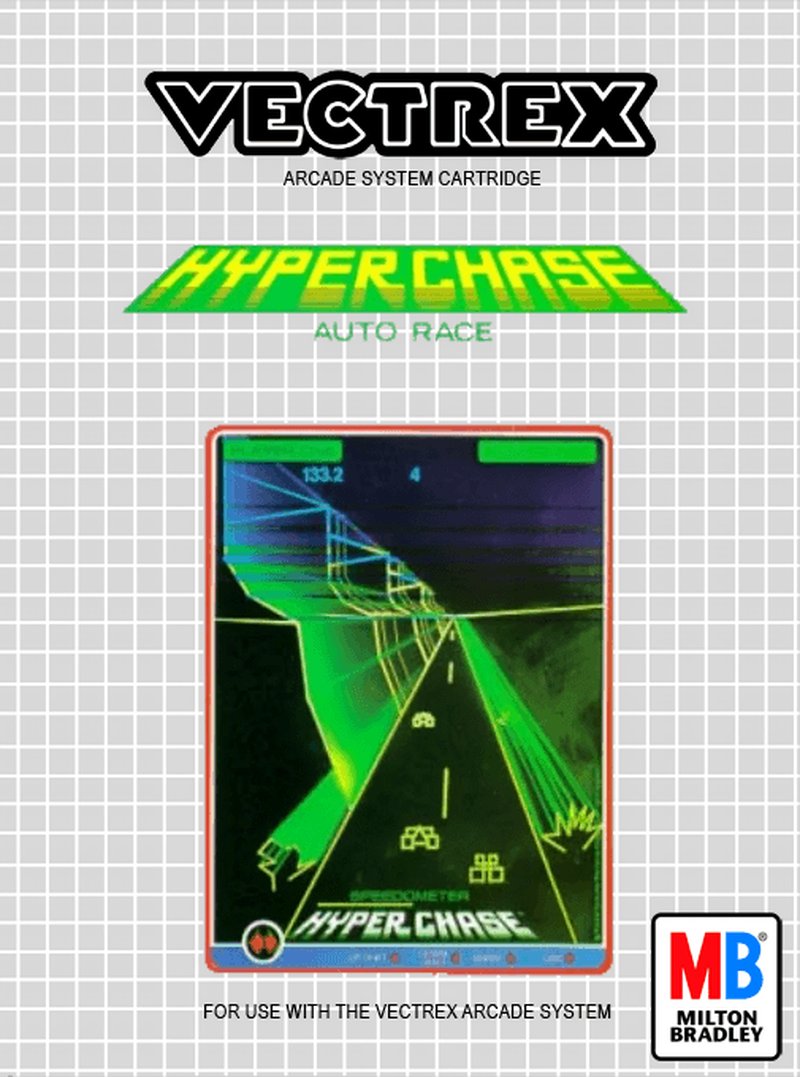
At a glance: Hyperchase · Vectrex · GCE, 1982 · Driving game · Score: 7.5/10
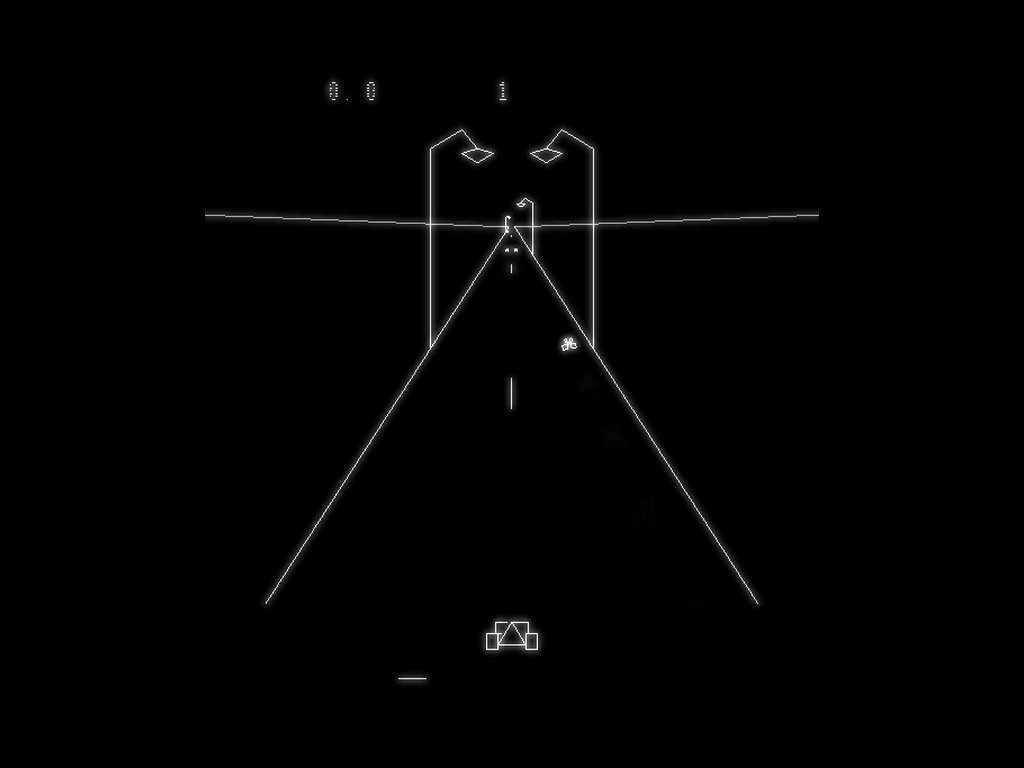
Every console library needs its driving game, and in 1982 that was a harder commission than it sounds: raster home machines drew roads in stripes and blocks, and speed was mostly a rumour the box art told. The Vectrex, characteristically, drew its road in light — two converging vector lines, a horizon, and traffic rendered as glowing shapes growing out of the distance at you. Hyperchase is GCE’s answer to the driving problem: a first-person chase down an endless highway, overtaking traffic, threading gaps, and learning the oldest lesson in racing games, which is that the car ahead is always slower than your plans. It is a simple game, an early game, and a better one than its simplicity suggests.
The view is the windscreen view, decades before that became the genre’s default in-car camera: the road rushes from a vanishing point, its edges drawn as the portrait screen’s natural converging lines, so the little Vectrex — a machine that draws perspective for free — suddenly looks like it was designed for this. Traffic comes in streams: cars to pass, cars to avoid, and the occasional closing-speed nightmare that fills the windscreen faster than your options. Your score is distance and daring; your lives are ended by the scenery’s oldest argument, the collision, rendered as the era rendered all such things — a starburst, a silence, a restart.

Speed, drawn honestly
Hyperchase’s virtues are the virtues of its medium. Because the road is a pair of true lines rather than a raster approximation, the sensation of speed scales smoothly: the traffic’s growth from speck to windscreen-filling shape is continuous, and judging a closing gap becomes an exercise in genuine depth perception rather than sprite-size folklore. The controls complete the illusion — steering with the analogue stick’s fine travel, managing speed with a delicacy the era’s digital pads could not offer — so the game can ask for millimetre overtakes and receive them. Where the library’s other early games use the stick as a luxury, Hyperchase uses it as the point: this is a game about gradients of pressure on a sprung lever, about squeezing rather than switching, and it feels like driving in a way no 1982 rival on any home system quite matched.
The structure is the era’s standard endless drive — survive, overtake, accumulate — but its manners are good: traffic patterns escalate in density and spite rather than mere speed, the road’s character changes enough to reset your attention, and the scoring rewards the brave pass over the timid cruise. It is a game designed for five-minute bursts that reliably become forty-minute ones, the sure sign of a driving game whose feedback loop is honest.
The short road
The debits are real and should not be minimised. Hyperchase is thin by the standards the library itself set within a year: one road, one traffic system, one verb set, and a difficulty curve that tops out where better games are just clearing their throats. There is no rival car with a personality, no championship structure, no scenery tour — the landscape is the road and the road is the landscape. Players who meet it after the library’s deeper cartridges may mistake its transparency for poverty; it is better understood as an early proof — of the windscreen view, of analogue driving, of the vector road — that the medium would spend the next decade cashing in. But proofs, in a twenty-five-game library, compete with masterpieces, and Hyperchase’s score reflects that company.
A game about gradients of pressure on a sprung lever — squeezing rather than switching. In 1982, nothing at home felt more like driving.

An endless road, honestly built
The design economy of Hyperchase repays attention precisely because so little is wasted. The endless highway is the correct structure for a 1982 driving game — circuits need scenery, and scenery was the one thing no home machine of the year could afford — so GCE spent the entire budget on the two things a driver actually watches: the road’s geometry and the traffic’s behaviour. Within that economy, the traffic system is the game. Cars arrive in patterns that teach a grammar — singles to pass, pairs to thread, the dreaded rolling roadblock that must be stalked until it breathes — and because closing speeds are drawn in true perspective, the grammar is learnable at a level raster contemporaries, with their jumping sprite scales, could not teach. You are not memorising spawn tables. You are learning to read distance, which is the actual skill of driving, smuggled into a cartridge.
The score attack that results has a purity the library’s more elaborate games sometimes lack. A Hyperchase run is a clean instrument reading of your nerve on the day: how long you held full speed in traffic, how late you committed to the gap, whether the overtake that killed you was greed or arithmetic. That is why the cartridge survives its thinness in collections — it is the Vectrex’s metronome, the five-minute test you set yourself between expeditions into Narzod’s canyon or Chasm’s caves. Not every game in a deep library needs to be a destination. Some need to be the road you drive to reach them, and Hyperchase, fittingly, volunteered.
The verdict
Hyperchase earns its place as the library’s driving game and as a small landmark of feel: the first home racer whose controls understood that speed is analogue. Keep it for high-score bursts, for demonstrations of what the stick could do, and for the particular pleasure of a gap threaded at full chat on a nine-inch glowing highway. The road is endless. The traffic is rude. Both are exactly as they should be.
It helps to meet Hyperchase on its own terms, in its own moment. In 1982 the home driving game was a field of compromises: striped roads, jumping sprites, speed as a number in the corner of the screen. Hyperchase’s wager was that speed could be a picture instead — that two converging lines, honestly drawn and honestly accelerated, would convince a player more completely than any amount of raster scenery. The wager looks modest now only because the entire medium eventually took it: every in-car camera, every vanishing-point highway in the decades of racing games that followed is spending Hyperchase’s currency. The Vectrex simply minted it early, in light.
And there is a final, practical pleasure the specifications never mention: Hyperchase is the cartridge that best shows a sceptic what the analogue stick is for. Thirty seconds of squeezing past traffic at full speed explains the hardware more completely than any essay — this one included — because the stick’s argument is made to the thumb, not the eye. Keep the cartridge by the machine for exactly that purpose. Some games are destinations. This one is the demonstration drive, and it closes the sale.
Start the engine. The highway is already moving, and it is not going to wait for you to finish reading.
Score: 7.5/10 — An early, honest driver: thin in content, rich in feel, and the stick’s favourite argument.