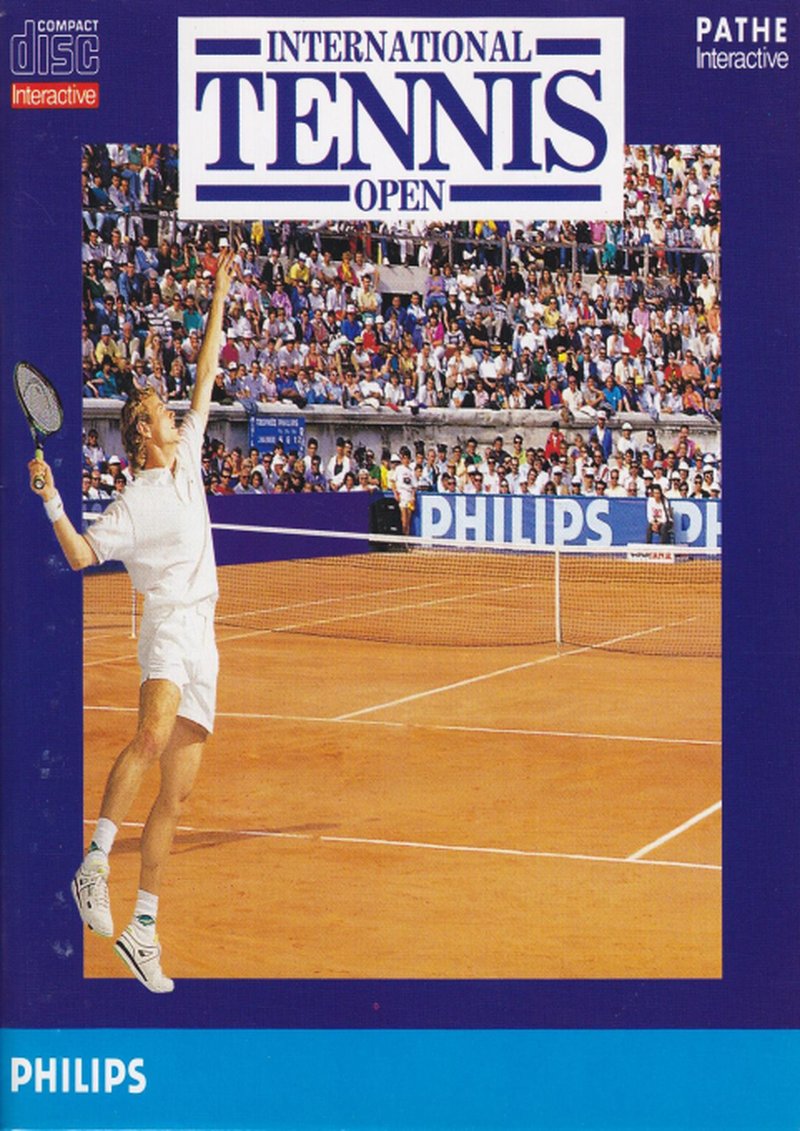
At a glance: International Tennis Open · Philips CD-i · Infogrames / Philips Interactive Media, 1992 · Sports simulation · Score: 7.5/10
International Tennis Open is the CD-i’s most improbable success story: a serious tennis simulation, developed by Infogrames and released in the format’s infancy in 1992, that used the multimedia machine for exactly what it was good at — digitised video, digitised sound, and sheer presentational abundance — while remembering to be a game underneath. You play Victor Player, a journeyman pro ranked somewhere near the bottom of the world, fighting through practice, quick matches and tournaments on grass, clay and hard courts toward the top of the rankings. The players are digitised actors, the courts are photorealistic, the umpire and commentator talk, the crowd murmurs and applauds in sampled audio. In 1992, on a television, nothing else in sports games looked or sounded like this. The question for a review is whether the tennis survives the presentation. Mostly, it does — which makes this one of the format’s quiet triumphs.
The production story explains the polish. Infogrames was Philips’ most committed early software partner — Tennis Open was one of ten CD-i titles the French studio built — and it treated the format’s strengths as a brief rather than a burden. The players were rotoscoped from filmed athletes, the courts rendered as photographic plates from a tilted overhead angle that shows the whole geometry of a rally, and the audio budget went on the things television tennis actually sounds like: ball strikes, grunts, crowd, commentary. The famous afterlife detail says everything about Philips’ ambitions for the title: during the 1993 and 1994 French Open broadcasts, French television ran a phone-in segment in which viewers played this game down a telephone line, steering Victor with their keypads, with a CD-i 220 as the prize. A game as a television show, in 1993. That was the multimedia dream, briefly real.
Playing the man, not the ball
The tennis itself is a simulation with an arcade heart, and the tension between the two is the review. The basics are excellent: positioning matters, the ball’s physics read honestly off the court surfaces — skiddy on grass, heavy on clay, true on hard — and rallies develop with a rhythm that rewards patience over button-mashing. Serve percentages, unforced errors and stamina all feed a post-match statistics screen of pleasing depth: aces, double faults, smashes, volleys, metres run, your ranking climbing from 99 towards 1. Singles only — there is no doubles — against a ladder of fictional opponents with distinct strengths, from the beatable Jimenez up to the formidable Garett.

The deductions are control-deep. Baseline rallying is smooth and satisfying, but the finer shots — the deliberate cross-court angle, the lob over an advancing net player, the drop shot — are unreliable to execute, a problem shared by almost every tennis game of the sprite era and worsened here by the CD-i’s controller and the slight detachment of steering digitised actors who are, in effect, playing back filmed movement. Critics at the time also noted the seams: the ball occasionally appears to pass near rather than off the racket, and the players’ sprite sets repeat across opponents, so a blonde rival may take the court with dark hair. Characterful flaws, but flaws. The difficulty, meanwhile, is stiff from the first tournament — this is a simulation’s learning curve, not an arcade game’s welcome mat.
The two-player edition and the splitter saga
A word for the game’s strangest legacy: the later two-player edition, which turned a solo simulation into genuine head-to-head tennis — provided you could wire it. Most CD-i players route the second controller through a port splitter, a dongle so essential to the format’s multiplayer life that the community eventually published open-source plans to build one. That a flagship sports title needed a hardware workaround to play doubles-adjacent tennis tells you everything about the CD-i’s games-vs-appliance confusion. With two pads connected, though, the game sings: human opponents solve the AI’s pattern-readability at a stroke, and the presentation — the changeover animations, the commentary, the stat screens — turns a living-room match into an occasion.
International Tennis Open is what the CD-i pitch promised and rarely delivered: television you could play, made by people who understood both halves of that sentence. It is the format’s best sports game, and it is not close.
Presentation deserves a final mark of its own. The change-of-ends sequences, in which both players loosen up with little stretches and shadow swings, were famous in their day for looking like the players were dancing with each other — an accident of rotoscoping that became the game’s most beloved visual. It is a good emblem for the whole production: technically ambitious, occasionally absurd, and impossible to imagine on a cartridge. Philips sold this game hard, bundled it, broadcast it, and built a sequel edition around it. For once, the flagship treatment was pointed at a game that could carry it.
Simulation, before the word was marketing
It is worth pausing on the word “simulation,” because Tennis Open earns it in the specific, unfashionable sense: it models a sport’s texture rather than its highlights. Ball speed off the racket, the difference a surface makes to a rally’s length, the way a second serve shrinks a player’s ambition, the ranking mathematics grinding away underneath a career — the game is interested in all of it, and its post-match statistics screen reads like a newspaper’s match report because the simulation has numbers worth reporting. Modern tennis games, with their licences and their player likenesses, routinely offer less of this substance. Infogrames built it for a machine sold to families who had never owned a console, which may be the most quietly impressive fact in this entire build-up.
The necessary counterweight is accessibility. A simulation this stern about its learning curve was a strange flagship for a family appliance, and plenty of 1992 buyers bounced off its first tournament and shelved it for the encyclopaedia. The score here reflects the game it is, not the audience it found: measured as a tennis title — against its cartridge contemporaries and most of its successors — it stands very tall. Measured as a CD-i crowd-pleaser, it asked more than the crowd had come to give. Both measurements are in the 7.5.
A practical note for today’s buyer, since this disc rewards one: the two-player edition is the version to hunt, both for the head-to-head game and because its release represents the production in its most complete form, but check which edition a listing actually is — the boxes are similar, the discs are not, and the solo original is the commoner find. Either plays well. Only one of them settles arguments between friends, which is what sports games are ultimately for.
Verdict
International Tennis Open earns 7.5/10: the finest sports title on the CD-i, with presentation that was genuinely pioneering and a simulation sturdy enough to hold it up. Deductions for unreliable finesse shots, repeating player sprites, singles-only structure and a difficulty curve that starts where other games peak. If you own the machine and care about sports games at all, this disc is not optional — it is the argument that the appliance could play.