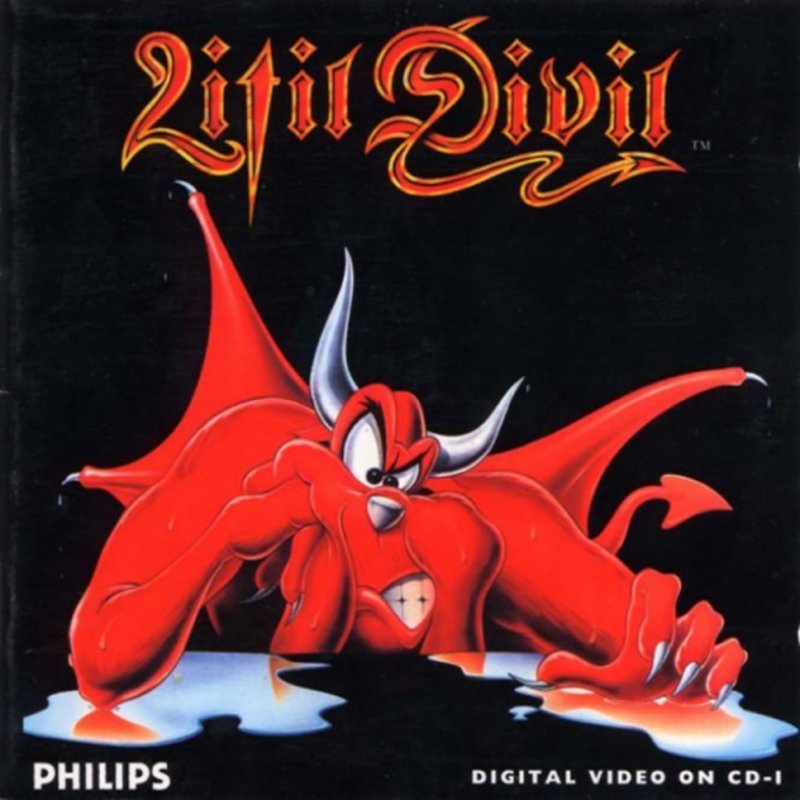
At a glance: Litil Divil · Philips CD-i · Gremlin Graphics / Philips Interactive Media, 1993 · Action-adventure · Score: 6.5/10
Litil Divil is the CD-i’s most likeable misfit: a cartoon dungeon crawler from Gremlin’s Irish studio, four years in the making, in which a small red devil named Mutt is chosen by lot to brave the five levels of the Labyrinth of Chaos and retrieve the Mystical Pizza of Plenty for the underworld. No divil has ever returned. The stakes are lunch. That joke — delivered with Disney-influenced animation, Rodney Matthews-flavoured art and voices throughout — powers a game that swings between two modes: over-the-shoulder tunnel exploration, where Mutt dodges pits, swamps and traps in a pseudo-3D maze, and fifty-plus puzzle-combat rooms, where the game becomes a series of inventive little arcade challenges. It is charming, funny, beautifully drawn and significantly harder than it has any right to be.
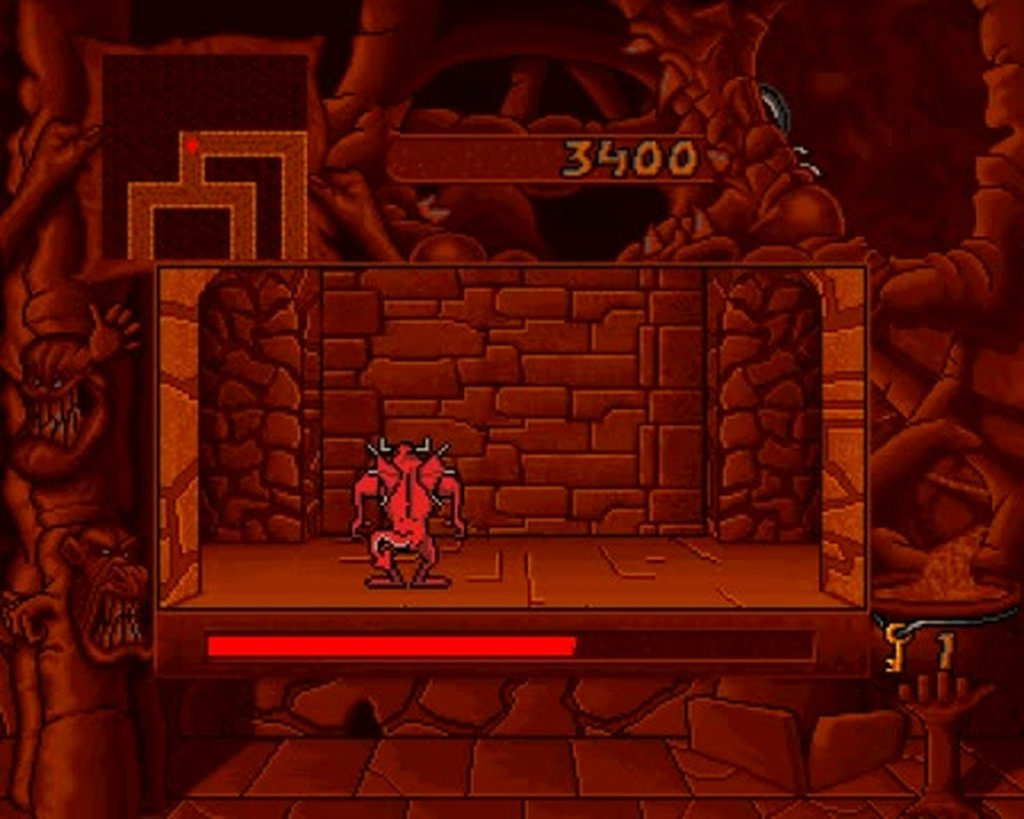
The structure gives the game its rhythm. The tunnels are the connective tissue — navigable corridors where Mutt collects gold, finds room doors and avoids the hazards that drain his health while a spinning skull warns that the Entity, the labyrinth’s enforcer, is closing in; take too long and Mutt is dragged to the torture chamber. The rooms are the game. Each is a self-contained problem in fancy dress: a giant spider whose offspring must be stomped unless you’ve bought the bug spray; a sumo demon who can only be beaten by popping him with a needle; bartenders, furnaces, swamp creatures and dozens more, many requiring a specific item bought from the labyrinth’s shops with found gold, or won from another room. It is a key-and-item web spread across five themed levels, and mapping it in your head is half the pleasure.
Looks like a cartoon, bites like a dungeon
The presentation is where Litil Divil spends its reputation, and it earns it. Gremlin did not skimp: Mutt is animated with a squash-and-stretch expressiveness that most CD-era games couldn’t afford, the rooms are colour-drenched dioramas, and the whole production has the hand-made warmth of a Saturday-morning cartoon that happens to be set in Hell. The CD-i version sits alongside the DOS and later Amiga CD32 editions as one of the game’s homes, and the format’s video capacity flatters its animated sequences. Patrick Phelan’s music keeps the jaunt going. As a piece of character and craft, this is top-tier CD-i material.
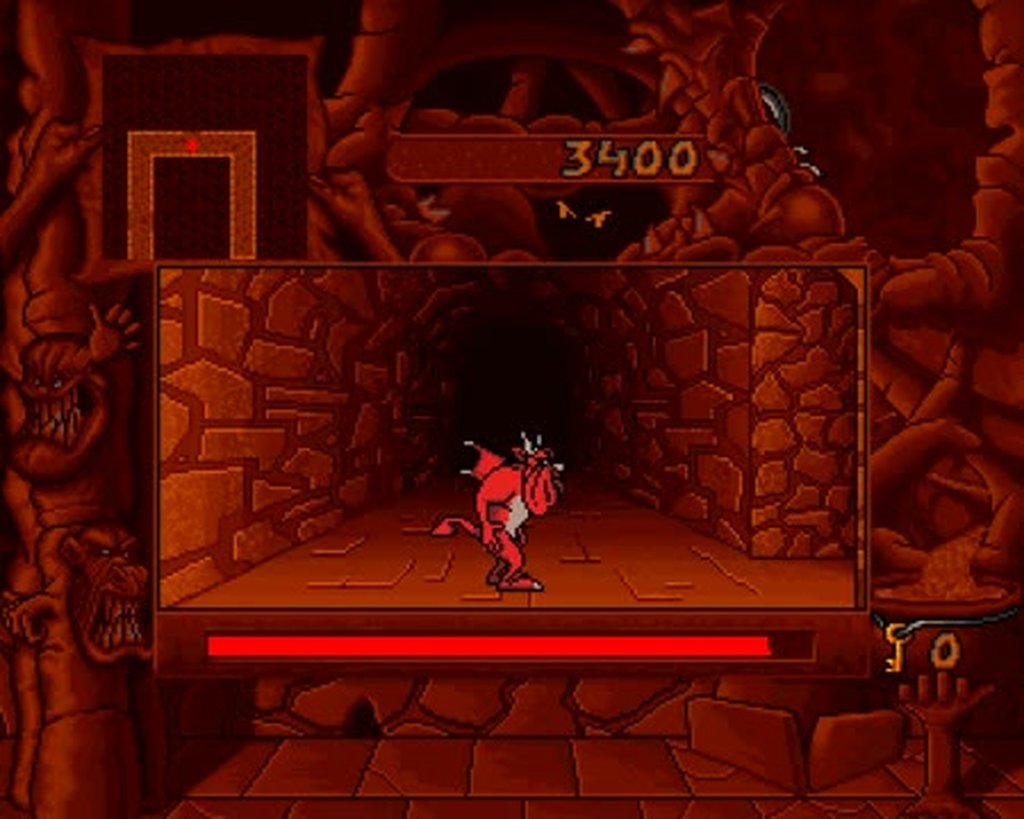
The bite is the difficulty, and it is not always fair. Tunnel traps escalate from telegraphed to pixel-demanding, and the later levels lean on memorised trap layouts in a way that stops feeling like skill and starts feeling like tuition paid in health. The rooms are better — their challenges are mostly readable and their solutions mostly earnable — but the item web can strand you: arrive at a room without its required object and the game sends you back through the tunnels to shop or search, with the Entity’s skull spinning faster all the while. Saving is more forgiving than many CD-i titles, but the friction is real, and players who come for the cartoon should know the cartoon has teeth.
The controller in the labyrinth
Control is the other deduction. The tunnel sections want analogue-ish steering — Mutt runs toward the camera’s horizon, dodging left and right, jumping gaps — and the CD-i’s pads translate that intention approximately. Room challenges, which range from timing games to light combat, each carry their own small learning curve, and the variety that makes the game delightful also means no single control scheme ever becomes second nature. None of this is disastrous, and the game’s generous spirit carries most players through; but set beside the precision of the original design’s ambitions, the CD-i pad is a blunt instrument in a watchmaker’s shop.
Litil Divil is a cartoon with a dungeon’s heart: generous in invention, stingy in mercy. Mutt deserved a bigger audience than three struggling CD formats could give him, and on CD-i he remains one of the shelf’s genuine characters.
Its development story adds poignancy. Begun in 1990, designed originally around five competing divils before the team settled on Mutt alone, with art direction influenced by Disney features and British fantasy illustration, Litil Divil was a labour of love that landed on DOS and CD-i in 1993 and CD32 in 1994 — three platforms, three small audiences. It has been re-released digitally in modern years, which is how most people now meet it. The CD-i original is a perfectly legitimate way to play it, and arguably the version whose full-screen cartoon presentation best matches the game’s intentions.
The Gremlin touch
Gremlin’s British and Irish studios were, in this period, quietly one of Europe’s most reliable sources of character-led games, and Litil Divil carries the house signature: a mascot with a personality rather than a powerset, humour written into the mechanics instead of pasted over them, and a difficulty that assumes the player is smarter than the marketing department does. Mutt’s world is full of small authored jokes — the shops, the signs, the torture chamber’s bureaucratic menace — and the rooms keep rotating their ideas rather than inflating their health bars. Fifty rooms is a lot of invention to sustain, and the hit rate is high: even the lesser rooms have a visual gag or a mechanical twist to justify their door.
The comparison that flatters it most is its own shelf-mates. Set Litil Divil beside the CD-i’s licensed cartoon games and the difference is authorship: this is a game designed as a game, by a studio with dungeon-crawling in its bones, rather than a cartoon with buttons attached. Its faults — the spikes, the steering — are the faults of ambition meeting three difficult hosts at once. Its virtues are its own, and they are the reason the game, alone among its CD-i cartoon contemporaries, has kept being re-released for thirty years.
One more thing should be said for the rooms, because they are the reason to persist: their best ideas would not shame a modern indie puzzler. The bug-spray economy — a room that cannot be beaten until an unrelated shop purchase arms you for it — is interconnected-world design years before the term existed, and the sumo demon’s needle, the bartender’s toll, the furnace’s timing all show a team thinking in mechanics rather than themes. When Litil Divil is good, which is often, it is good in the way games are supposed to be: it surprises you with what its own rules can do. The tunnels tax you. The rooms repay you. Over five levels, the account stays — just — in credit.
Bring a notebook, incidentally. The item web spans five levels and dozens of rooms, and the game predates the era of the in-game journal; mapping which room wants which object, and which shop sells it, is half the campaign and all of the nostalgia for a certain kind of player. Consider the notebook part of the period equipment, like the gamepad.
Verdict
Litil Divil earns 6.5/10: first-class animation, character and invention; real deductions for difficulty spikes that confuse toughness with unfairness, and for controls that never quite give Mutt the precision his labyrinth demands. It is one of the easiest CD-i games to love and one of the harder ones to finish — and both halves of that sentence are the review.