
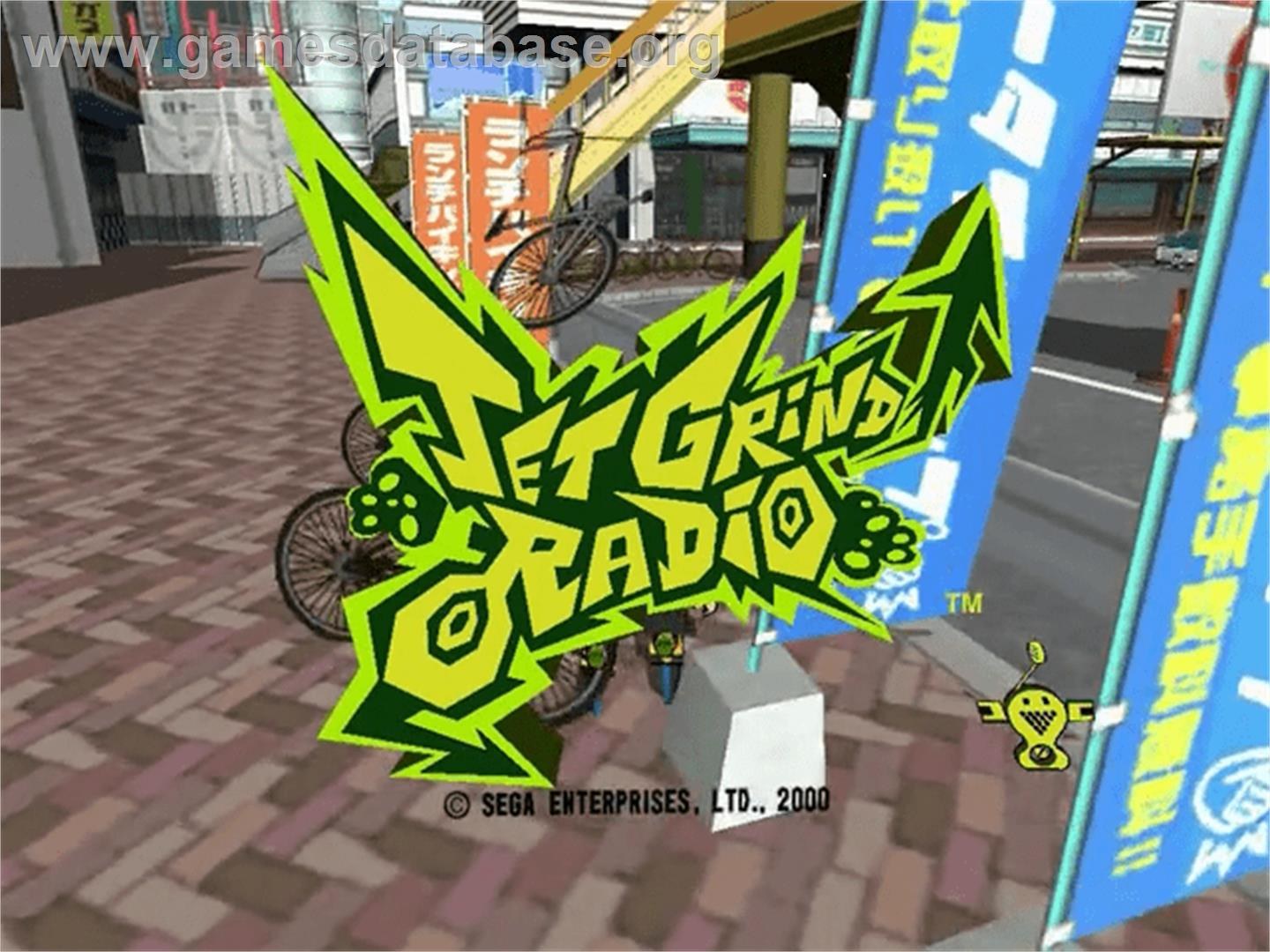
Some games age into antiques. Jet Set Radio ages into a poster you would still put on your wall. Smilebit’s 2000 inline-skating graffiti game — released in North America as Jet Grind Radio — took one look at the brown-and-grey realism race consuming the industry and answered with cel shading, primary colours and a pirate radio station. It is not merely one of the best-looking games on the Dreamcast. It is one of the best-looking games of its decade, full stop, and the rare early-3D title whose art direction has completely defeated its polygon count.
You are Beat, a runaway skater in Tokyo-to, a near-future Tokyo carved up by rival gangs and patrolled by the increasingly unhinged Captain Onishima and his riot police. Your crew, the GG’s, claims turf the only way that matters: roller-skating through shopping districts and skate parks, grinding every rail in sight and painting over rival tags with your own graffiti while Professor K narrates the turf war from his pirate station, Jet Set Radio. New recruits join through challenge stages — copy a trick line, win a race, out-tag a rival — and the map steadily opens from the shopping streets of Shibuya-cho to the neon heights of Benten-cho and the industrial sprawl of Kogane-cho.
Style With a Steering Problem
The skating itself is a study in momentum. The GG’s magnetic skates lock onto rails, pipes and wires, and whole stages are designed as grind circuits: leap from a billboard to a crane cable to a rooftop edge and the city becomes a single flowing line. Painting is the game’s signature mechanic — pull up to a tag spot and the game walks your analogue stick through a series of sweeping motions, one per stroke of the piece, while police close in around you. It turns vandalism into a rhythm game played under pressure, and landing the final stroke of a huge piece as a helicopter arrives is a thrill no sequel or imitator has quite matched.
Honesty demands the counterpoint: Jet Set Radio can be genuinely awkward to control. The camera swings with a mind of its own, the skaters turn like shopping trolleys at low speed, and the same analogue stick handles both steering and spray-painting, which causes occasional chaos at the worst moments. The timer, too, is a period relic — stages are generous once you know the routes, but first runs can end in a frustrating countdown while you hunt the last tag arrow. These are real flaws. They are also, somehow, part of the texture: Tokyo-to is a place you learn by falling off it.
The Sound of Pirate Radio
If the visuals won the argument, the soundtrack signed it. Hideki Naganuma’s score mashes funk breaks, hip-hop samples, J-pop and electronic noise into something that still sounds like the future, and it is layered with licensed tracks that fit so naturally most players assume the whole thing was composed in-house. Professor K’s between-stage broadcasts stitch the music into the fiction — the soundtrack isn’t accompaniment, it’s a character. Few games have ever used music this well, and the Dreamcast’s audio hardware gives every sample a satisfying punch.

The Dreamcast version is the original and, for purists, the reference: later ports smoothed edges and (in some regions and re-releases) shuffled parts of the licensed soundtrack, while the American release added its own stages and music to the Japanese original. Whichever way you arrive, the core is unchanged — a short, dense campaign you will finish in a weekend and think about for years, built for score-chasing revisits. Its graffiti-editor, letting you design your own tags, was quietly ahead of its time, too.

Learning Tokyo-to by Heart
What keeps Jet Set Radio in the conversation, beyond its looks, is how completely it commits to being a game about territory and expression rather than completion. The graffiti pieces themselves are glorious — huge, witty, increasingly elaborate murals that take dozens of spray cans and both nerve and route-planning to finish — and collecting new designs, hidden characters and the elusive Jet rankings for each stage gives the campaign a score-attack spine that outlasts the story. The rival challenges are the purest expression of the fantasy: a one-on-one race or tag duel through streets you have ground a hundred times, where local knowledge is the whole skill set.
It also matters that the game was saying something. Under the candy colours sits a cheerful little act of defiance — kids on skates painting over a corporate-police city’s grey order, with a pirate DJ as their patron saint — and the Dreamcast, itself the underdog machine fighting giants, was the perfect home for it. The sequel on Xbox refined the skating and opened the city up, and you should play it too. But the original’s tighter stages, stranger music licensing jigsaw and sheer concentration of ideas-per-minute keep it the essential version of the idea. When Sega announced a new Jet Set Radio as part of its classic-revival programme, the excitement that followed was not nostalgia for a logo — it was for this exact feeling, in this exact city.
A word on versions, since Dreamcast owners have choices to make. The Japanese original, the American Jet Grind Radio and the European release differ in small ways — extra stages and music in the Western editions, some licensing wrinkles that have followed the game through every re-release since — but the Dreamcast originals share the essential thing later ports diluted: the analogue-stick graffiti system at its most tactile, on the controller it was designed for, with Naganuma’s mix at full strength. Play it on a CRT or through the console’s VGA output and the cel shading resolves into something close to a moving comic book. Few games from the year 2000 can be described, without irony, as looking modern. This one can.
The police escalation deserves a final mention, because it is the game’s comic engine. Onishima begins with squad cars and bluster and ends — as your tags conquer a district — with tear gas, attack dogs and hardware that would embarrass a small army, all deployed against teenagers on roller skates whose crime is painting. The absurdity is the point, and the escalating pressure turns late-stage tag runs into genuine heist sequences: one eye on the stick motions, one on the closing cordon, Professor K screaming encouragement through the radio. Very few games make vandalism feel this heroic.
It is also, quietly, one of the Dreamcast’s best arguments for the VMU era of little extras: custom graffiti drawn in the editor, rankings to chase, a package that treats your creativity as content. The whole production behaves like the pirate station at its centre — broadcast loud, take risks, sign off before the authorities arrive.
The Verdict
Jet Set Radio is the Dreamcast’s manifesto: colour over realism, style as substance, and a city that begs to be learned by heart. The controls will occasionally fight you, and the clock is an acquired taste. Everything else — the lines through Shibuya, Naganuma’s impossible soundtrack, the sheer confidence of the cel shading — is timeless.
Score: 9.0 / 10 — Tokyo-to belongs to the GG’s, and twenty-five years on, nobody has taken it back.