
Hey hey — it’s time to make some crazy money. Few arcade ports announce themselves as perfectly as Crazy Taxi. Sega’s Hitmaker took its 1999 coin-op phenomenon — a yellow cab, an open city modelled on San Francisco’s hills, and a stopwatch with no mercy — and brought it home to the Dreamcast in 2000 with its dignity fully intact. What arrived was not a driving game in any conventional sense. There are no laps, no rivals and no finish line worth the name. There is only the next fare, the arrow pointing at their destination, and the beautiful panic of getting them there with seconds to spare.
The loop is arcade purity. Pick one of four drivers — Axel, B.D. Joe, Gena or Gus, each with their own cab and temperament — then roam the city collecting customers, who leap in with a cash offer scaled to distance. Deliver fast and the fare pays out with a Speedy rating and time added to your clock; deliver slowly and they bail out mid-journey, which is somehow more humiliating than crashing. Between fares, the city teaches you its second language: Crazy Drifts around corners, Crazy Jumps off the famous hills, near-miss Crazy Throughs in traffic — every stunt feeds the tip meter, and chaining them is where the real money hides.
One City, Perfectly Tuned
The Dreamcast port’s great strength is how completely it respects the arcade original while quietly doubling it. Alongside the arcade city, home players got an Original mode with a second, larger map, and the Crazy Box: a suite of sixteen mini-challenges — bowling with your cab, bursting balloons, impossible jumps — that functions as a disguised tutorial for every advanced technique the main game never explains. Master the Crazy Dash (a standing-start boost), the Limiter Cut and the drift, and the city transforms from a scramble into an instrument. The learning curve is the game, and it is a magnificent one.
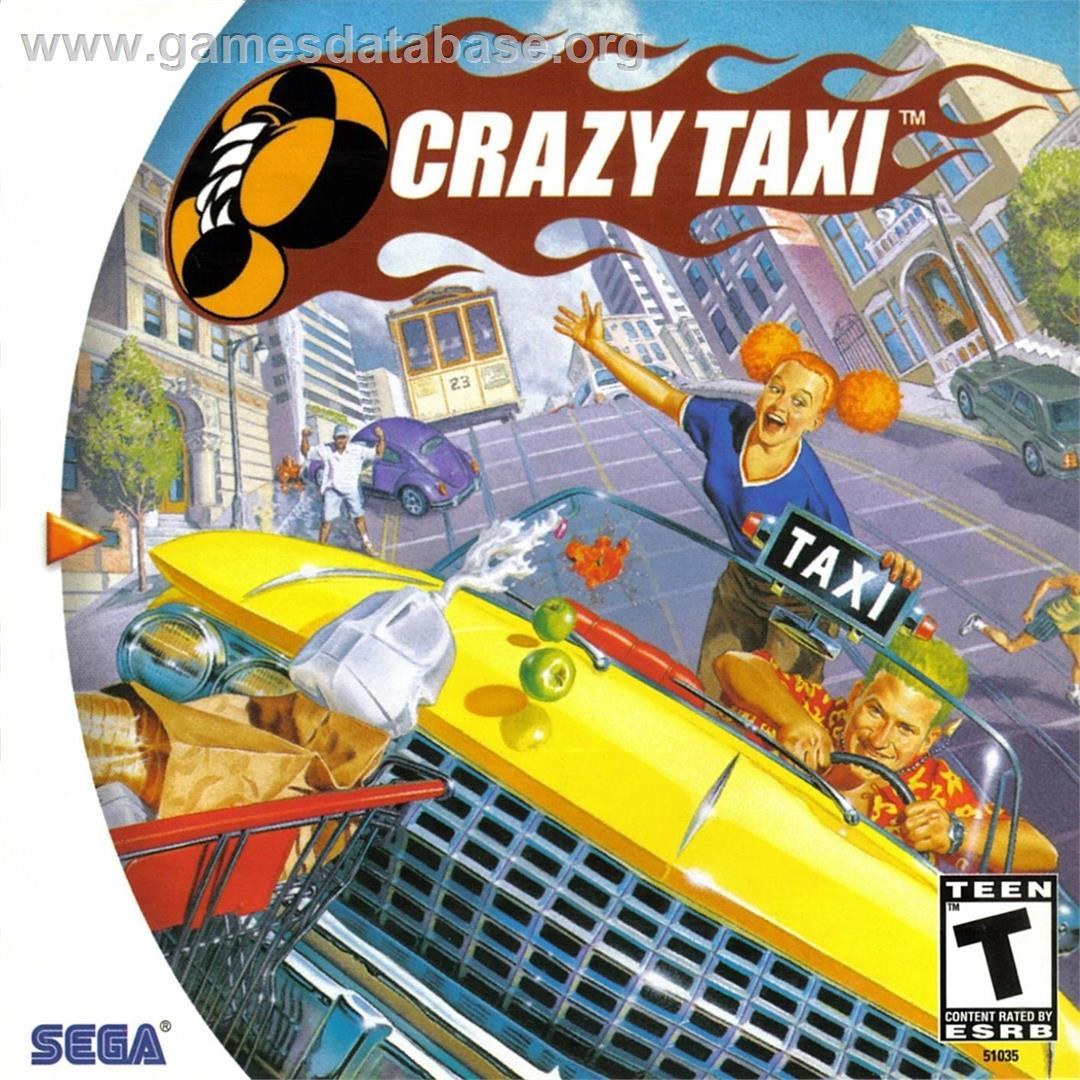
Presentation does heavy lifting. The city streams by at a mostly steady clip with the Dreamcast’s colours turned all the way up — cable cars, beachfronts, and hills that exist purely to be launched off. The licensed punk soundtrack, with The Offspring and Bad Religion doing the shouting, became so inseparable from the game’s identity that its absence in some later re-releases felt like a missing limb. The announcer, the fare cries, the screech of a drift held a second too long — Crazy Taxi’s audio design is a time capsule you can hear.
Short Rides, Long Life
The fair criticism is brevity of structure. Sessions are measured in minutes, there is no progression system beyond licence classes and your own mastery, and players who need a campaign will find only the clock. But that is like criticising a pinball table for not being a novel. Crazy Taxi is a score-attack game from the last golden age of score attack, built to be replayed in ten-minute bursts for years, and its home conversion loses almost nothing in translation — the Dreamcast pad’s analogue triggers even make a respectable stand-in for arcade pedals, though a wheel adds feel if you have one.
The City Is the Star
Give the map its due. Crazy Taxi’s city — a loving, compressed riff on San Francisco — is one of the great arcade spaces: steep launch-ramp hills in the residential districts, a beachfront strip, downtown canyons, a university, a stadium, and destinations that range from a certain fried-chicken chain to the cable-car turnaround, all of it knitted together by shortcuts that only reveal themselves after dozens of runs. The fare system quietly teaches urban geography — short-hop customers cluster downtown, the big money waits at the edges of the map — and the glowing destination arrow, paired with the colour-coded fare rings, keeps your eyes on the road and your brain in pure route-planning flow. Traffic, pedestrians who dive theatrically from your path, and the occasional tram keep the streets feeling alive without ever truly obstructing the fantasy: this is a city that exists to be driven through badly, at speed, for money.
It is also a game that respects the player’s intelligence about difficulty. The default settings forgive; the licence ranks — S class for the truly committed — do not. Watching a master run, where every fare is chained with drifts and jumps and the timer never dips, is to see an entirely different game hiding inside the one you thought you knew. That depth, in a port you could buy for a home console while the arcade cabinet was still earning, is why Crazy Taxi anchored so many Dreamcast collections — and why its sequels, for all their extra cities and passengers, never quite displaced it.
Two more practical joys deserve mention before the verdict. First, the port is generous with options arcade players never had: adjustable time limits and traffic, a choice of the arcade or original city in free play, and licence tests that turned mastery into a measurable pursuit. Second, it is a superb spectator game. The fares’ panicked yelps, the near-misses, the last-second handbrake arrivals — Crazy Taxi generates living-room commentary like few racers of its era, and its quick sessions make it the disc that goes in while dinner is cooking and stays in until somebody says “one more go” for the ninth time. In an age of hundred-hour commitments, a game this complete in ninety seconds flat feels almost radical.
Four Drivers, Four Tempers
The driver select screen deserves more credit than it gets. Axel’s balanced cab is the teacher, but each driver genuinely re-tunes the game: B.D. Joe’s heavier machine ploughs through traffic and rewards aggression, Gena’s setup favours precision and quick recoveries, and Gus — the veteran in the vintage-styled cab — drifts like he is on rails of his own. Learning which driver suits which city, and which suits your own bad habits, adds a layer of garage strategy to a game that otherwise fits on a postcard. It is also where the game’s personality lives: the victory whoops, the despairing slump of a failed fare, the little animations that turn four stat blocks into the four cabbies you would trust with your last ninety seconds.
And a nod to longevity: because a run takes minutes, Crazy Taxi has outlived games ten times its size in most collections. It is the Dreamcast disc that visitors get shown, the one that explains the console’s whole philosophy — arcade heart, home comforts, colour turned up, nonsense welcomed — in a single fare. Every collection needs a game like that, and few systems have a better one.
The Verdict
Crazy Taxi is the Dreamcast’s purest arcade conversion: loud, sunlit and endlessly replayable, with a skill ceiling hidden under a pick-up-and-play surface. Learn the dash, learn the drifts, learn the city — then spend years shaving seconds. Yeah yeah yeah yeah yeah.
What more can a port be asked to do? It preserved an arcade classic perfectly, doubled its content, taught its own secrets, and gave a new console an identity in the process. The Dreamcast had bigger games, but it had none more emblematic.
Score: 8.5 / 10 — Ten minutes to learn, a lifetime of fares to chase. The meter is still running.