
At a glance: Killzone: Liberation · PSP · Guerrilla Games, 2006 · Tactical action · Score: 8.5/10
The bravest thing about Killzone: Liberation is what it refuses to be. Faced with bringing Sony’s flagship FPS to a handheld with one analogue stick, Guerrilla did not shrink the formula and hope; they changed the genre. Liberation is an isometric tactical shooter — part twin-stick action, part squad command, part puzzle box — and it is not merely a good Killzone game. For a year or two, until the PS3 sequels found their footing, it was the best Killzone game, full stop, and the PSP’s most intelligent action title.
The story bridges the first game and Killzone 2 with unusual care. Weeks after the Helghast invasion of Vekta was turned back, General Metrac holds the southern city of Rayhoven and its hostages — among them people Captain Jan Templar cannot abandon — and the ISA’s counterstroke is fought street by street through canals, docks and industrial yards. Cutscenes in a graphic-novel register give the war a human scale the FPS games’ spectacle often skipped, and Templar, Rico and the turncoat-turned-ally Luger carry a plot about occupation and resistance that earns its grey areas.
Command, cover, consequence
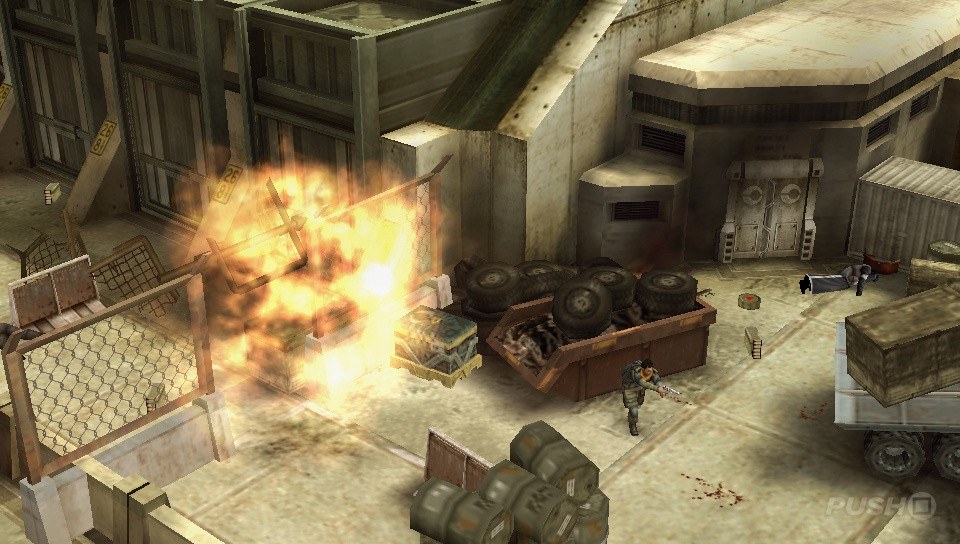
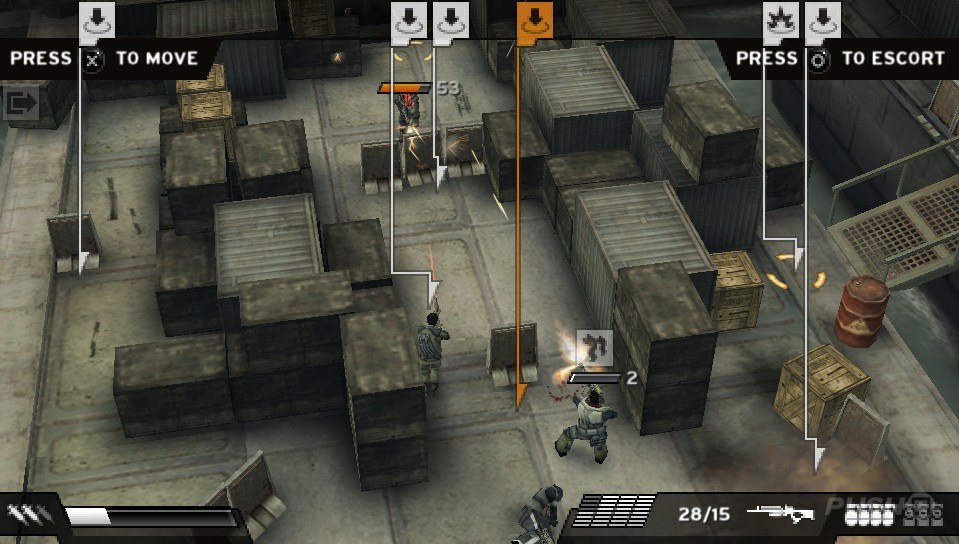
You move with the nub and aim with a lock-and-strafe system that keeps one thumb free for the game’s real signature: ordering your AI buddy. A tap assigns Rico (or another companion) to a position, a target or a task — holding a chokepoint, planting a charge, reviving you when the plan fails, as plans do. The battlefield is readable from the isometric height: cover is geometry, sightlines are arguments, and the Helghast — dragoons, shock troopers, mounted guns, the occasional spider-mine swarm — are placed like chess problems with guns. Liberation’s gunfights are won in the two seconds before they start.
Between missions, an upgrade economy lets you specialise Templar — carrying capacity, grenade types, a silent crossbow for the stealth-leaning, a jetpack in the downloadable chapter that the post-launch support added for free. Yes: Liberation pioneered again, releasing an entire fifth chapter and infrastructure multiplayer as free downloads in 2007, extending a campaign of sixteen missions into one of the PSP’s best-supported games. The multiplayer — six players, modes from deathmatch to assault on proper maps — was a handheld benchmark in its own right.
Guerrilla’s other masterpiece
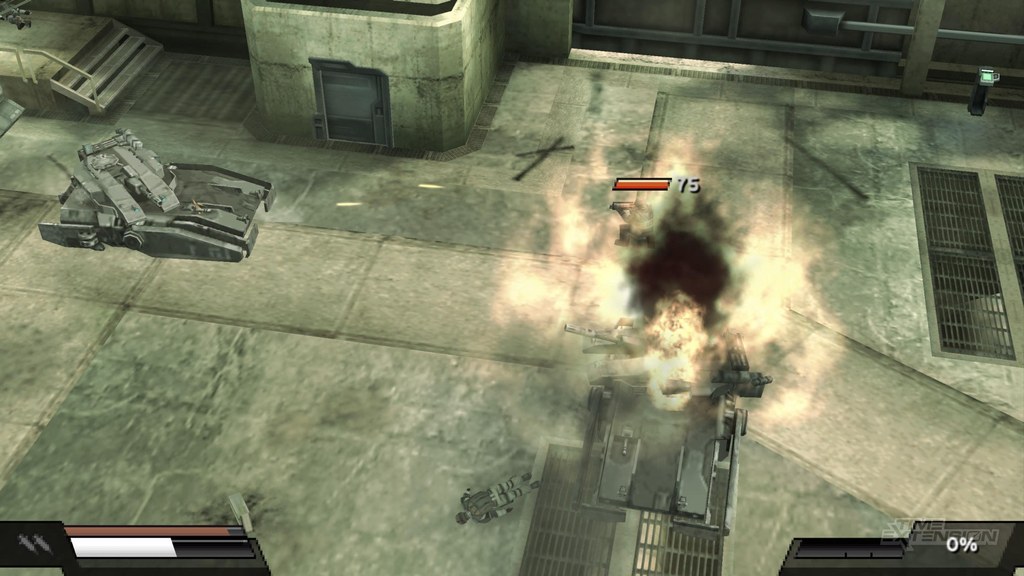
The presentation is a clinic in handheld art direction. The isometric camera buys the budget for dense, war-chewed environments — flooded streets, burning refineries — rendered in the series’ rust-and-concrete palette, with animation that reads at distance: a Helghast’s posture tells you his weapon before his first shot. Joris de Man’s score gives the campaign a mournful brass spine. Nothing about Liberation looks like a compromise, because its central decision turned the PSP’s limits into a viewpoint the big games could not use.
The compromises that remain are control-shaped: aiming without a second stick means the lock-on occasionally chooses the Helghast you meant to ignore, and later missions’ difficulty spikes lean on buddy-AI quirks. The story, too, ends on the saga’s middle chapter terms — a bridge, not a destination. But as a demonstration that a franchise can change genre to suit a machine and emerge stronger, Liberation stands beside Daxter and Peace Walker in the PSP’s hall of fame — the shooters that understood the assignment was translation, not reduction.
Challenge rooms and the score chase
Liberation’s afterlife is built on its Gameshark-era extras done properly: challenge games that isolate the system’s skills — grenade golf with live Helghast, crossbow accuracy trials, survival stands — each graded, each feeding unlocks. Combined with the campaign’s collectible intelligence files and the free fifth chapter, they make Liberation one of those PSP games whose credits are a midpoint. Guerrilla, a studio then known for spectacle, revealed a quiet talent for the score-attack arcade underneath the war.
The buddy system, examined
Your AI companion is the design’s riskiest bet and its signature. Rico is not a turret: he flanks, takes cover, calls targets, and occasionally makes the decision you were about to countermand, in the manner of every good sergeant. Ordering him well — splitting sightlines, cross-firing a doorway — is the difference between Liberation as a shooter and Liberation as the tactics game it secretly is. Later squad shooters on full consoles have shipped with less convincing partners than this PSP lieutenant.
A war with a map
Rayhoven and its hinterland give Liberation something the FPS entries lacked: geography you can hold in your head. Canals, a port, a refinery, the southern marshes — the campaign’s isometric eye turns the theatre into a board you learn, and the story’s occupation plot lands harder for it, because you have seen the streets you are liberating from above, like a commander and a citizen at once. It is the great unrepeatable trick of the format change: the handheld game understood its war better than the flagship did.
Guerrilla before Horizon
Studio histories remember Guerrilla for Killzone 2’s graphics and Horizon’s reinvention, but Liberation is the entry that proves the craft was there early — a team willing to abandon its own genre for a machine’s sake and land at the top of a different one. If the PSP has a theme, it is exactly that willingness, repeated by its best developers. Liberation is one of its purest expressions, and the easiest Killzone recommendation a reviewer can make without a single caveat about hardware.
The Helghast, humanised by distance
Something the isometric view quietly achieves: it makes the Helghast legible as soldiers rather than monsters. From above, their patrols have routines, their officers have habits, their positions have logic — and the game’s best missions exploit the humanity of that logic with feints and flanks. Killzone’s fiction always insisted its villains were people in a fascist machine; Liberation is the entry where the gameplay finally agrees, and the war feels heavier for it. Tactical distance, paradoxically, brought the enemy closer.
Sound of the occupation
De Man’s score and the game’s sound design deserve a paragraph of their own: Liberation sounds like a war reported from one street away — artillery as weather, radio chatter as texture, and a brass-led theme that gives the ISA’s resistance a dignity the FPS entries’ bombast rarely paused for. On headphones, the isometric battlefield gains a dimension no camera angle provides. It is the rare handheld game whose audio budget is audible in every scene, and a significant part of why its Vekta feels occupied rather than merely decorated.
One more consideration for the returning player: Liberation’s downloadable chapter and challenge content were distributed free, in an era when that generosity was a genuine surprise, and tracking down a complete copy today is part of the fun of collecting for this system. However you arrive, arrive ready to think. Liberation is a shooter that treats the space above the battlefield as the place where wars are actually decided — by a captain, a lieutenant and a player who learned to look before they fired.
Verdict
Smart, tough and beautifully built: Liberation is the thinking player’s PSP shooter and the Killzone game its own series spent a decade catching up to.