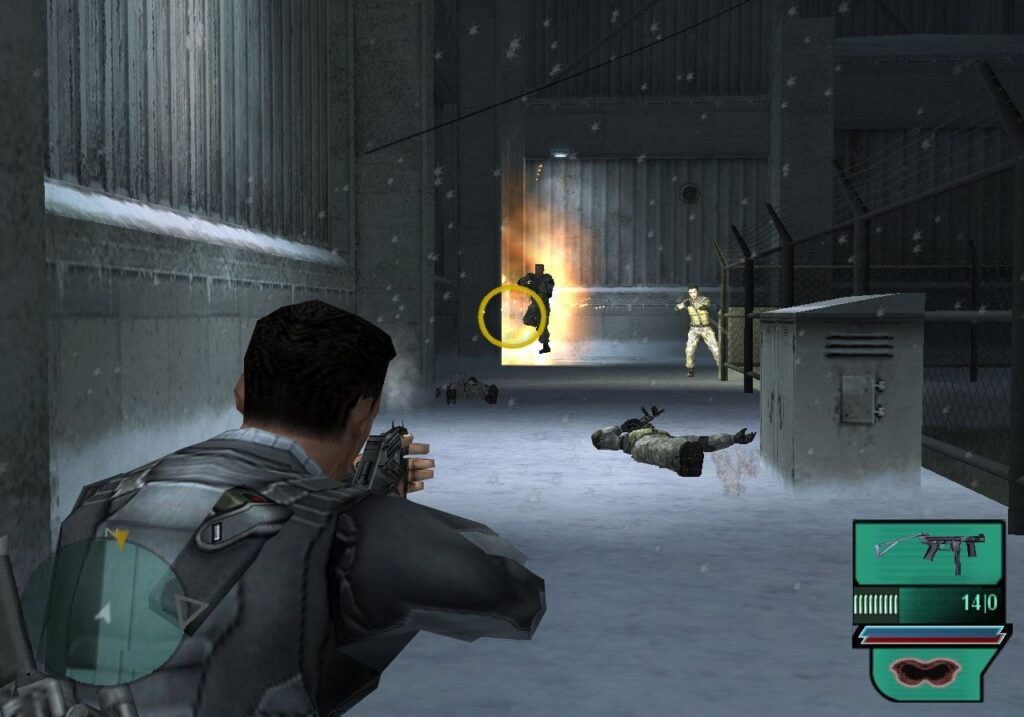
At a glance: Syphon Filter: Dark Mirror · PSP · Bend Studio, 2006 · Third-person shooter · Score: 8.5/10
Every handheld shooter of the PSP generation had to answer the same riddle: how do you aim with one analogue stick? Most answered badly. Bend Studio answered Dark Mirror — a control scheme (move on the nub, aim on the face buttons, strafe with the shoulders) that sounded like a compromise and played like a revelation, wrapped around a Syphon Filter campaign that treats the PSP as a machine for grown-up spy thrillers. In 2006 this was the game that made critics use the phrase console experience on a handheld without apologising, and time has been kind to the claim.
Gabe Logan is back, and Bend writes him properly: a tired professional whose agency sends him from an Alaskan oil refinery under terrorist attack to a casino in the Balkans and a war-crimes cover-up with roots in his own service record. Dark Mirror’s plot is the series at its most grounded — mercenaries, deniable operations, the Red Section conspiracy — told in cutscenes that punch far above handheld weight and anchored by the Logan-Lian Xing partnership, gaming’s most underrated professional marriage.
Shooting that respects the hardware
The campaign’s set pieces run on variety: sniper overwatch from a cable car, a train assault, an embassy siege, close-quarters work in a Peruvian mine where the darkness is a mechanic and the night-vision goggles are your best friend. Gabe’s gadget bag — taser, air pistol, darts of three flavours, the E.D.U. that sees through walls — encourages the series’ signature blend of stealth and sudden violence, while the snap-to-cover and blind-fire systems anticipate console shooters that would not standardise them for years. Multiplayer, both ad-hoc and the era’s infrastructure online, carried eight-player matches across modes the campaign teaches you.
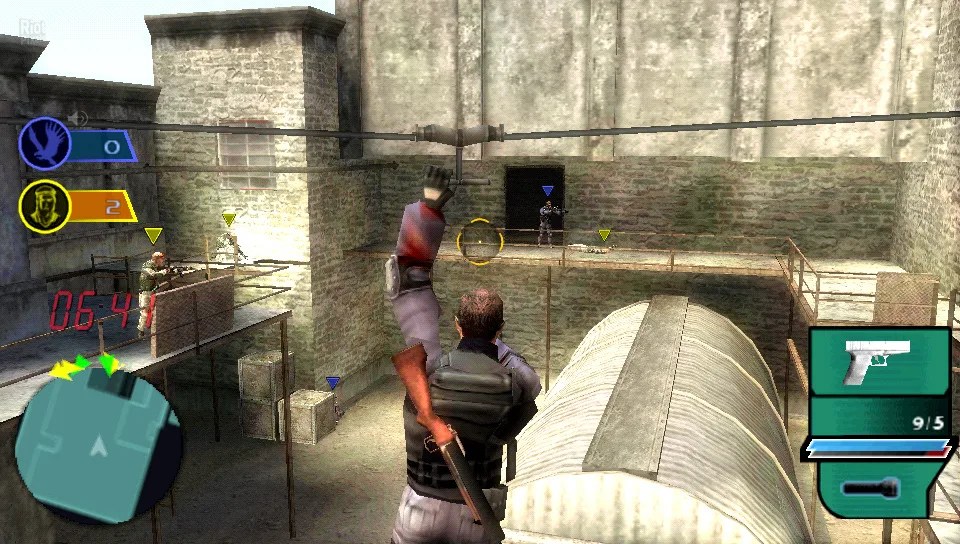
What lifts Dark Mirror above its competent peers is pacing and place. Levels are built as sequences of small, legible problems — a courtyard, a hostage, a turret — each readable at a glance on the small screen, each soluble in the order you prefer. Checkpoints are kind, difficulty is honest, and the whole campaign is structured in episodes that fit a commuter’s timetable without feeling episodic in the cheap sense. It respects the player’s evening and the player’s intelligence with the same gesture.
A Bend masterclass
Technically, this is Bend Studio announcing the craft that later produced Days Gone: environments with real geographic logic, character animation that sells weight, and a frame rate that holds its nerve in firefights the hardware should have flinched at. The soundtrack’s synth-orchestral tension and the sound of Gabe’s boots on refinery grating do more for atmosphere than the plot summaries suggest. Even the menus are in character: this is a game art-directed as a thriller, not a product.
Deductions, fairly made: the face-button aiming, for all its ingenuity, remains a dialect modern players must relearn; a couple of escort and defence sequences show their age; and the story’s twists, while satisfying, are spy-fiction furniture to anyone raised on the genre. The sequel, Logan’s Shadow, is arguably its equal — larger set pieces, a darker turn — and the pair together form the PSP’s essential shooter library. Dark Mirror gets the nod here for arriving first and teaching the machine what it could do.

Multiplayer that punched up
Dark Mirror’s online mode deserves a historian’s footnote: eight-player infrastructure matches on a handheld in 2006, with objective modes — rogue agent hunts, retrieval, deathmatch — on maps drawn from the campaign’s best spaces, running through Sony’s early online service with a community that kept servers busy for years. Ad-hoc play covered the bus and the playground. Bend understood that a shooter lives or dies socially, and they shipped both halves of that life on day one, on a machine most developers treated as a single-player island.
Difficulty and the training dividend
The game is generous with its teaching: a training programme frames the controls as agency certification, a challenge mode remixes campaign spaces into scored tests, and the difficulty settings scale enemy smarts rather than sponge. Veterans of the PS1 Syphon Filters will find the taser — yes, that taser, with its famous commitment to the bit — balanced at last into a tool rather than a war crime. Newcomers get a shooter that respects the learning curve it invented for its own hardware.
Bend’s calling card
Dark Mirror and its sequel Logan’s Shadow are why Bend Studio’s name, for a generation of handheld players, meant trust. The studio’s PSP output — two Syphon Filters, a Resistance spin-off of similar quality — never once treated the machine as a B-team assignment. Playing Dark Mirror now is watching a craftsman at the exact moment the tools and the ambition matched: every corridor lit, every set piece timed, every menu in character. The PS Vita got a fine Uncharted from Bend. The PSP got their masterclass.

The series’ best self
A closing claim, offered plainly: Dark Mirror is the best Syphon Filter game. The PS1 originals have nostalgia’s vote and the PS2 entries have scale, but neither matches this one’s pacing, control invention or script discipline. It is the entry a newcomer should play first and the one veterans cite without the qualifying shrug. Gabe Logan spent a decade as a second-tier mascot of PlayStation’s spy shelf. On the PSP, for one perfect campaign, he was the best in the business.
Logan’s Shadow and the duology effect
Any Dark Mirror review owes its sequel a paragraph: Logan’s Shadow (2007) took the same engine to bigger set pieces — a ship in a storm, a train in the mountains — and a story that darkens Gabe’s world considerably, adding swimming, underwater combat and a cliffhanger the series never resolved. The two games are best played as one long campaign, and together they represent the PSP shooter library’s foundation. Dark Mirror is the better starting point and, by a nose, the better game; the nose belongs to its villain, and to 2006’s sheer novelty.
The set piece audit
Replaying Dark Mirror today, the set pieces hold up with embarrassing ease against modern handheld shooters: the refinery’s opening assault teaches movement under fire without a tutorial voice; the casino level turns cover into choreography; the final act’s revelations are staged in spaces you have fought through, so the plot twists land in geography you own. Bend’s level designers understood that a thriller is a sequence of rooms with intentions, and every room in Dark Mirror intends something. That discipline, more than any gadget, is the game’s real weapon.
Play it with the series’ history in mind and Dark Mirror becomes something more than a great shooter: it is the moment a B-tier franchise produced an A-tier game by respecting a small machine completely. Bend would go on to bigger budgets and longer developments; many PSP owners still name this six-hour campaign as their favourite thing the studio ever made. The Agency is calling, Logan. Answer on the small screen — it is where you did your best work.
Verdict
The PSP shooter by which the others are judged: smart controls, a proper thriller plot and Bend Studio’s craft in every corridor. Gabe Logan’s finest mission is a portable one.