For about four years, the most exciting name in British games was a company that would not tell you anything. Ultimate Play the Game gave no interviews, printed no faces, named no individual programmers on its packaging, and communicated almost entirely through cryptic adverts and games that seemed to arrive from slightly in the future. Its boxes were bigger than everyone else’s, its prices were higher, its inlays were printed like the covers of fantasy novels — and the games inside justified every bit of the theatre. At the centre of it were two brothers from Leicestershire, Tim and Chris Stamper, who built the Spectrum’s defining catalogue and then, with a discipline almost unheard of in the cottage industry around them, walked away at the top and did it all again as Rare.
The Stampers came to games from the arcade trade — Tim had worked on arcade hardware and conversions — and that origin shows in everything Ultimate made: an arcade operator’s instinct for immediate readability wedded to a craftsman’s refusal to ship anything ordinary. They founded Ultimate in 1982, based in Ashby-de-la-Zouch, and the first releases of 1983 announced the standard instantly. Jetpac put a spaceman on a hostile moon, assembling his rocket piece by piece under fire, refuelling it, and blasting off to do it all again on a harder world — a complete, compulsive arcade loop in 16K, written with a polish that made most 48K games look embarrassed. Alongside it came the likes of Pssst, Cookie and Tranz Am: small, bright, perfectly tuned arcade pieces, each one a calling card. Jetpac in particular has never really dated; it is the Spectrum’s purest fifteen minutes.
Sabreman Changes Everything
In 1984 Ultimate changed scale. Sabre Wulf sent its new hero Sabreman — pith helmet, sword, entirely unbothered by the plausibility of his surroundings — into a vast flipping-screen jungle maze of hundreds of screens, hunting the pieces of an amulet through orchids that altered his speed and temper, past wolves, natives, boars and the Wulf itself. It was colourful in defiance of the Spectrum’s notorious colour clash, it was huge, and Ultimate charged £9.95 for it when a standard game cost half that — in a larger box, with the confidence of a publisher selling literature. The market paid, gladly. Sabre Wulf was the year’s defining release and it established the pattern of Ultimate’s middle period: exploration games of real size, built around a character, sold as events.
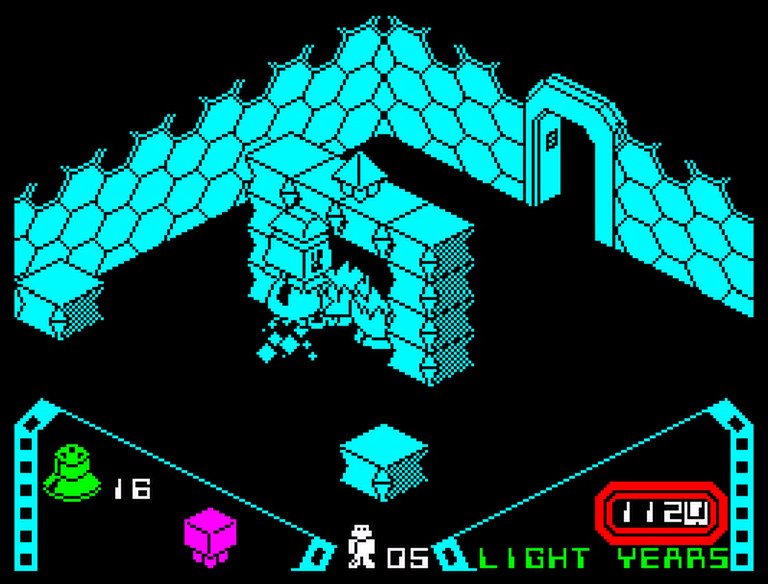
Underwurlde, Sabreman’s second outing the same year, was stranger — a vertiginous underworld of bouncing, bubbling ascent and sudden falls, with the hero ricocheting around caverns on geysers of gas — and then came the detonation the company had, famously, been keeping in a drawer: Knight Lore, and with it the Filmation engine, isometric 3D of a sophistication the industry had not believed the Spectrum capable of. Our full Knight Lore review elsewhere on this shelf gives the game its own due; in the company story its significance is simpler. Filmation was Ultimate’s moat. Alien 8 applied the engine to a science-fiction rescue mission of charm and ingenuity — a robot caretaker thawing a starship crew — and through 1985 the isometric style Ultimate had pioneered became the house style of half the industry, while the originators, characteristically, began looking for the exit.
The Mystique Was the Marketing
It is easy, now, to treat Ultimate’s secrecy as a cute affectation. At the time it was a serious commercial weapon. British games in 1983 were sold on screenshots and hype; Ultimate sold on reputation alone, letting each release arrive wrapped in an unusually beautiful box and the accumulated trust of the last one. The big-box Sabre Wulf and Knight Lore packaging, the consistent art direction, the refusal to discount — this was a company behaving like a film studio in an industry of market stalls, and it built a brand so strong that the Stampers were able to do the two things nobody else in Ashby, Liverpool or anywhere else in the British business managed: sell the company at its peak, and keep the talent.
The end, when it came, was brisk. The later Spectrum catalogue thinned — the Filmation sequels and the fairground strangeness of later releases never quite matched the 1983–85 run — and in 1985 the Ultimate name and catalogue were sold to U.S. Gold, while the Stampers retained the one asset that mattered: themselves, and the team around them. Renamed Rare, they pivoted with startling prescience to Nintendo’s NES just as the American console market was resurrecting, becoming one of Nintendo’s most valued Western partners — Battletoads, Donkey Kong Country, GoldenEye 007, Banjo-Kazooie — before Microsoft acquired Rare in 2002 for a sum reported in the hundreds of millions. The line from Jetpac to GoldenEye is direct and unbroken: same brothers, same secrecy, same insistence that the game on the screen be a year ahead of what the hardware was supposed to allow.
The Arcade Heart: Atic Atac and the 16K Miracles
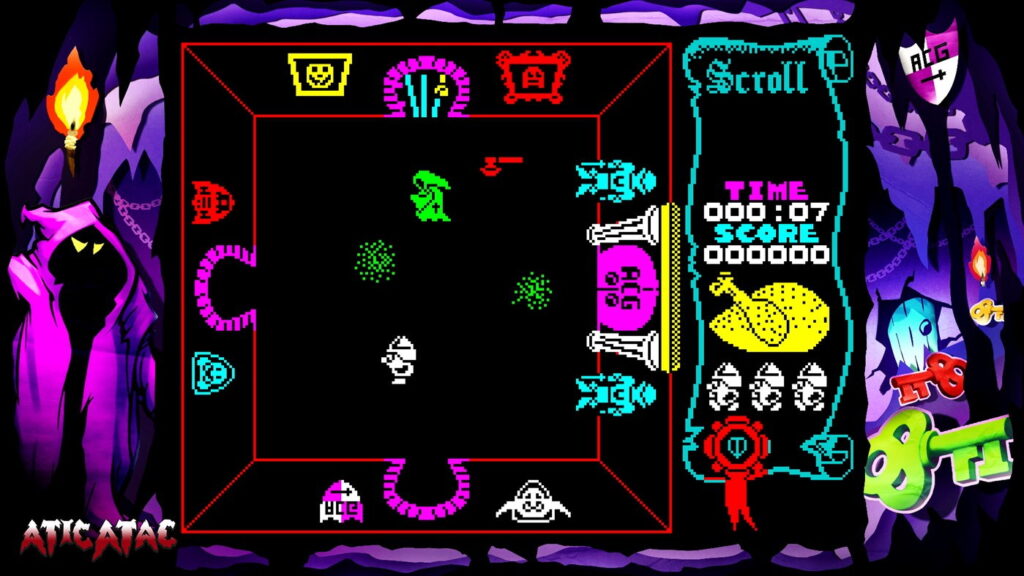
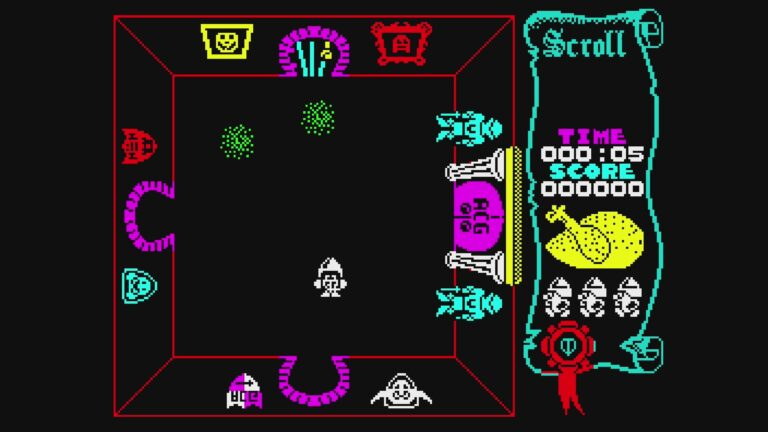
Two exhibits deserve naming in any account of the company’s range. The first is Atic Atac (1983), a haunted-house arcade adventure viewed from above, in which a knight, wizard or serf sprints through a mansion of respawning ghouls hunting the three pieces of the Golden Key of ACG. It is fast in a way Spectrum games were not supposed to be — rooms redraw instantly, enemies pour in, the whole thing played at a sprint with one eye on the roast chicken that serves as your energy — and it quietly invented the grammar of the top-down action-adventure years before the genre had a name. The second exhibit is the early 16K work itself: Jetpac, Pssst and Cookie were written for the smaller, cheaper Spectrum, a machine with less memory than a modern email, and they are complete in a way that shames bloat in any era. Jetpac’s assemble-refuel-launch loop has been remade, ported and lovingly imitated for forty years, and it earned the ultimate professional compliment of the age: Nintendo’s own people noticed the brothers behind it. When Rare later became a Nintendo studio, it was not a pivot into the unknown. It was a courtship that had begun, in a sense, with a spaceman and his rocket in 16K.
There is also a lesson in what Ultimate refused to do. They did not chase film licences, the industry’s favourite shortcut to the charts. They did not flood the market with sequels — Sabreman’s adventures are four distinct games, not one game four times. They did not discount, did not badge-engineer, and did not stay: when the Spectrum market began its long slide into budget reissues and licence fodder, the Stampers had already sold the label and left. Almost every other great British name of the era rode the market down. Ultimate is the exception that proves how rare the discipline was.
What the Catalogue Still Teaches
Revisit the Spectrum catalogue today — Jetpac, Atic Atac with its haunted-house dash for the Golden Key, Sabre Wulf, Underwurlde, Knight Lore, Alien 8, and the elegant oddities around them — and what strikes you is not nostalgia but standards. These games load fast, explain themselves in seconds, waste nothing, and are animated and coloured with a care that shames far richer productions. The Stampers’ arcade schooling meant feel came first: Jetpac’s thrust, Atic Atac’s pace, Sabreman’s sword. Their business schooling meant the catalogue was an asset to be protected, priced and finally sold properly — a lesson the rest of the British bedroom industry, brilliant and chaotic, mostly learned too late.
Ultimate’s Spectrum reign lasted barely four years, and the company released perhaps a dozen games that matter. But influence is not counted in units. The isometric adventure, the premium big-box release, the developer-as-brand, the British studio that conquered Nintendo — all of it runs through Ashby-de-la-Zouch, through two brothers who would not do interviews and let sixty-odd screens of jungle and one impossible isometric castle do the talking instead. The Spectrum had bigger sellers. It never had a classier act.