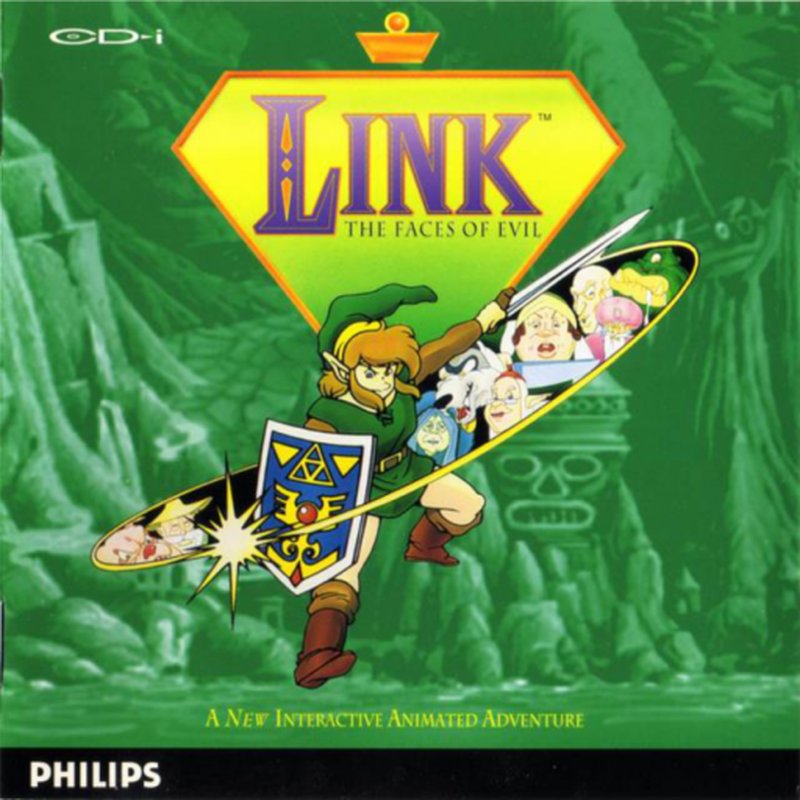
At a glance: Link: The Faces of Evil · Philips CD-i · Animation Magic / Philips Interactive Media, 1993 · Action-adventure · Score: 3.5/10
On 10 October 1993, Philips released the first two Legend of Zelda games ever made outside Nintendo — on the same day, built on the same engine, by the same small team, for a machine almost nobody owned. Link: The Faces of Evil sends Link to the island of Koridai, where Ganon has seized power and his minions have carved the land into the giant stone effigies of the title. You travel a painted map, dive into side-scrolling stages, bash monsters for rubies, buy lamp oil, rope and bombs from a shopkeeper who has become immortal in quotation, and eventually throw the Book of Koridai at Ganon. As a piece of internet culture, it is a ten out of ten. As a video game you are asked to actually play, it is one of the most punishing action-adventures of its decade — and not in the ways its designers intended.
The development story explains a great deal. Animation Magic — the joint American-Russian venture built from Dale Disharoon’s company and animators in St Petersburg — made Faces of Evil and its sibling Wand of Gamelon simultaneously, on a combined budget reported at around $600,000, with a core team of just four programmers, one audio engineer, four artists, a producer and a freelance writer. The animation that resulted is fluid, plentiful and utterly unhinged in tone; the game underneath it was assembled at the same sprint. Both facts are visible in every minute of play.
A Zelda game, structurally
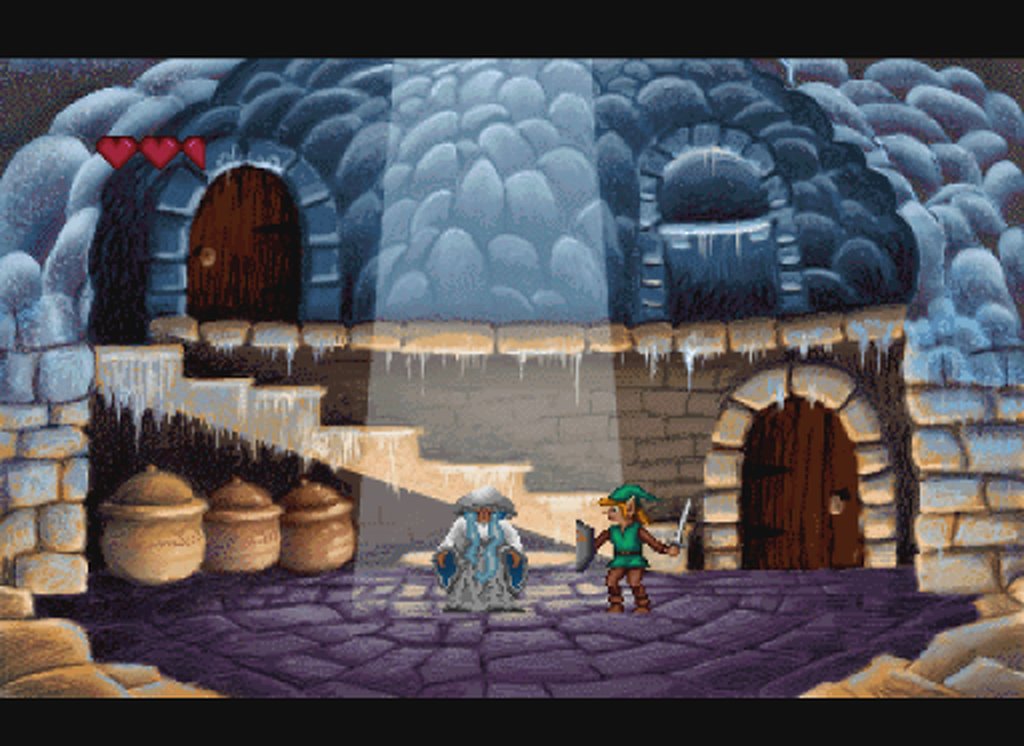
Give the game its due first: the skeleton is recognisably Zelda. There is an overworld map with named regions to unlock in sequence. There are shops, item upgrades, heart containers, side characters dispensing clues, and a progression from sword-and-shield scrapping to a powered-up arsenal — a stronger sword, fire-spitting power gloves, a winged helmet for high places. The side-scrolling combat is modelled openly on Zelda II: The Adventure of Link, Nintendo’s own black sheep, and in still screenshots the painted backdrops — by a team working in a Russian classical-influenced style — can look genuinely beautiful, all storybook colour and weird, looming statuary.
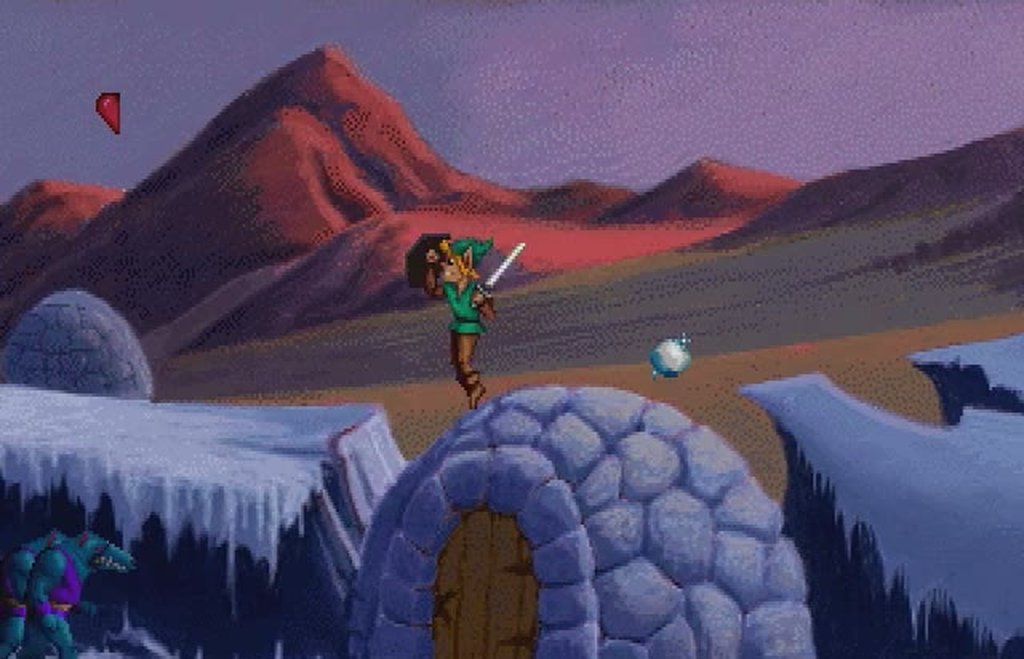
The trouble begins the moment anything moves, including Link. Control is the game’s original sin. Link’s sword has a hitbox that feels shorter than the sprite suggests, enemies absorb or deal damage with telegraphed unfairness, and knockback routinely deposits you into pits or into a second enemy. The CD-i controller situation — a remote-derived pad with a thumbstick-disc — turns every precision jump into a estimate. Enemies respawn as you cross screen boundaries, so retreating to regroup simply restocks the ambush. Difficulty in Faces of Evil is rarely about learning a stage; it is about surviving the interface long enough for the stage to run out.
The economy of frustration
Then there is the grind. Rubies drop stingily, shop prices are set in another economy entirely, and the consumables — lamp oil for dark areas, rope for climbs, bombs for cracked walls — are mandatory progression items that burn away as you use them. A player who explores in the wrong order can arrive at a barrier without the item or the funds to pass it, and the game’s answer is to send them back to farm the same respawning enemies with the same miserable sword. Zelda II was demanding, but it was demanding inside a responsive, readable system. Faces of Evil borrows the structure and none of the feel, and the result is a game that takes perhaps four hours to finish and makes each of them feel personally negotiated.
Every infamous thing about Faces of Evil — the voices, the faces, the shopkeeper — is charming. Everything you have to do between those moments is the problem. It is a cartoon wrapped around a chore.
The cutscenes need their paragraph, because they are why you have heard of this game. Animated in St Petersburg with rotoscope-adjacent looseness and voiced in America with total, guileless sincerity, they produced the King of Hyrule wondering what’s for dinner, a Link who cannot wait to bomb some Dodongos, and Morshu the shopkeeper, whose fifteen seconds of screen time — lamp oil, rope, bombs, and the news that your rubies are not enough — became one of gaming’s most durable memes, remixed for thirty years. Judged purely as animation, the scenes are energetic, expressive and frequently lovely in stills. Judged as direction, they are tonal chaos: the game cannot decide whether Link is a hero, a sitcom character or a hostage, and settles for all three in rotation.

The map is the best idea in the game
One structural choice deserves rescue from the wreckage. Koridai is presented as a genuine place: the map screen shows the island’s regions as painted landmarks, stages unlock in a loose order rather than a strict line, and returning to an early region with a late-game item to open a shortcut or a secret feels, briefly, like the series this is imitating. The named faces themselves — giant carved heads that serve as late-game stages — are a strong, weird image, more Grimms’ fairy tale than Nintendo house style, and the game’s artists clearly relished them. There is a version of Faces of Evil, built by a team with twice the time and a controller with a proper D-pad, that is a rough but interesting Zelda II descendant. The tragedy of the actual game is that you can see that version through it, like a face behind glass.
It is also worth recording that the game is not broken in the technical sense. It loads, it saves, its stages are completable, its final confrontation with Ganon — kill him with the Book of Koridai, the only weapon that works, a story point the game communicates so vaguely that many players died in front of him for hours — does function once you know the trick. Nothing here is unfinished. It is finished, polished in its animation, and simply designed around the player’s discomfort: scarce money, mandatory consumables, respawning enemies, unresponsive movement. That is a design philosophy, and in 1993, on a platform whose owners had few alternatives, it passed. It should not pass here.
What survives
Two things genuinely survive contact with the game today. The first is the music and sound design, which work harder than the budget should have allowed, with stage themes that give each region a real identity. The second is sheer strangeness of geography: Koridai’s regions — a militia camp, a haunted swamp, the literal faces themselves — are more imaginative than the game built on top of them. The 2020 fan remasters, which rebuilt both Animation Magic games with modern controls and quality-of-life fixes, proved the point by subtraction: with responsive input, the design is merely mediocre. As shipped in 1993, it is worse than mediocre, because the shipped input is the game.
Verdict
Link: The Faces of Evil is historically enormous and practically gruelling. It matters — as evidence of what the Nintendo-Philips settlement really meant, as the source of a generation of internet comedy, and as a beautifully painted artefact of a team working impossibly fast. But a review scores the playing, and the playing is a slow, stiff, grind-gated slog in which the controller, the hitboxes and the economy all conspire against the player. Watch the cutscenes anywhere. Play this only with a historian’s patience. 3.5/10.