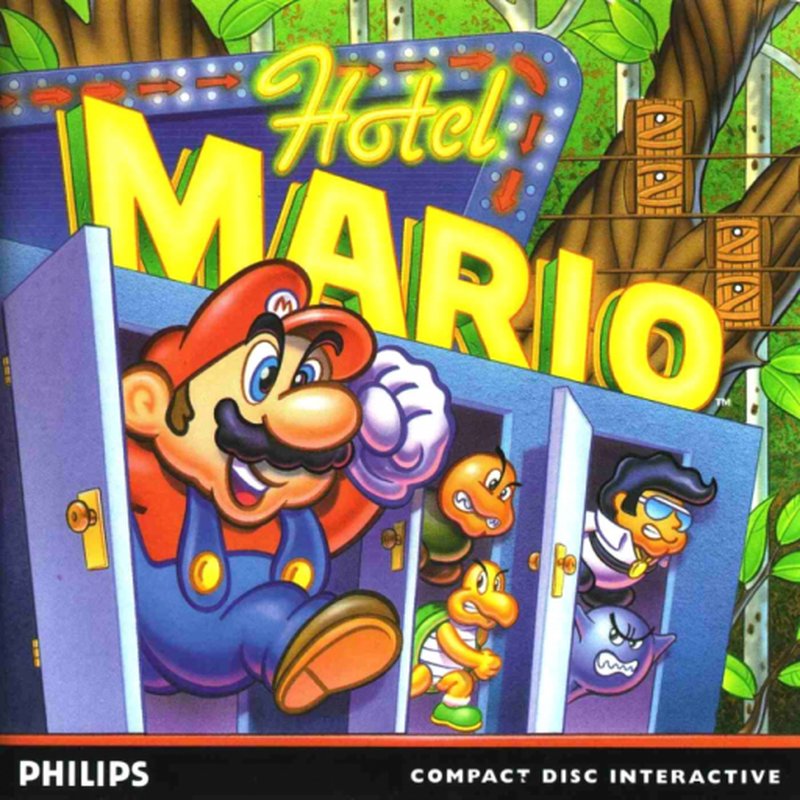
At a glance: Hotel Mario · Philips CD-i · Fantasy Factory / Philips Interactive Media, 1994 · Puzzle platformer · Score: 4.5/10
There is exactly one Mario game on the Philips CD-i, and it is a game about closing doors. Bowser has turned the Mushroom Kingdom into the Klub Koopa Resort, a chain of seven hotels run by the Koopalings, and Mario — with Luigi in the two-player mode — has to work through every floor of every hotel shutting every door before the clock runs out. That is the whole premise, and the game never explains why the doors matter. What it does explain, at legendary length, is itself: fourteen animated cutscenes of Mario and Luigi walking towards the camera, delivering the most quoted dialogue in CD-i history. You know the lines. The internet made sure of that. The question a review has to answer is whether anything playable survives underneath the memes — and the honest answer is: a little, but not enough.
Strip away the cutscenes and Hotel Mario is a single-screen arcade puzzler in the lineage of Mario Bros. and Wrecking Crew. Each stage is a cross-section of five hotel floors joined by elevators. Doors stand open; you close one by walking through it. Enemies — Goombas, Koopas, Wigglers, Buzzy Beetles and worse — wander out of the doors and cheerfully reopen them, so a stage becomes a small war of attrition between your route-planning and their wandering. The first six hotels hold ten stages each and the seventh holds fifteen, every hotel themed, from Morton’s wooded treehouse to Bowser’s gothic finale, and every hotel ends with a Koopaling boss fight.

Doors, elevators and the art of the route
At its best, the game finds a genuine puzzle rhythm. Doors hide power-ups — a Super Mushroom for an extra hit, a Fire Flower for fireballs, a Starman for brief invincibility, coins towards an extra life at thirty — and the elevators behave differently in each hotel, some looping, some reversing, some on timers of their own. A good stage asks you to sequence a whole floor before moving on, because chasing one reopened door across the building while three more pop open behind you is how the 200-second limit kills you. You also lose a life if every door on the stage is open at once, a fail state that arrives with horrible speed once a stage gets away from you.
The problem is that Mario himself is not equipped for the job Philips gave him. He moves with a laggy, floaty weight that belongs to a machine designed around a remote control, and the CD-i’s pack-in controllers — infrared wands and thumbstick remotes built for pointing at menus — are simply the wrong tool for a precision arcade game. Jumps feel committed a half-second before they happen. Stomping, the most basic verb in Mario’s vocabulary, becomes an estimate. On a proper gamepad the game is merely stiff; on the remote most CD-i owners actually had, it is a negotiation.
Hotel Mario is not the worst game ever made, whatever the listicles say. It is something sadder: a competent arcade idea handed to the wrong hardware, the wrong controller and the wrong century’s idea of what multimedia meant.
How Mario ended up on a Philips
The strangest thing about Hotel Mario is not the doors. It is the licensing meeting that produced it. When Nintendo walked away from its CD-ROM partnership with Philips — the deal that was supposed to produce a CD add-on for the Super NES — the settlement left Philips holding rights to use Nintendo characters in CD-i games. Mario and Zelda, the two crown jewels, were licensed out to a multimedia platform whose makers had never run a games business, and Nintendo exercised essentially no supervision over what was made with them. Hotel Mario was the in-house attempt: developed by Philips’ own Fantasy Factory rather than an outside studio, which makes it the most “official” of the CD-i Nintendo games and, in a way, the most damning. Nobody at Nintendo looked at the door game and said no.
Context matters for the score, though. In 1994 the CD-i was not being sold against the SNES in the toy aisle; it was a $700 multimedia appliance in hi-fi shops, and Philips was still working out what a CD-i game even was. Hotel Mario’s structure — short stages, simple rules, lots of video — is a rational answer to a brief that said “make something a family can play with a remote control.” The tragedy is that the brief itself was wrong, and seventy-five stages of it could not hide that for long. Contemporary reviewers were lukewarm rather than scandalised; the “worst Mario ever” verdict is a retrospective one, hardened by the cutscenes’ second life online.
Seven hotels, diminishing returns
The hotel structure deserves a fair hearing before the verdict. Each hotel changes the terms slightly: new enemy mixes, new elevator behaviour, new hazards layered onto the same five-floor template. Morton’s opening hotel is a gentle tutorial in all but name. Later hotels — Lemmy’s High-ate Regency, Ludwig’s Thump Castle, Wendy’s Blitzkrieg Suites — lean harder on speed and on enemies that must be dodged rather than stomped, and the design occasionally produces a stage that feels like a proper arcade puzzle, where the winning route clicks into place and the last door slams shut with seconds to spare. Those moments are real, and they are why the score above is not lower.
But seventy-five stages is a lot of a little. The template never grows a second idea to stand beside the first — no new verb, no structural surprise, just more doors, faster enemies, tighter clocks. By the fifth hotel the loop has shown everything it owns, and the Koopaling fights, which should be punctuation, play as endurance tests under the same imprecise jumping. Two-player alternating Luigi softens the grind socially; it does not deepen the game. A twenty-stage Hotel Mario would be a curiosity. A seventy-five-stage one is a sentence.
The cutscenes are the game now
It would be dishonest to review this in 2026 and pretend the animated sequences are a footnote. They are the reason Hotel Mario is immortal. Animated cheaply and voiced with total sincerity, they give us a Mario who hopes Princess Toadstool has made lots of spaghetti, a Luigi who reminds you that a haunted hotel is an invitation to disaster, and the single most useful piece of advice in the series: get ready to catch a falling player, and if a door is locked, maybe leave a note. As comedy, they are perfect — surreal, quotable, endlessly remixable. As game direction, they are a disaster: long, unskippable-feeling interruptions that stop a fast arcade loop dead every few stages to deliver hints a loading screen could have carried.

Judged as a piece of craft, there are things to respect. Background artist Trici Venola’s hotels are genuinely characterful — each building took about a week to design, with the door itself the first element drawn — and the sprite work is clean and readable. The soundtrack bounces along cheerfully. Fantasy Factory, Philips’ own California studio, clearly contained people who cared. But care cannot fix a 200-second timer, enemies that undo your work faster than the controls let you redo it, and boss fights against the Koopalings that reduce to pattern-memorisation under the same laggy handling.
Verdict
Hotel Mario’s reputation as one of the worst Mario games is earned, but it is worth being precise about why. The door-closing concept is not stupid — it is Wrecking Crew logic, and in short bursts on a decent controller it produces real, small-scale tension. What sinks it is everything around the concept: unresponsive movement, a controller ecosystem hostile to arcade play, stages that outstay their welcome across seventy-five levels, and cutscenes that ate the budget and the legacy alike. Play it today as a historical artefact and it is fascinating. Play it as a Mario game and the doors close on it. 4.5/10 — one point of that is for the spaghetti.