
At a glance: LittleBigPlanet · PlayStation 3 · Media Molecule / Sony Computer Entertainment, 2008 · Platformer / creation platform · Score: 9.0/10
Every console generation gets one game that feels like it arrives from the future. For the PlayStation 3 it was LittleBigPlanet — a knitted, cardboard, sticker-covered platformer about a small sack person, which smuggled into millions of homes a complete game-creation studio, a social network, and a philosophy: Play, Create, Share. Media Molecule, a tiny Guildford studio founded by ex-Lionhead staff, bet that players would build the game for each other. They were right to the tune of millions of published levels. The servers that hosted that universe were switched off in 2021, and we will come to what that means. But the disc in your hand still contains one of the most charming platformers ever made, and a creation toolset that changed what a console game could be.
Stephen Fry walks you into a craft box
The story mode is a world tour through the gardens, savannas, temples and wedding chapels of the LittleBigPlanet, narrated — in the performance that launched a thousand imitations — by Stephen Fry, whose tutorials treat the player like a clever friend being let in on a wonderful secret. The fifty-odd levels, built by Media Molecule entirely with the game’s own tools, are a masterclass in showing rather than telling: each region introduces a material, a gadget, a contraption, and then the community tools unlock and the game cheerfully informs you that everything you just played, you can now build. Sackboy himself is an avatar of pure expression — dress him, sticker him, make him dance, slap your friends’ sackpeople with a frying pan — and his floppy, physics-driven movement, criticised by precision-platformer purists then and now, is a deliberate choice: this is a toy before it is a test.
Physics, felt and cardboard
The game’s world runs on a proper 2.5D physics simulation — three layers of depth, real momentum, materials with honest properties: wood burns near fire, sponge can be grabbed, polystyrene is light, metal is not, electricity and plasma kill in their own ways. Levels are machines. A Media Molecule level is a Rube Goldberg device you platform through — counterweights, rocket cars, spinning wheels of sponge over pits of fire — and the joy is systemic: things wobble, slip and occasionally collapse in ways the designers did not script, and the game finds it hilarious rather than broken. Two-to-four-player co-operative play, on the couch or (in its day) online, multiplies the chaos; the versus moments, the race gates, the co-operative levers that need two sackpeople and one shared brain cell, are the multiplayer the PS3 did best.
LittleBigPlanet’s real subject is not platforming. It is the discovery that making the thing is as much fun as playing the thing — a lesson the whole industry spent a decade learning from it.
The creator that ate the game
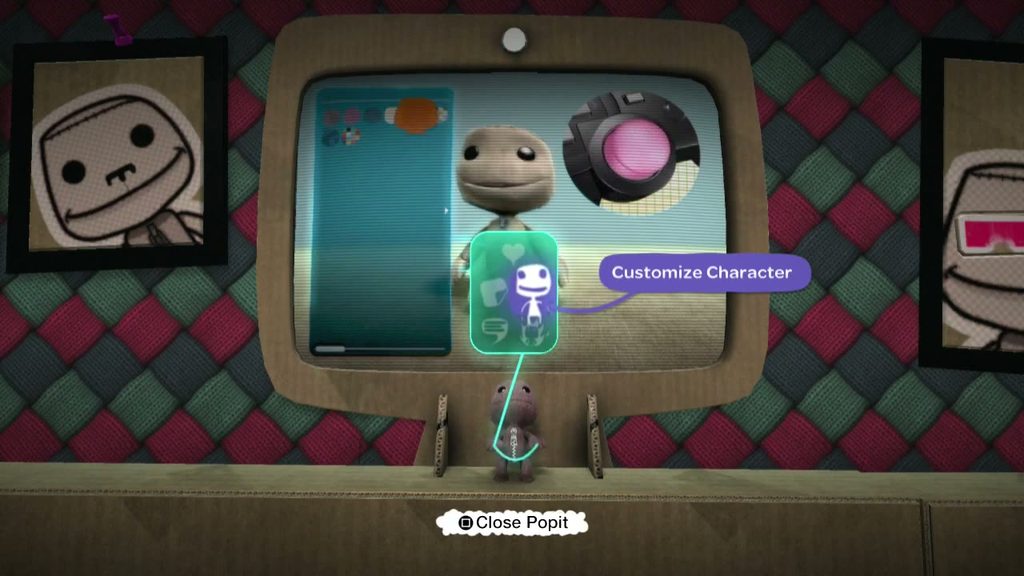
Create mode is the revolution and it is all still on the disc: a popit menu of materials, shapes, bolts, pistons, winches, sensors, switches, emitters, and a logic vocabulary that inventive players stretched into calculators, working computers, recreations of other games and genres nobody at Media Molecule had imagined. The thermometer that caps a level’s complexity became a design constraint players treated as a sport. Offline today, you can still build everything; what is gone is the publishing universe — the millions of community levels, the hearting and queueing and the level-of-the-day culture that made LittleBigPlanet a place rather than a product. That loss is real, and any modern review must record it: the story mode, the creation tools and local multiplayer survive intact and are excellent; the infinite library does not. What remains is a superb platformer and a complete creative studio. What is gone was, for a few years, the most hopeful place in games.

Presentation as personality
The art direction — real-world craft materials photographed into textures, everything at a slight handmade wobble — has aged better than almost any realistic game of 2008. The soundtrack is a licensed mixtape of global indie joy that somehow coheres, and the whole package radiates a warmth the PS3 library, heavy with grey shooters, badly needed. Performance is steady; loading between community levels was the era’s tax, and the disc version’s story levels load kindly. Sackboy went on to front sequels, a kart racer and a console launch; this first game remains the purest expression of the idea, before the tools got complicated and the novelty thinned.
Playing it in 2026
Set expectations correctly and LittleBigPlanet is still a delight: buy it for the story campaign (a good eight hours, doubled by prize-bubble hunting and ace runs), for couch co-op that grandparents and children can share, and for a creation suite that will absorb a certain kind of player for months. The floaty jump demands five minutes of adjustment; the rewards for adjusting are fifty levels of escalating invention and a toolbox with no modern equivalent on any console. Every game since that has let players build and share — and there are many, some enormous — is standing in this game’s craft box.

What the community built, remembered
Because the servers are gone, it is worth writing down what they held, for the record. At its peak the published universe passed seven million levels. There were working recreations of other famous games rebuilt block by block in felt and sponge; there were original platformers longer than the story mode; there were musical calculators, playable pianos, logic-gate computers built by teenagers who taught themselves engineering to do it; there were terrible, wonderful, five-second joke levels with forty thousand plays. Media Molecule’s curation — the team picks, the community spotlights, the gentle, teacherly tone of the whole place — kept it feeling like a school exhibition rather than an app store, and it was, for a generation of players now grown, their first experience of making something and having strangers love it. Some of those kids became developers; several have said so in interviews, by name, about this game. The disc cannot show you that universe any more. But it can still hand you the same tools, the same narrator, and the same invitation — and the story levels remain the finest tutorial ever disguised as fifty platforming stages. Preservation lost a city here. What survives on the disc is still the blueprint, and the blueprint is brilliant.
A last word on the jump
Every review since 2008 has filed the same caveat, so let it be filed here with the respect of accuracy: Sackboy’s jump is floaty, his momentum commits early, and players raised on precision platformers will die a few unfair-feeling deaths while their hands recalibrate. Media Molecule chose toy physics over tight physics on purpose, and the levels are designed for the choice. Give it the five minutes. The game on the other side of the adjustment is worth it.
The verdict
LittleBigPlanet is one of the PS3’s essential exclusives and one of the most influential games of its century — a platformer of rare charm wrapped around a creation platform years ahead of its time. The closure of its servers dimmed its infinity, but the disc’s authored content and tools remain a complete, generous, joyful package. Play it, then build something; that was always the point.
Score: 9.0/10 — Knitted, glued and utterly groundbreaking. The PS3’s most inventive exclusive.