At a glance: inFamous · PlayStation 3 · Sucker Punch / Sony Computer Entertainment, 2009 · Open-world action · Score: 8.5/10
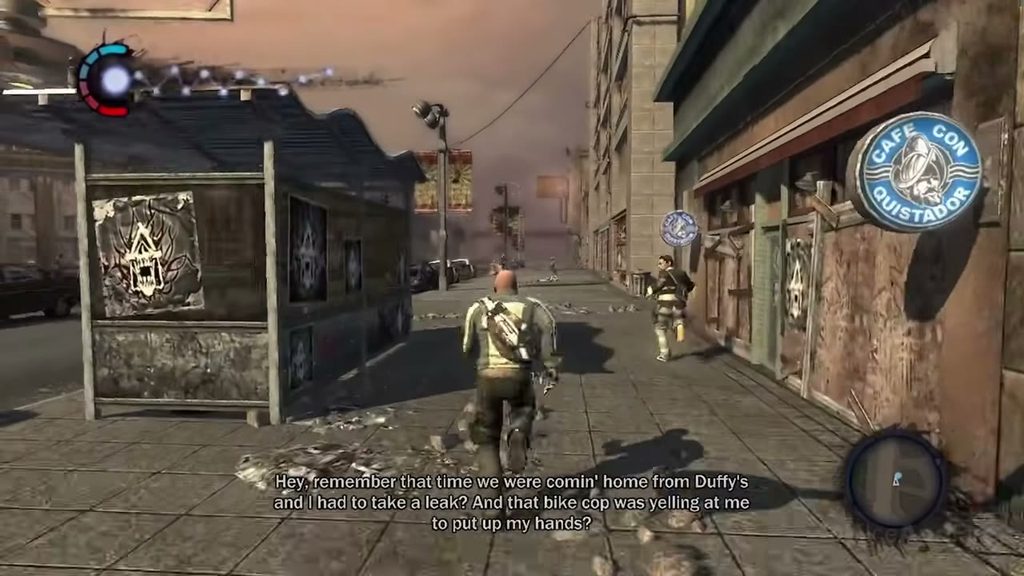
Before superheroes conquered every medium on Earth, inFamous did something brave with them: it made having powers feel like a burden you could aim. Sucker Punch — the Sly Cooper studio, of all people — delivered the PS3’s first great open-world exclusive in May 2009, a rain-slicked urban sandbox where a bike courier named Cole MacGrath wakes up at the centre of a crater, in a quarantined city, with lightning in his hands and every faction in Empire City wanting to use him or bury him. It is a grimier, scrappier game than its reputation as a system showcase suggests, and its scrappiness is its character.
Empire City, after the blast
The Ray Sphere explosion kills thousands, collapses the government, and leaves Empire City’s three districts to gangs with names like a fever dream — the Reapers, the Dust Men, the First Sons — while a plague does the slow work. Cole, guided by an FBI handler’s voice on the phone and shadowed by his best friend Zeke, a genius slacker whose jealousy is the story’s slow fuse, hunts the man who handed him the package that destroyed his life. The plot is told partly in gorgeous motion-comic panels that still look sharp, and it builds to a final revelation — about the villain Kessler and what he has been preparing Cole for — that retroactively deepens the entire game and remains one of the best twists of its generation. No spoilers here. It earns the word.
Lightning as a language
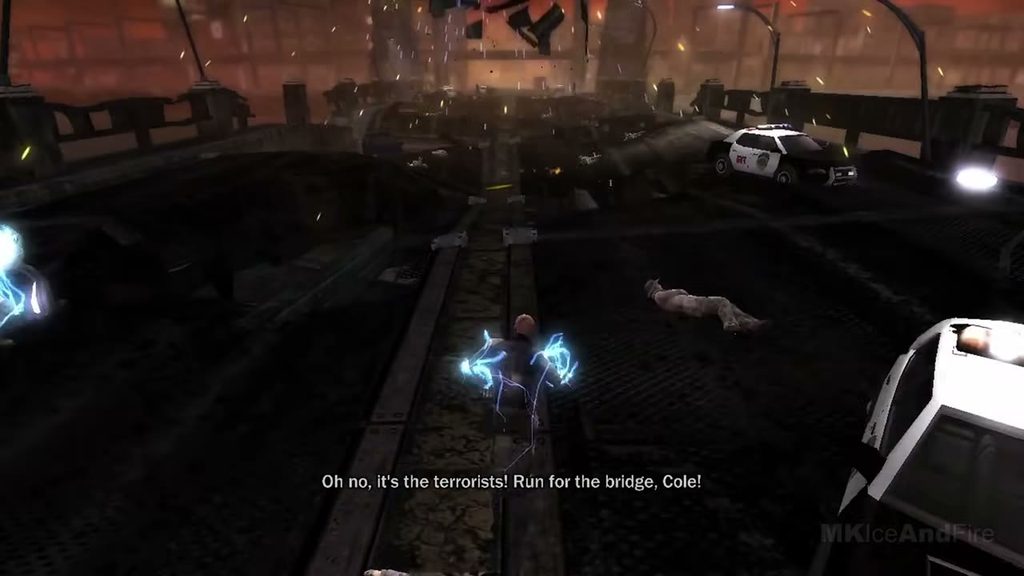
Cole’s powers grow the way a good moveset should: one tool at a time, each opening the whole city further. The basic bolt is a pistol; shock grenades, a rocket-like blast wave, a precision headshot mode, polarity shields and the screen-clearing Lightning Storm arrive across twenty hours, and several of the best are movement powers in disguise — induction grinding along rails and wires turns the rooftops into a rail network, and static thrusters give Cole a glide that makes crossing districts a pleasure rather than a commute. Combat is cover-based shooting translated into electricity, fought against enemies who climb, snipe and rush with genuinely nasty coordination on the higher difficulties. The city’s electrical grid is your health system: drain junctions to heal, fear the blackout districts where nothing hums, and feel the design click — Cole is a creature of the infrastructure, and the sandbox is wired around him.
inFamous understood something most superhero games still miss: powers are only interesting when the world is built to need them, fear them and run out of them.
The karma question
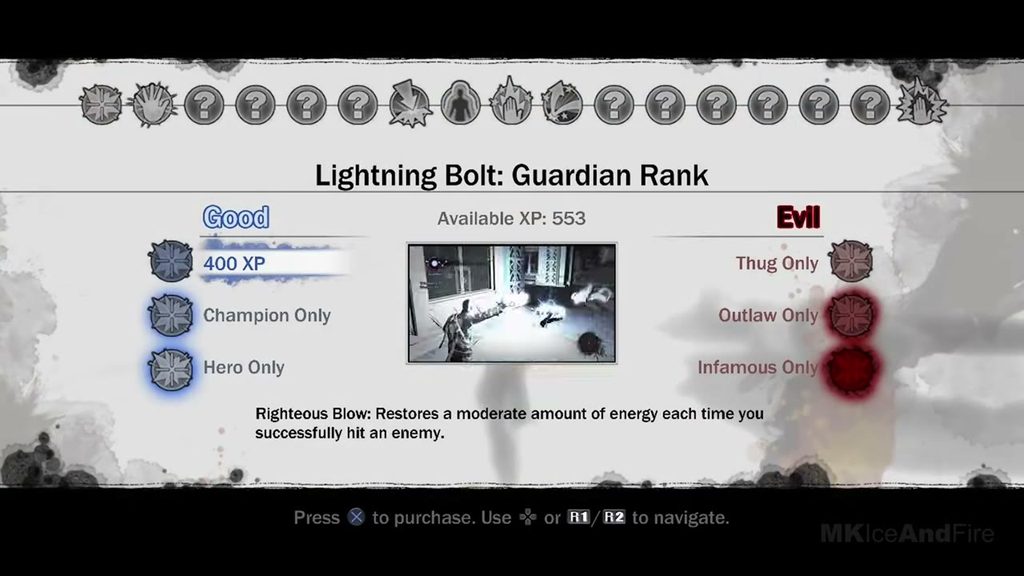
Empire City watches Cole, and the game’s famous karma system grades him for it. Heal civilians, restrain enemies and choose the city’s needs and Cole’s lightning turns clean blue, posters of him appear on walls, and citizens cheer and photograph him in the street. Drain the dying for health, execute the helpless and follow Zeke’s shortcuts, and the current turns a corrupted red-black, the crowd flees, and Cole’s skin itself starts to crack with it. The binary choices are sometimes blunt — a valve, two outcomes, a morality klaxon — and by modern standards the system is a dial rather than a philosophy. But its feedback into the world, into which powers unlock and how missions branch at the margins, made 2009 players genuinely argue about their Coles, and the evil path’s powers (arc lightning that chains through crowds) are temptingly better in a fight, which is exactly the point a morality system should make.
The sandbox and its seams
Side content is structured with a discipline later open-world games abandoned: clearing a district’s side missions — surveillance taps, rooftop races, convoy ambushes, hidden packages — permanently pushes the gangs out of that territory, so the map visibly becomes safer because of you. The 350 blast shards scattered on every ledge are the era’s definitive collectible hunt, and the Dead Drops, recordings by an undercover agent, build the conspiracy in audio. The seams show too: mission templates repeat, the climbing — automatic, magnetic, generally excellent — occasionally grabs the wrong ledge at the worst moment, and the frame rate sags in the Warren’s shantytown brawls. The sewer power-restoration missions, first-person-free platforming descents that unlock each district’s grid, divide players to this day; we file them under atmospheric and repetitive in equal measure.
Legacy on the wire
inFamous won its famous 2009 duel with its multiplatform rival by identity: a fully exclusive open world built for the PS3’s strengths, from Sucker Punch’s streaming rooftops to particle-heavy storms. It spawned a stronger sequel, a beloved standalone vampire expansion, and a PS4 chapter — but the original’s bleakness, its grounded plague-city tone before superhero fatigue existed, has a flavour the series never repeated. The motion comics, the twist, the grind rails: it all holds.

A word for Zeke, and for the ending
Retrospectives of inFamous tend to discuss Cole, the powers and the city, and skip its secret weapon: Zeke Dunbar. Elvis-obsessed, conspiracy-addled, building gadgets in a rooftop nest of televisions, Zeke is the rare comic sidekick written with a genuine wound — he is ordinary in a story about the extraordinary, and the game is honest enough to let that curdle. His arc gives the karma system its human face: the city grades Cole’s soul on a meter, but Zeke grades it in person, and his judgement stings more. It also sets up the finale’s celebrated twist, which recontextualises the villain’s entire campaign and lands harder because the game spent twenty hours making you care about the friendship it is quietly pricing. We will keep the spoiler embargo that has held since 2009 — suffice to say the last hour reframes the first, the sequel builds directly on the wound, and the ending’s reputation as one of the generation’s best is earned in full. Few open-world games of the era had a story worth finishing. This one has a story that finishes you.
The Festival of Blood footnote
Completionists should track down the game’s strange little coda: Festival of Blood, the standalone Halloween expansion that reimagines Empire City’s successor district under a vampire carnival, gives Cole a stake, a flight power and a campfire-tale frame story, and compresses everything likeable about the series into three exuberant hours. It began life as inFamous 2 DLC, but its spirit — a studio playing in its own sandbox after hours — was born in the first game’s design, and it remains the easiest way to fall for the series’ charms in an evening.
Two Coles
Replay value, finally, is built into the thesis: good Cole and evil Cole are not a palette swap but two power sets, two reputations and two versions of several missions, and the game is short enough — twenty hours done thoroughly — that seeing both is a realistic ambition rather than a New Game Plus fantasy. Play the hero first. The villain’s run lands harder with something to corrupt.
The verdict
inFamous is the PS3’s essential open-world debut: a superhero origin with a sting in it, a city wired intelligently around its hero’s powers, and a karma system that — for all its dial-turning simplicity — makes power feel consequential. Rough edges and repetition keep it from the library’s highest shelf, but no PS3 collection telling the story of the console is complete without it.
Score: 8.5/10 — The thinking player’s superhero game. Empire City still crackles.