At a glance: The Legend of Zelda: The Wind Waker · GameCube · Nintendo EAD, 2002 (Japan) / 2003 (North America and Europe) · Action-adventure · Score: 9.5/10
Every console generation gets one reveal that splits a fandom down the middle, and for the GameCube it happened before most people had even bought the machine. Nintendo had teased a realistic Link duelling Ganondorf in the Space World 2000 demo, and then, a year later, showed the world a cartoon: a wide-eyed, cel-shaded boy on a flooded ocean, drawn like a storybook and sailing like a Saturday-morning serial. The internet of 2001 did not take it well. The internet of 2001 was wrong. Played today on the original 2002 GameCube disc — and it is specifically that original this review covers, not the Wii U’s Wind Waker HD remaster — The Wind Waker is not just vindicated. It is arguably the most expressive, confident and quietly radical Zelda Nintendo has ever made.
A sea instead of a field
The Great Sea is the boldest structural idea in the series. Hyrule is gone, drowned beneath an endless ocean after the hero of legend failed to return, and what remains is an archipelago of small islands scattered across a grid of open water. Where Ocarina of Time gave you a field to cross, The Wind Waker gives you an ocean to sail — and sailing, genuinely, is the game. Aboard the King of Red Lions, a talking boat who is rather more than he first appears, you learn the wind itself as a mechanic: the Wind Waker baton conducts melodies that bend the breeze to your heading, fill your sail, and turn a simple journey between islands into a small ritual of weather, patience and discovery.
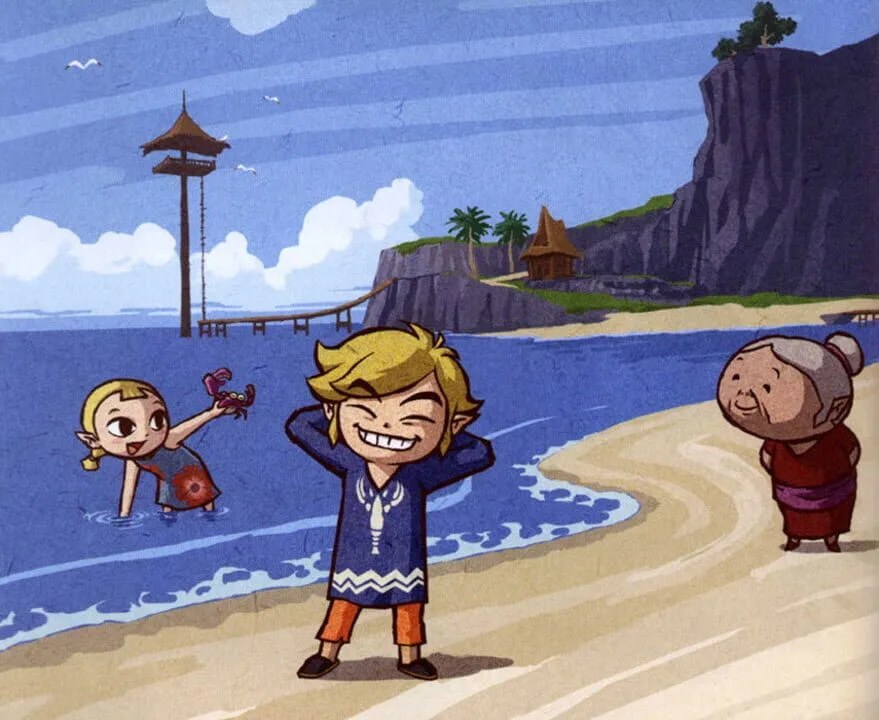
That openness comes with the game’s one honest flaw, and it is fair to name it: the sailing can be slow. Crossing several quadrants to reach a distant island takes minutes of real time, and in the GameCube original there is no Swift Sail to hurry things along — that quality-of-life addition arrived a decade later in the HD remaster. On original hardware you plan routes, you watch the sky change, you stop for rafts, lookout platforms, submarines and treasure charts along the way. Some players will find the pace meditative. Some will find it padding. Both are describing the same design, and the game is honest about which side it is on: the sea is not a loading screen between the content. The sea is the content.
The face that launched a thousand arguments
Nothing about the cel shading was a compromise, and two decades of imitators have not dulled it. The GameCube original renders Link with a squash-and-stretch expressiveness no Zelda before or since has matched: eyes that widen at a creaking door, narrow in suspicion, dart sideways in one of gaming’s great pieces of comic timing as he sidles along a wall or realises what a barrel is about to do to him. Enemies telegraph attacks in broad pantomime. Explosions bloom into stylised smoke rings. Because the style aims at illustration rather than realism, it has aged in a way its contemporaries simply have not — boot up the 2002 disc on a CRT or a good upscaler and it looks like a game that could release this year, which is more than almost any other 2002 title can claim.
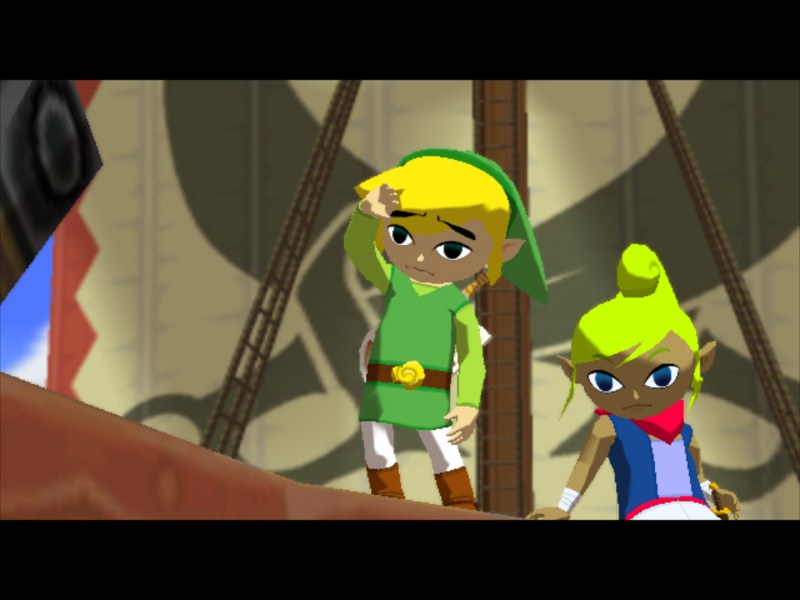
The cast sells it. Tetra, the pirate captain who rescues and relentlessly teases Link, is the sharpest-written companion the series had produced to that point. Medli and Makar, your dungeon partners, give the temples a cooperative warmth. And this game’s Ganondorf — measured, melancholic, motivated by a drowned kingdom and a wind that brought only death to his people — remains the most human portrayal of the villain in the entire series. The final act, played out in a sunken Hyrule held still beneath the waves, lands with a weight that a supposedly childish art style was never supposed to be able to carry. It carries it easily.
Dungeons, combat and the conductor’s baton
Structurally this is classic 3D Zelda: two early dungeons, a mid-game revelation, then a run of temples built around partner characters and new equipment. The set is smaller than Ocarina’s or Twilight Princess’s, and veterans will feel the missing dungeon or two — the late game leans on a Triforce chart hunt that asks you to gather charts, pay Tingle a small fortune in rupees to decipher them, and fish up the shards. On the GameCube original that quest is at its longest and most expensive, and it is the one section where the game’s pacing genuinely sags. It is also, in fairness, the section that sends you to every neglected corner of the map, and many players meet their favourite islands because of it.
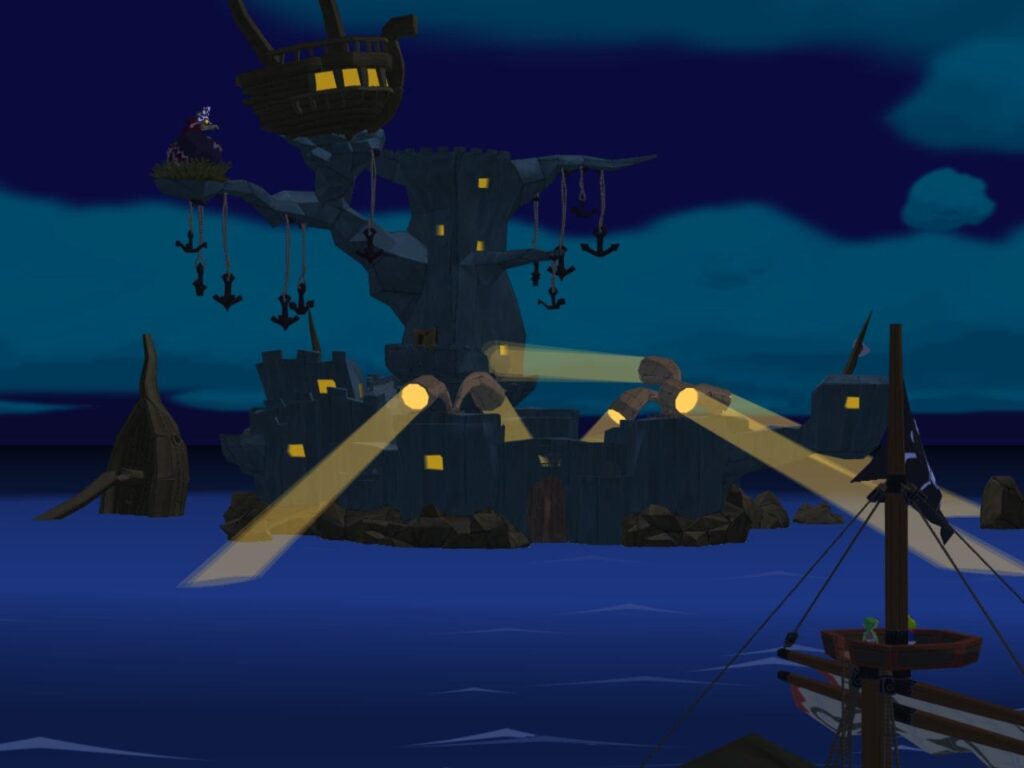
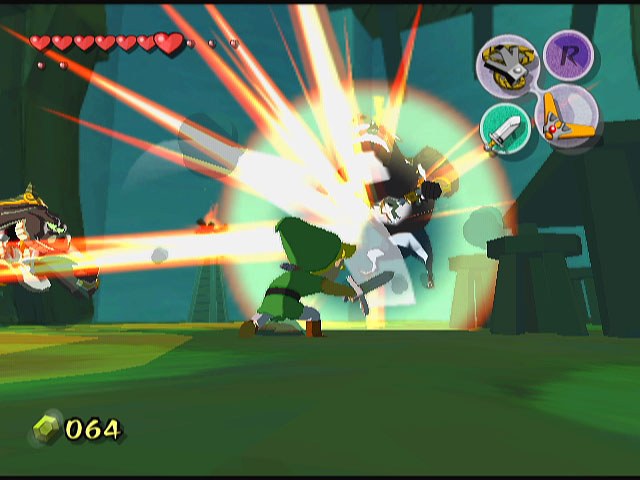
Combat, meanwhile, is the best the 3D series had managed. The counter-attack system — a musical sting, a flash on the A button, and Link rolls, leaps or somersaults around an enemy’s guard — turns every Moblin and Darknut into a small fencing match. You can disarm enemies and use their own weapons, snipe with the bow in first person, and clear Forsaken Fortress as a stealth exercise in barrels and searchlights before you ever earn a proper sword run at it. The items are a strong set: the Deku Leaf turns gliding into a wind-reading skill, the Grappling Hook doubles as a treasure-salvage tool, and the boomerang’s multi-target lock still feels modern.
Sound of the sea
The score deserves its own paragraph. Built on Irish and folk instrumentation — fiddles, flutes, mandolin-like plucks — it gives the Great Sea a travelling-music identity unlike any other Zelda soundtrack. The title theme, the Aryll’s theme variations, the Dragon Roost Island melody and the shanty energy of Windfall Island have all outlived the console. The GameCube’s audio hardware handles the dynamic layering beautifully: melodies swell as enemies approach and settle as the coast clears, and the baton-conducted songs are mixed as genuine performances rather than menu jingles.
Playing the original in 2026
A practical note for collectors: the GameCube original and the HD remaster are different experiences in ways that go beyond resolution. The original’s GameCube controller mapping, its Tingle Tuner connectivity through a Game Boy Advance — a second-screen experiment years ahead of its time, letting a second player drop hints and items — and its unhurried sailing give it a distinct rhythm the remaster deliberately tightened. Neither is the “wrong” version, but the 2002 disc is the historical artefact: the game as the doubters first booed and then, one island at a time, fell for. On a period CRT, with the wind mechanics unhurried and the cel shading at native resolution, it remains a completely coherent artistic statement.
The verdict
The Wind Waker’s flaws are real but specific: leisurely sailing with no fast option on original hardware, a Triforce hunt that outstays its welcome, and a dungeon count on the lean side. Everything else — the expression, the writing, the sea, the combat, the ending — is close to flawless, and the whole package has aged better than any Zelda of its era precisely because it refused to chase realism. If you own a GameCube, this is one of the two or three discs that justifies the shelf space on its own. Just make sure you are playing the real thing: the 2002 original, purple-console vintage, cel shading exactly as the doubters first saw it — and learned to love.
Score: 9.5/10 — A storybook masterpiece that turned the series’ biggest gamble into its most timeless adventure.