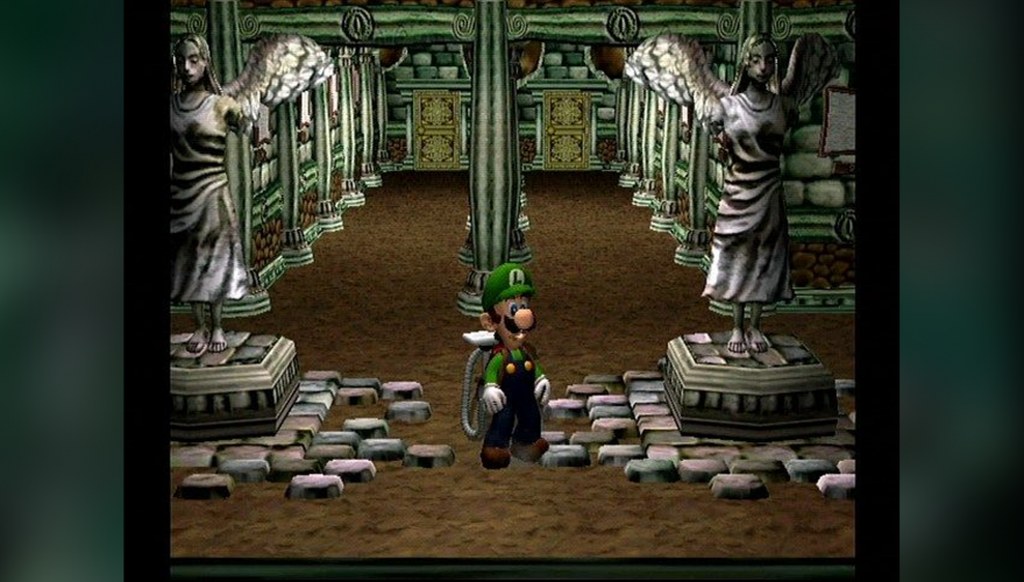
At a glance: Luigi’s Mansion · GameCube · Nintendo EAD, 2001 · Action-adventure · Score: 8.0/10
The GameCube launched without a Mario platformer — a sentence that still reads like a misprint — and in its place Nintendo offered something stranger and, in its way, braver: a haunted house, a terrified younger brother, and a vacuum cleaner. Luigi’s Mansion was the console’s flagship launch title in 2001, a showcase for everything the new hardware and its odd two-stick controller could do, wrapped in a ghost story small enough to finish in an evening. It was criticised at launch for exactly that brevity. Judged today, that focus is its charm: this is Nintendo’s most concentrated piece of atmosphere, a diorama of a game in which every room is a puzzle box, every ghost has a name and a personality, and Luigi’s frightened humming — he hums the theme, nervously, in the dark, and so would you — is one of the great character performances in the medium.
The Poltergust 3000
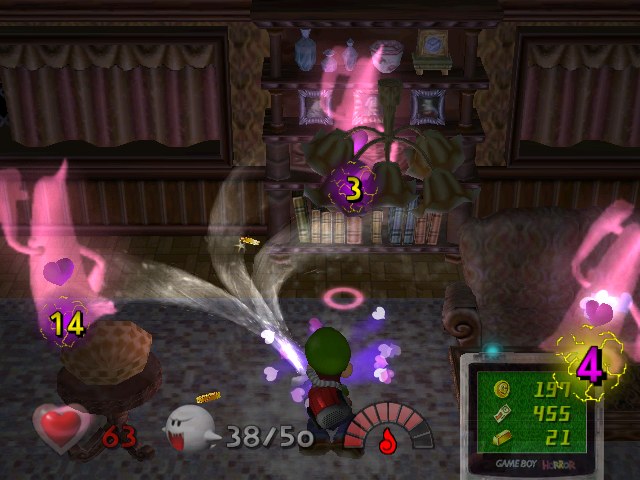
The core mechanic is ghost fishing. Armed with Professor E. Gadd’s Poltergust 3000, Luigi explores a mansion he “won” in a contest he never entered, searching for Mario, who is missing somewhere inside King Boo’s illusion. The two-stick system — left stick for Luigi, right C-stick for the direction of torch and vacuum — was the GameCube controller’s reason to exist, and it turns capturing into a physical tug-of-war: flash a ghost’s heart with your torch, engage the vacuum, then pull against its escape like landing a fish while it drags furniture, and your health, across the room. Portrait ghosts, the mansion’s former residents, each require an observed weakness first: the vain bodybuilder, the drowned pianist whose music you must hear, the twins who want to play hide and seek. These little observational puzzles, solved by reading each room like a detective, are the game’s soul — closer to a point-and-click adventure wearing an action game’s clothes than to anything Mario had done before.
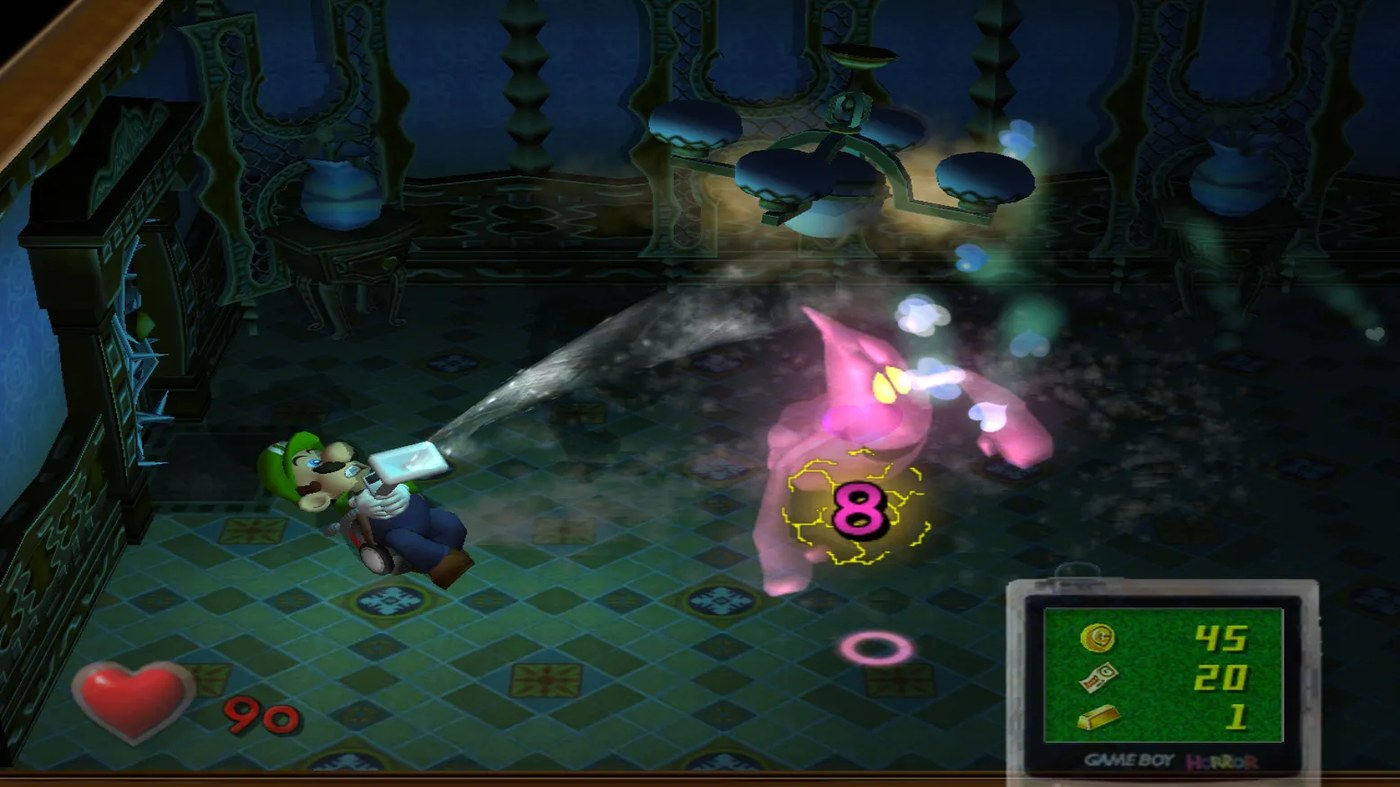
Elemental medals extend the toolkit — fire, water and ice ghosts absorbed into the vacuum let you light candles, water plants and freeze hazards — and money, gloriously, is everywhere: in drawers, chandeliers, shaking suits of armour, rendered as showers of coins, bills and gold bars that the GameCube clearly delighted in throwing around. Your final rank depends on the fortune you amass, which converts curiosity into score and makes every unopened drawer in a cleared room itch.
A dollhouse of dread
The mansion itself is the technical showpiece. Four floors unlocked in Areas, each room a self-contained scene with its own lighting character: a ballroom with spinning dancers, a conservatory, a billiard room, a flooded cellar, a rooftop under a full moon. The GameCube’s lighting and particle work — torch beams cutting dust, curtains breathing, the vacuum’s effect on every loose object — made this the launch title you showed visitors, and it holds up remarkably because its scale is domestic: small rooms, lovingly dressed, viewed from a fixed dollhouse intimacy rather than a sprawling world that dates its ambitions. The sound design matches it: a sparse, plucked score, Luigi’s whimpers and calls for his brother (press the button. You will press the button, calling “Mario?” into the dark), and E. Gadd’s gibberish babble through the Game Boy Horror, the game’s in-world gadget and a lovely period joke.
The honest charge sheet
The criticisms from 2001 remain accurate, and a fair review repeats them. The main adventure is short — most players will see the credits in six to eight hours, less on a replay — and its structure is rigidly linear: one Area at a time, doors unlocked in order, Boos hunted as a quota between floors. The Boo hunt itself, a game of hot-and-cold with a radar and fifty hidden ghosts, can tip from charming to tedious when the last few hide in rooms you have vacuumed twice. The inverted C-stick aiming divided players then and will now; there is no option to change it, and the final boss is a difficulty spike that has frustrated a generation of younger players the game otherwise suits perfectly. A Hidden Mansion mode, remixed and harder, plus the ranking system, extend the disc’s life, but this is a miniature by design, and players wanting a twenty-hour adventure should look elsewhere on the same shelf.
Character, at last
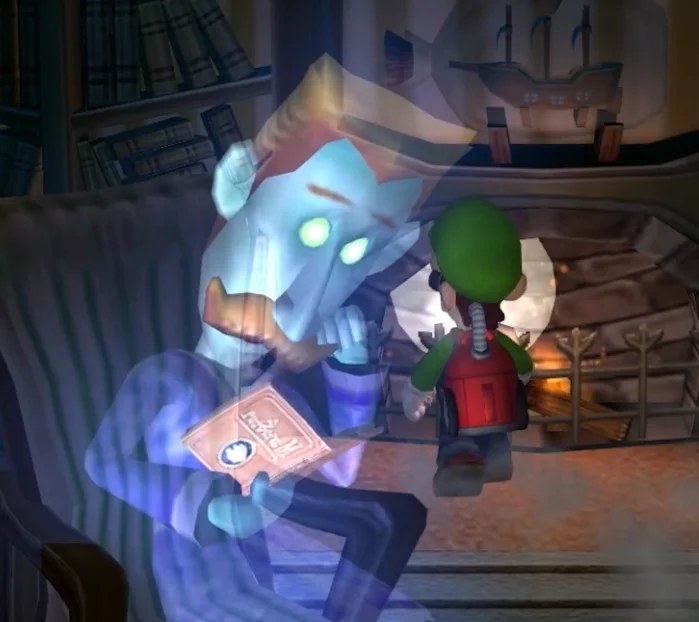
The deepest thing Luigi’s Mansion did was permanent: it gave Luigi a self. Before 2001 he was Mario in green, defined by a palette swap and a higher jump. After it, he had a personality the whole medium recognises — frightened, kind, reluctant, brave in the specific way that means doing the frightening thing anyway — and Nintendo has built on that foundation ever since, through two sequels that expanded the formula and a generation of players for whom Luigi, not his brother, is the relatable Mario character. The performance is carried by small things: his trembling idle animations, the way he calls for Mario with rising desperation, his little victory hums. Charles Martinet’s voice work here is some of the finest in his long tenure, precisely because it is so unheroic.
The mansion rewards the methodical, too. Its four Areas are graded, its treasure is ranked, and its gallery of portrait ghosts — framed, literally, in E. Gadd’s collection, with gold, silver and bronze frames awarded by how cleanly you land each capture — turns mastery into art collection. A perfect run, all gold frames and a fortune amassed, is a genuine challenge hiding inside the “easy” launch game, and the harder Hidden Mansion awaiting on the other side of the credits (in the PAL version, substantially reworked) doubles the dare. Brief the game may be; thin it is not.
The verdict
Time has been kind to Luigi’s Mansion precisely because its ambitions were never about size. It launched a console by proving Nintendo could do mood, character and tactile mechanics as well as it did worlds, it gave Luigi a personality that two sequels and a generation of memes have built an empire on, and it remains the coziest horror game ever made — scary the way a fairground ghost train is scary, which is to say perfectly. Short, yes. Slight, never.
Availability notes for the modern hunter: the GameCube original was joined years later by a Nintendo 3DS remake with reworked visuals and a co-operative option, which is a fine way to play it — but the GameCube version remains the atmospheric reference, its lighting moodier, its screen bigger, its controller the one the Poltergust was designed around. If a launch title’s job is to make a new console feel like a place, Luigi’s Mansion made the GameCube feel like a haunted house you never wanted to leave. It still does, every October especially, when it has quietly become a seasonal ritual for half the people who own it.
And if the brevity still worries you, consider the company it keeps: some of the most replayed games ever made are evenings, not months. Luigi’s Mansion is the GameCube’s perfect evening — beginning, middle and end in one sitting, with a frightened hero, a humming theme, and a mansion that feels bigger in the memory than any map could make it.
Score: 8.0/10 — A miniature masterpiece of atmosphere and character: brief, linear, and utterly unforgettable once Luigi starts humming.