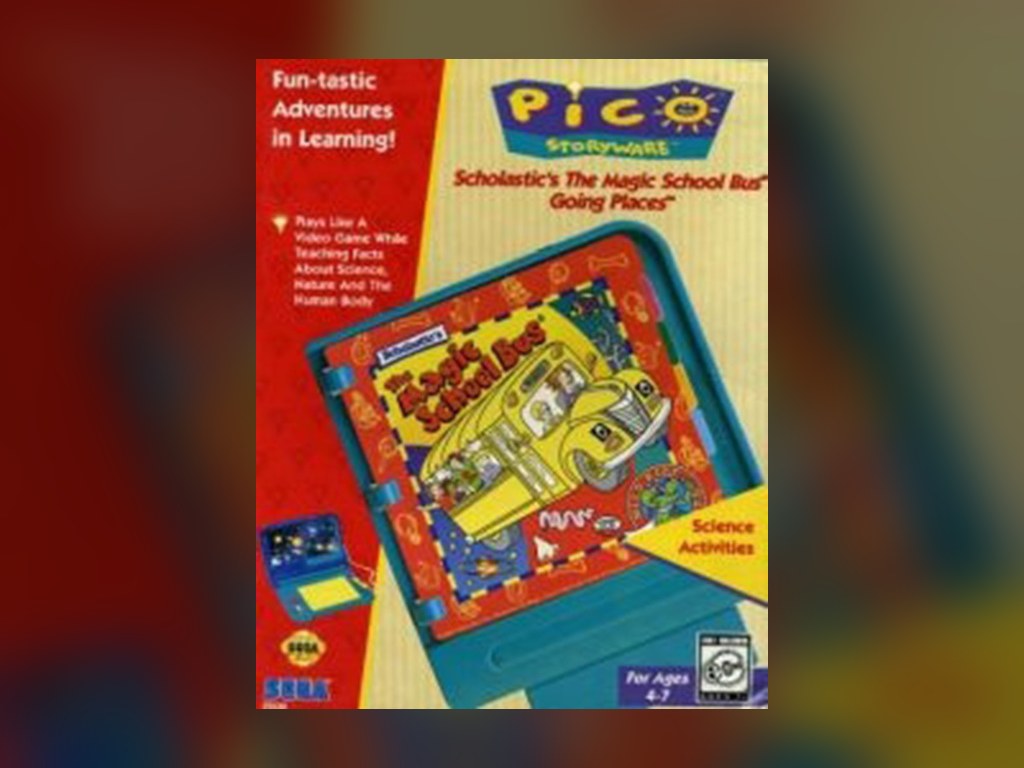
At a glance: Scholastic’s The Magic School Bus: Going Places · Sega Pico · Novotrade / Sega, 1995 · Science edutainment · Score: 8.0/10
Seatbelts, everyone. The Magic School Bus was the nineties’ best science brand for children precisely because it treated field trips as adventures and questions as fuel, and Going Places — Novotrade’s Pico adaptation for Scholastic, released in North America in February 1995 — is built the same way. The Bus changes shape, the class piles in, and every page turn is a new environment to explore and interrogate. It skews older than most Pico books, five-to-eight rather than three-to-six, and it shows in the best way: more vocabulary, more genuine why-questions, and activities that ask children to observe and predict rather than merely match and count. For a school-age child in 1995, this was the Pico book that felt least like a toy.

The book, page by page
A Pico Storyware is a picture book first and a cartridge second, and Scholastic’s The Magic School Bus: Going Places uses that shape well. The cast — Ms. Frizzle, her class and the shape-changing Magic School Bus itself — carries the child through field trips to varied environments, observation and matching tasks, science-flavoured mini-games and story pages between trips. Turning a physical page changes the scene on the television, changes the music, and changes the job to be done, and that rhythm still feels clever: the book tells the hands when to move on, and the screen rewards the turning. Sessions settle into a comfortable loop of story page, activity page, praise, next page, which a child of 5 to 8 can follow without an adult reading instructions aloud — the voices do that work, page after page.
Pen work
Everything is driven by the Magic Pen on the touch pad and on the book’s own final page, with the console’s chunky buttons in support. The pen suits this material: pointing at answers, tapping objects in busy scenes and drawing where the book invites it are natural actions for small hands, and the targets are big, forgiving and clearly spoken. There is a real skill being practised underneath the play — hand-eye coordination between pad and screen, careful pointing, listening to a whole instruction before acting — and the book paces it kindly, never timing a 5-year-old into panic. Adults should expect to set the console up, then be usefully unemployed for most of a session.

What it teaches, honestly
The stated curriculum is science curiosity, places and environments, observation, vocabulary and simple experiments in idea form, and the honest verdict is that it is really taught, not merely advertised: the Pico book for the top of the age range: real vocabulary, observation and prediction, and a healthy attitude to wrong answers. That is the standard this site judges Pico software by — not whether it resembles a Mega Drive game, but whether a child leaves a session having practised something real, willingly, at the right level for 5 to 8. On that standard this book earns its place. Its limits are equally clear: introductory science throughout — environments to notice rather than systems to understand — so fact-hungry children will want more than it gives. Neither the strength nor the limit is a surprise, and parents in the 1995 knew what they were buying — which is part of why the Pico sold in the millions.
Take chances, make mistakes, get messy — on a console whose software feared wrong answers, the Frizzle philosophy was the curriculum.
The Frizzle philosophy — take chances, make mistakes, get messy — survives the adaptation, and it matters. Educational software of the era was usually terrified of wrong answers; this book treats them as stops on the trip, which is both better pedagogy and better television. The science itself is introductory by necessity: environments, creatures, weather and machines presented as things to notice and name rather than systems to master. Depth hunters will call it shallow, and they are half right; but the product being sold here is not facts, it is the habit of asking. Judged as the Pico’s bridge title — the book a child could grow into as the Pooh and Berenstain books grew small — Going Places is one of the American library’s most valuable cartridges.

Presentation and place in the library
Built on the Pico’s Mega Drive-derived hardware, the book mixes large, clear cartoon art with constant sampled speech — the system’s party trick, and the reason pre-readers could use it alone. Music is cheerful and short-looped in the way of all Pico software; adults in the room will hear those loops in their sleep, which was as true in 1995 as it is for collectors now. As a USA release it also tells you something about its market: this is the science edutainment end of a library that treated very young children as a real audience with real design, years before the app-store era rediscovered them.
A session, start to finish
Picture the intended scene, because Pico software was designed for a room, not a desk. The console sits open on a table or a lap tray, the book locked into its slot, the television a few feet away. Power on, cover page, a burst of music and speech, and Ms. Frizzle, her class is already talking to the child before a single instruction has been read by anyone. The first pages teach the session’s grammar — turn, look, tap, listen — and by the third spread a child of 5 to 8 is running the book alone: turning pages at their own pace, repeating a favourite activity four times because the book allows it, skipping nothing because the story will not let the pages be skipped in spirit. A full run through the book suits the format’s natural session length, roughly fifteen to twenty-five minutes, and the closing creative or free-play pages act as a cool-down rather than a cliff-hanger. There is no save file because a picture book does not need one; tomorrow’s session starts at the cover, and for this audience repetition is not a compromise but the entire method, the same page teaching the same lesson a little deeper each time it is turned.
The adult in the room: replay, siblings and patience
Every Pico book is also, unavoidably, entertainment for an audience of one supervising adult, and Scholastic’s The Magic School Bus: Going Places handles that audience better than most. The speech is constant but characterful rather than robotic, the music loops are short — you will know them by heart within one session, for better and for worse — and the activities are pitched so that an older sibling can be promoted to helper rather than excluded as too old, reading the story pages aloud and demonstrating the pen while the younger child takes the turns. That sibling ladder matters in real houses, and Pico books that built it in, as this one does through its clear story-activity rhythm, stayed in use for years instead of months. For collectors playing today, the same qualities make it a kind book to demonstrate the system with: five minutes shows a visitor everything — the page turns, the voices, the pen, the praise — and why a machine like this sold in the millions to families who had never bought a console before.
Verdict
Judged on its own edutainment terms — target age 5 to 8, pen in hand, book open on the lap — Scholastic’s The Magic School Bus: Going Places scores 8.0/10. It is recommended for collectors building a representative Pico shelf and, more importantly, it would still do its original job today for a child of the right age with a working console and a patient television. That double life, teaching tool and time capsule, is the Pico’s whole appeal, and this book carries both halves well.