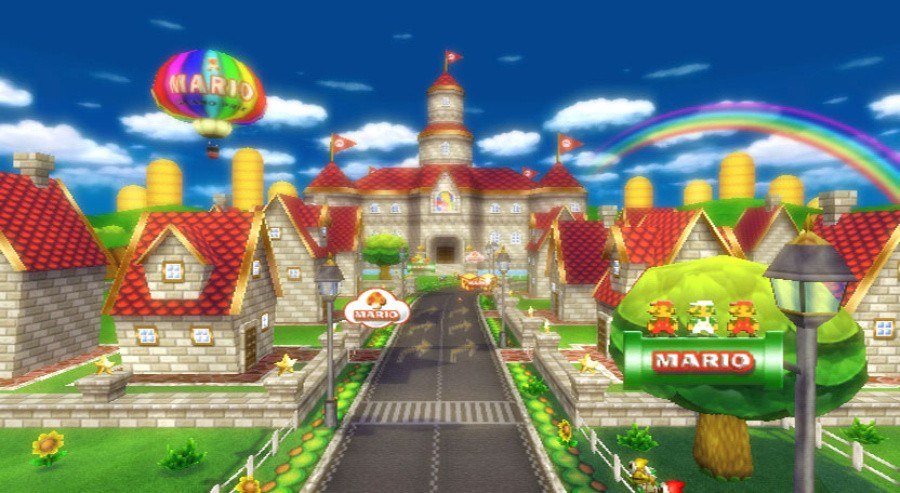
Mario Kart Wii, released in 2008, is the entry that turned a beloved party series into a mass-market phenomenon — the one bundled with a plastic wheel in millions of living rooms, the one your non-gaming relatives could play, and, underneath that friendly surface, one of the deepest and most chaotic racers Nintendo has ever made. It is also, remarkably, still alive: when Nintendo switched off the Wii’s online servers in 2014, the community built its own — our Wiimmfi feature covers that story — and races run on it to this day. A game people refuse to let die deserves a proper review.
At a glance: Mario Kart Wii · Nintendo EAD · Wii · 2008 · Kart racer · Players: 1–4 local, online (official servers closed 2014; community servers available)
Twelve racers, double the trouble
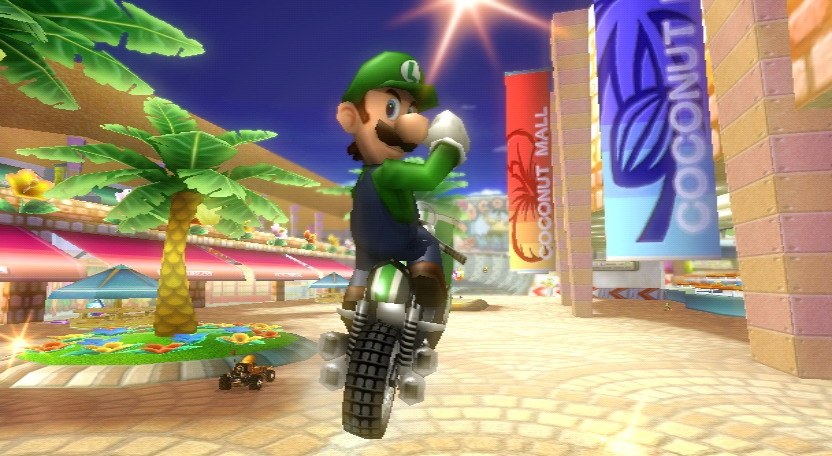
The headline change is scale: fields expand from eight racers to twelve, and everything about Mario Kart Wii flows from that decision. Twelve racers means more items in play, more comebacks, more carnage in the midfield — and a rubber-banding item system tuned to keep the pack savagely close. Purists grumbled then and grumble now that the item storm — blue shells, POW Blocks that spin out everyone ahead of you, lightning, mega mushrooms — can mug a skilled leader in the final lap. They are not wrong. But Mario Kart Wii’s chaos is its identity: this is the most volatile, least predictable entry in the series, a game where first and twelfth are separated by seconds and by luck, and where a race is never, ever over. As a party game it is close to perfect. As a pure test of skill, it asks you to make peace with the storm — and rewards you with technique that genuinely matters: tight drift lines, wheelie management on straights, and low tricks off every ramp to squeeze out boost.
Bikes are the other big addition, and they split the game in two. Karts drift wide with the classic hop-and-slide; bikes lean into inward drifts, carve tighter lines and pop wheelies for straight-line speed. Mastering a bike is the fastest way around Mario Kart Wii, and the Time Trials scene — which thrived for years on the game’s staff-ghost and leaderboard system — is largely a bike scene. Thirty-two tracks split evenly between new courses and retro picks from every previous Mario Kart, and the new sixteen are a strong set: Coconut Mall’s escalator chaos, Waluigi Stadium reimagined, Maple Treeway’s autumn canopy, a superb Rainbow Road, and Grumble Volcano, which sinks into the lava as the race goes on. The retro half is equally generous and, in hindsight, set the template every later entry followed.

The wheel, the remote, and every other way to steer
Mario Kart Wii may be the most control-flexible game Nintendo has ever shipped. It supports the Wii Remote in the bundled Wii Wheel shell, the remote on its side, remote-and-Nunchuk, the Classic Controller and the GameCube pad — and the wheel, for all the snobbery it attracted, is genuinely good: motion steering with a big, forgiving wheel made the game instantly legible to complete beginners, which is precisely why it conquered the living room. Beneath that accessibility sits a grading system of licences and star ranks that quietly demands excellence across all four engine classes, a Battle mode rebuilt around team play and respawns that divided fans of the old free-for-all, and an unlockable roster — including your Mii — that kept households racing for months.

Online: ahead of its time, kept alive by its fans
In 2008, Nintendo online was a punchline — and Mario Kart Wii was the exception. Twelve-player worldwide races, regional matchmaking, downloadable competitions, ghost downloads and channel-based rankings made it the Wii’s flagship online game by a distance, with an ease of use the rest of the platform never matched. Its official closure in 2014 should have been the end; instead, fan servers kept the lights on, and the game’s competitive community — time trials, clan wars, custom track distributions — became one of the great preservation stories in gaming. That afterlife is covered in depth elsewhere on this site; for this review it is enough to say that a 2008 Wii game’s online mode being worth your time in 2026 is an achievement few games in history can claim.
Depth where you least expect it
It is easy to mistake Mario Kart Wii’s accessibility for shallowness, and the game’s long competitive life exists to correct that mistake. Start with the drift system: Mario Kart Wii rewards the player who understands the difference between a kart’s wide, hop-initiated slide and a bike’s inward lean, who knows which vehicles hide the sharpest stats behind joke exteriors, and who treats every straight as a negotiation — a bike’s wheelie buys real speed but surrenders steering, so the fastest players in the world are constantly deciding, corner by corner, when to lift the front wheel and when to keep it planted. Add trick boosts off every lip and ramp, item defence — holding shells and bananas as shields is a genuine skill — and a shortcut culture that ranges from legitimate line-cutting to the famous Grumble Volcano glitch laps that time-triallers turned into an art form, and you have a game whose ceiling competitive players were still raising years after release.
The single-player campaign structure deserves its due as well. Four cups of new tracks, four of retro picks, four engine classes, mirror mode beyond them, and a star-ranking system draped over every cup that grades your driving rather than merely your finishing position — the road to a three-star licence plate is long, structured and quietly addictive in a way that gave solo players a reason to stay long after the party moved on. Expert staff ghosts in Time Trials set honest benchmarks on every course, and beating them unlocks a roster depth — characters, karts and bikes — that keeps the garage interesting for months. Mario Kart Wii is remembered, rightly, as the people’s Mario Kart. It was also, less famously, one of the most complete packages the series has ever shipped.
The honest caveats
The item balance will infuriate you some evenings — that is structural, not incidental. Battle mode’s team-only format was a downgrade for many. The visuals, even by Wii standards, play it safe, and 150cc’s AI has a vindictive streak that goes beyond theatre into genuine cheapness now and then. And the wheel, beloved as it is, is simply not the fastest way to play, which matters once the household arms race begins.
Verdict
Mario Kart Wii is the series at its most populist and its most chaotic — a game of twelve-car pile-ups, comeback lightning and living-room legend, wrapped around driving technique deep enough to sustain a competitive scene for nearly two decades. It is not the purest Mario Kart. It might be the most fun per square foot of sofa ever committed to a disc.
If you are picking up a copy today, look for the later pressings bundled with the Wii Wheel if you want the full living-room experience, and know that every Wii model runs the disc identically. The community servers mean the cartridge-era ritual — gather friends, race all evening — now extends online again, which is more than most games from 2008 can say.
Score: 8.5/10