
Twilight Princess was a promise kept under pressure. After The Wind Waker’s bright cartoon seas split the Zelda audience, Nintendo answered with the game the faithful had demanded since that famous Space World demo: a vast, sombre, adult Hyrule, a Link with dirt under his fingernails, and a world big enough to ride across. It launched alongside the Wii itself in 2006, carrying an entire console on its shoulders — and, famously, carrying a mirrored twin of itself, because the Wii version flips the whole world left-to-right so that the mostly right-handed player base could swing a sword with the Wii Remote and have Link swing his.
At a glance: The Legend of Zelda: Twilight Princess · Nintendo EAD · Wii (also GameCube) · 2006 · Action-adventure · Players: 1
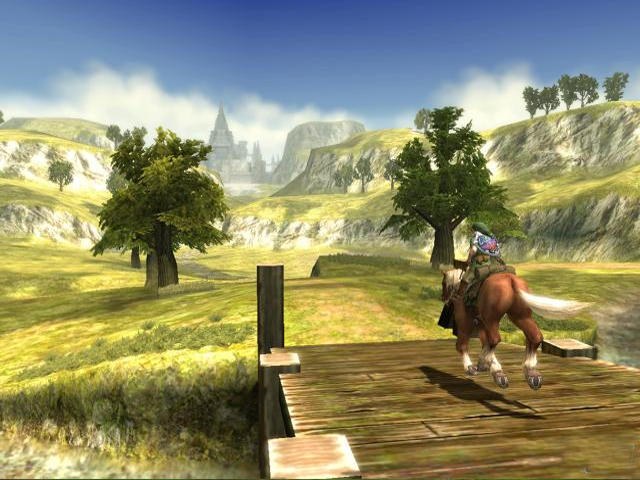
Two worlds, one wolf
The structure twists the classic formula early. When the Twilight Realm — a dusk-lit shadow world — swallows Hyrule piece by piece, Link is dragged into it and transformed into a wolf. As Wolf Link you sniff out scents, dig, leap to rooftops and hunt the Tears of Light that push the twilight back, all under the guidance of Midna, the impish, sarcastic companion who rides on your back and quickly becomes the emotional centre of the whole game. Midna is the best thing in Twilight Princess: funny, cruel, secretive and, by the end, genuinely moving — a companion whose story arc carries more weight than the princess-rescue plot wrapped around her.
The alternation between human and wolf gives the adventure its rhythm. Dungeons are solved as Link, with the series’ finest-ever toolbox: the clawshot (then a second one, for double-clawshot acrobatics across ceilings), the spinner that grinds along rails, the ball and chain, magnetic Iron Boots that let you walk up walls and across ceilings. Twilight Princess’s dungeon design is, room for room, some of the best the series has ever produced — sprawling, mechanical, puzzle-dense cathedrals that reward you for thinking in three dimensions. Arbiter’s Grounds and the City in the Sky are still name-checked in best-dungeon arguments for a reason.
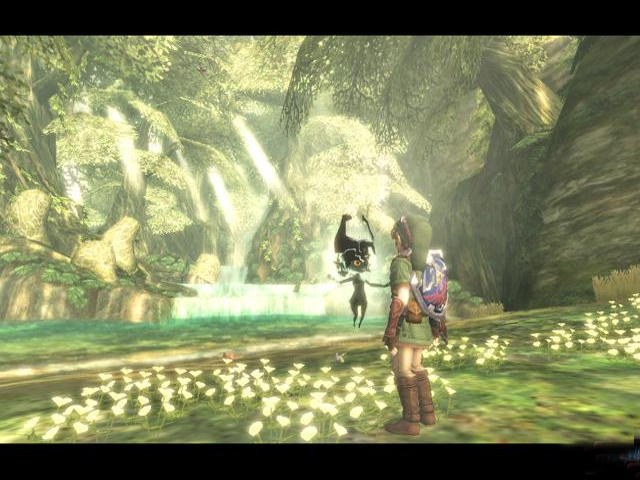
The Wii version, honestly assessed
This review covers the Wii original, and its Wii-ness deserves an honest paragraph. Aiming the bow, clawshot and fishing rod with the pointer is superb — quicker and more precise than an analogue stick, and it still feels good today. Swordplay is the compromise everyone remembers: a shake of the remote triggers a swing rather than tracking your arm, which works fine but never delivers the one-to-one fencing the launch-era imagination had promised. Hidden skills taught by a skeletal mentor add genuine depth to combat, but most enemies can still be shaken to death. The mirrored world, meanwhile, is pure trivia until you compare maps with a GameCube player and discover your east is their west.
Visually, this was a GameCube game wearing a launch-title sash, and it shows in its textures — but its art direction, all autumn golds and twilight murk, has aged with dignity, and Hyrule Field at sunset on horseback remains an image players carry for decades. The horseback combat, including a superb mounted duel on a bridge, pointed directly at the series’ future. What has aged worst is the pacing: a long, hand-held opening in Ordon Village, and a middle stretch where the formula — twilight hunt, dungeon, repeat — becomes predictable before the back third opens up with the game’s best ideas.

The dungeons are the argument
It is worth dwelling on those dungeons, because they are the reason Twilight Princess still wins arguments two decades on. Consider the variety of the thinking on show. The Goron Mines walk you across ceilings in magnetic boots, upside-down, while lava glows beneath your head. Snowpeak Ruins is not a temple at all but a crumbling yeti mansion, where the dungeon item is a wrecking ball and the soup your host’s wife is cooking becomes a running, genuinely touching side-story. The Temple of Time lets you command a statue to mirror your movements across its halls. And the City in the Sky — all wind, double clawshots and a dragon duel at the top of the world — is the kind of set-piece most series manage once a decade. Each dungeon teaches its item, tests it, twists it and then stages a boss fight that uses it in anger, and almost none of that craft depends on nostalgia. Put a first-time player in front of Arbiter’s Grounds today, with its spinner-rail chases and its undead swordsman, and the design speaks entirely for itself.
Hyrule as a place, not a checklist
The world between the dungeons holds up its end too, in a way that feels almost old-fashioned now. Hyrule Field is big and, by modern open-world standards, gloriously empty — no towers, no question marks, no chores — just grassland, bridges, hidden grottos, poe souls to hunt at night and the road to the next place that matters. Side pursuits are pursuits, not content quotas: bug collecting for Agitha’s ball, a fishing hole run with real care, heart pieces hidden by observation rather than by map markers, a multi-stage trading of favours across Castle Town. Even the much-mocked Tears of Light hunts serve a purpose in the rhythm, forcing you to learn each province as a wolf — by scent, rooftop and burrow — before you ever ride through it as its hero. Twilight Princess trusts scale and familiarity to do the work that later games would outsource to systems, and returning to it in 2026, that trust feels less like a limitation than a philosophy. This is an adventure built like a novel: chapters, not tasks.
A big game with a big heart under the gloom
For all its reputation as the “dark” Zelda, Twilight Princess is at its best in its warmth: the children of Ordon, the postman sprinting across Hyrule with total commitment, a fishing hole you can lose an evening to, and Midna herself. Its villains split opinion — Zant’s late-game unraveling is either a brilliant rug-pull or a waste of a menacing build-up, and the final antagonist arrangement owes a debt to tradition that not every player wanted repaid. But moment to moment, this is a generous, craftsmanlike epic, routinely offering forty-plus hours of adventure without padding its map with chores.
Verdict
Twilight Princess on Wii is a magnificent traditional Zelda: the series’ best dungeons, its best companion, and a Hyrule built to be ridden across at dusk. Its motion swordplay is a period compromise and its opening hours dawdle, but as the Wii’s launch epic — and as the definitive “big Hyrule” answer to Wind Waker — it earned its place. Play the Wii version for the pointer aiming and the historical quirk of the mirror; stay for Midna.
A practical note for Wii owners choosing a copy today: the Wii disc is the common, inexpensive one, it runs happily on every Wii model, and its pointer controls make it the version many returning players now prefer despite the mirror quirk. The GameCube original is a collector’s piece with the world un-flipped and conventional controls; the Wii U HD remaster is a third, separate release with its own changes. This review judges the Wii original on its own terms — and on those terms, as the console’s launch epic, it more than stands.
Score: 9.0/10