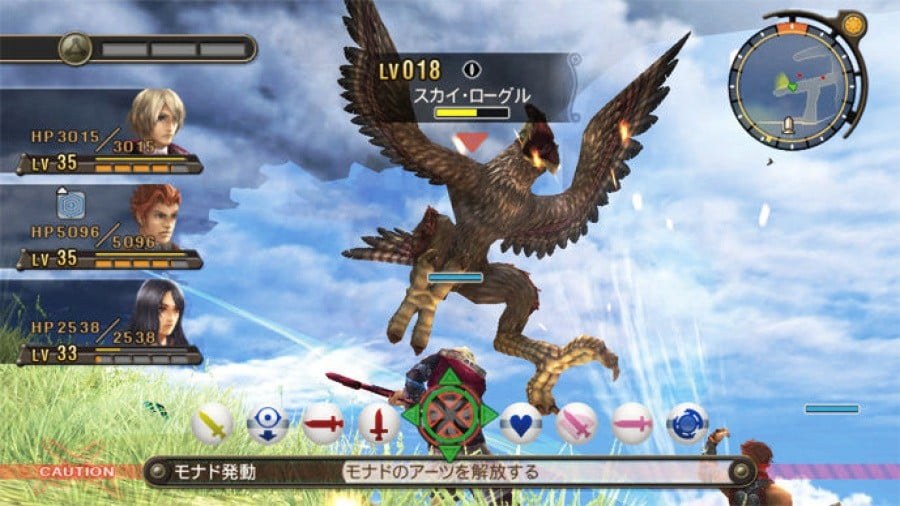
Xenoblade Chronicles should not have existed — not on this hardware, and not in the West at all. Developed by Monolith Soft and released in Japan in 2010, it reached Europe in 2011 and North America in 2012 only after one of the most famous fan campaigns in gaming history, Operation Rainfall, petitioned Nintendo to localise it. What players were fighting for turned out to be worth the fight: a Japanese role-playing game of staggering scale and ambition, running — somehow — on the little Wii, telling its story across the bodies of two dead gods and quietly rewriting the rules of its genre as it went.
At a glance: Xenoblade Chronicles · Monolith Soft · Wii · Japan 2010 / Europe 2011 / North America 2012 · JRPG · Players: 1
A world built on two gods
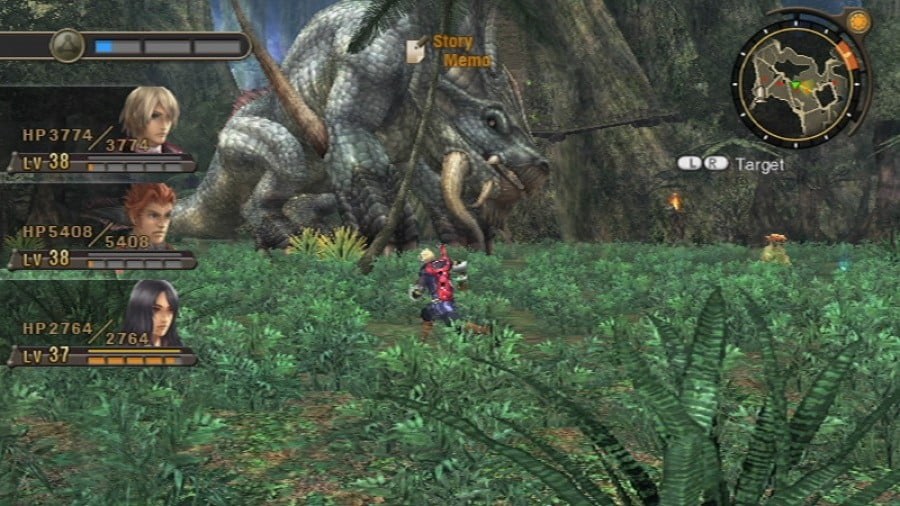
Long ago, the titans Bionis and Mechonis fought to a standstill and died locked in combat; life grew on their corpses. Your home, Colony 9, sits on the Bionis’s lower leg. That is not a metaphor the game trades in idly — Xenoblade’s entire world is anatomy. You will cross the Bionis’s knee, climb its back, traverse an ocean at its waist and eventually stand on its shoulder looking down at the leg you started on, with everything you have explored visible below. No loading-screen trickery hides the joinery: the draw distance on Wii hardware borders on the unreasonable, and stepping out of Colony 9 to see the land simply continue — up, across and away — remains one of the great first-hour moments in any RPG. When the Mechon, the machine life of the other titan, attack the colony and tragedy strikes, young researcher Shulk takes up the Monado, a sword that grants visions of the future, and the revenge quest that follows grows, layer by layer, into something far larger.
Combat that shows you the future
Xenoblade’s battle system borrows MMO grammar — auto-attacking, cooldown-based Arts, aggro and positioning — and makes it sing in single-player. Position matters constantly: Shulk deals bonus damage from behind and the side, so every fight is a small dance. Party composition matters: a tank to hold aggro, a healer or a damage-dealer changes the texture of every encounter. And the Monado’s visions are a stroke of genius — when an enemy is about to land a devastating attack, the game literally shows you the future, freezing the moment and giving you time to warn a companion, shield the target or disrupt the attack. It turns the JRPG’s oldest frustration, the cheap boss one-shot, into a dramatic mechanic. Later refinements in the series all descend from ideas born here, on hardware that had no business hosting them.
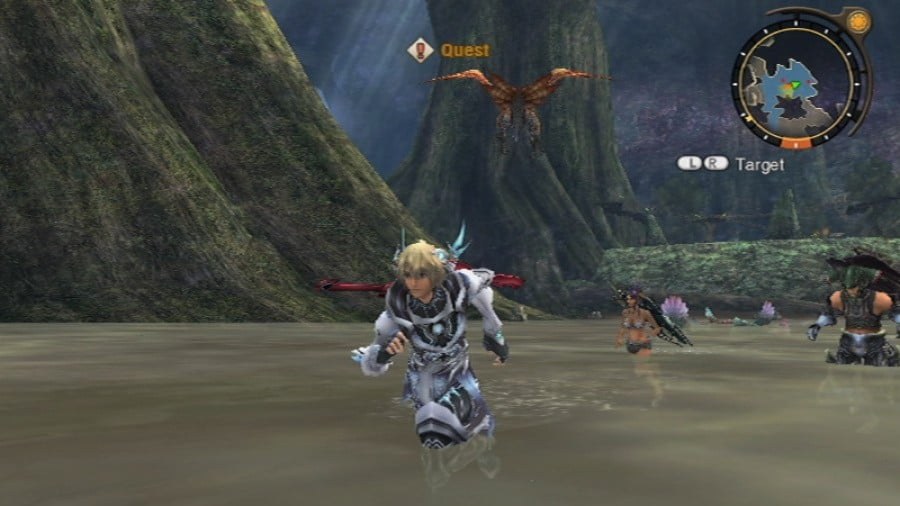
What truly set the game apart in 2011, though, was its respect for the player’s time — ideas the genre at large took years to adopt. Experience arrives from discovering landmarks and completing quests without returning to a quest-giver; the clock can be set to any hour; fast travel is generous; fallen in battle, you respawn at the last landmark with no lost progress. Its affinity systems reward you for caring about its world: hundreds of named townsfolk with schedules and relationships, a collectopaedia, gem crafting, colony reconstruction. The side content can overwhelm — the quest count is enormous and many are simple — but the game never forces it on you. It is a world built to be inhabited at your pace, and its British-voiced cast (a localisation decision that gave the game a flavour all its own) grounds its cosmic stakes in dry, likeable, very un JRPG-standard performances.

A cast worth sixty hours
None of that scale would matter if the people inside it were ciphers, and Xenoblade’s party is its secret weapon. Shulk could have been a blank chosen one; instead he is a gentle weapons researcher whose visions make him a burden-bearer, growing more haunted as the sword shows him more. Around him the game builds the JRPG’s most likeable ensemble of its era: Reyn, the best friend whose loyalty is a mechanic as much as a trait; Sharla, a medic carrying a colony’s grief; Dunban, the previous Monado wielder, fighting one-armed with total elegance; and late arrivals we will not spoil, who stretch the party’s — and the story’s — understanding of who counts as a person. The Heart-to-Heart conversations scattered across the world, optional dialogues gated by the affinity the party builds in battle, give the cast room to be funny, petty and kind in ways the main plot has no time for. It is character work of a standard the genre’s bigger-budget entries routinely fail to reach.
The soundtrack of two gods
And then there is the music, which players who have finished the game will already be hearing. A team of composers led by Manami Kiyota and including Yoko Shimomura and Yasunori Mitsuda produced a score that does the work of a second narrator: Gaur Plain’s theme turns a first walk across the Bionis’s leg into a rite of passage, the night arrangements strip the same lands down to piano and melancholy, and the battle themes escalate without ever becoming wallpaper. JRPG soundtracks are a competitive field, but Xenoblade’s belongs in the first rank — and on Wii hardware, through a television’s speakers, it was one more way this game refused to accept the limits it was handed. Taken together — the world, the systems, the cast, the score — Xenoblade Chronicles is not merely a great game that happened to be on the Wii. It is the game that proved the Wii’s library had a masterpiece in a genre the console was never supposed to host, and it launched a series Nintendo now treats as a crown jewel. The Wii original is where that started, disc, waggle-free Classic Controller support and all.
The honest caveats
The Wii’s limits do show. Character models and facial animation are a generation behind the environments, the resolution softens the spectacle, and the frame rate can strain in the busiest battles. The quest design, for all the systems wrapped around it, leans heavily on fetching and slaying quotas. And this is a very long game — sixty hours at a brisk pace, far more for completionists — with a difficulty spike or two that will send you back to the side content whether you planned to visit it or not. The later Definitive Edition on Switch is, in most technical respects, the smoother way to play this story today; that is worth saying plainly. What the Wii original keeps is its context: this was the version that should not have existed, the one a fan campaign dragged across two oceans.
Verdict
Xenoblade Chronicles is the Wii’s great epic and one of the finest JRPGs ever made — a game of impossible vistas, humane systems and genuine heart, built on hardware that mocked its ambitions and released in the West because players demanded it. The Wii shelf has bigger brands, but it has no greater adventure. If you play one RPG on the system, it is this one.
For Wii collectors, one practical note: the North American release was a retailer exclusive at launch, which is why that version has become the pricey one; the European disc is identical in content for PAL Wii owners. Either way, the original release remains a landmark worth owning in the format that started the story.
Score: 9.0/10