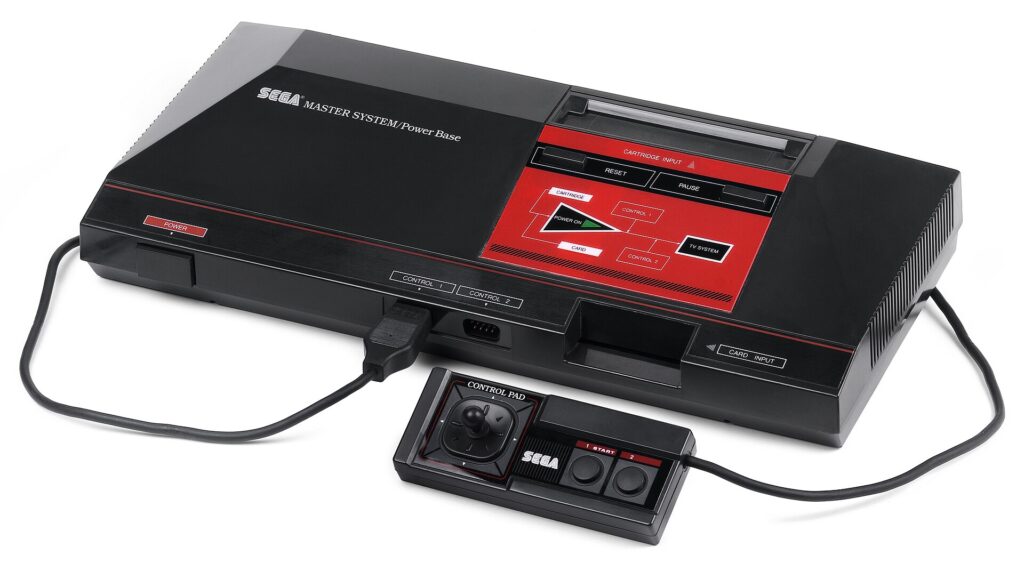
Walk into an electronics shop in São Paulo today and you can buy a brand-new Master System. Not a vintage unit, not a retro-styled tribute — a current product, on a shelf, made by the same Brazilian company that has been building them since 1989.
That sentence makes no sense in the United States, where Sega’s 8-bit console is remembered as the machine that lost: the also-ran buried under Nintendo’s avalanche. It makes perfect sense in Brazil, where the Master System never went away. And in Britain, where it outsold the NES through the whole 8-bit era, it reads like a dispatch from a different planet.
One console, three histories. This is the whole story, from beginning to — well, there is no end yet. How Sega built the most capable 8-bit machine of its generation, lost with it in two countries, won with it in two others, and accidentally created the longest-lived games console in history.
Born in the Famicom’s Shadow
Sega came to home consoles from strength. By the early 1980s it was one of the great names in arcades, but the living room was new territory, and its first machine, the SG-1000, was launched in Japan on July 15, 1983 — the very same day Nintendo launched the Famicom. Posterity treats that as a walkover. It wasn’t, at first: the SG-1000 sold 160,000 units in its first year, roughly triple what Sega had expected, and for a while a recalled, faulty Famicom chip left Sega’s machine as the safer buy.
It didn’t last. Nintendo’s software machine started to turn, and Sega’s follow-up, the SG-1000 II of July 1984, was a holding action. So Sega did what Sega did best in those years: it went back to the engineering bench and overbuilt. The designers Hideki Sato and Masami Ishikawa — names that would matter again when the Mega Drive came — drew up a successor around a custom video chip that grew out of Sega’s own arcade graphics work. It could hold more colors on screen at once, draw bigger sprites, and scroll more smoothly than the Famicom it was chasing.

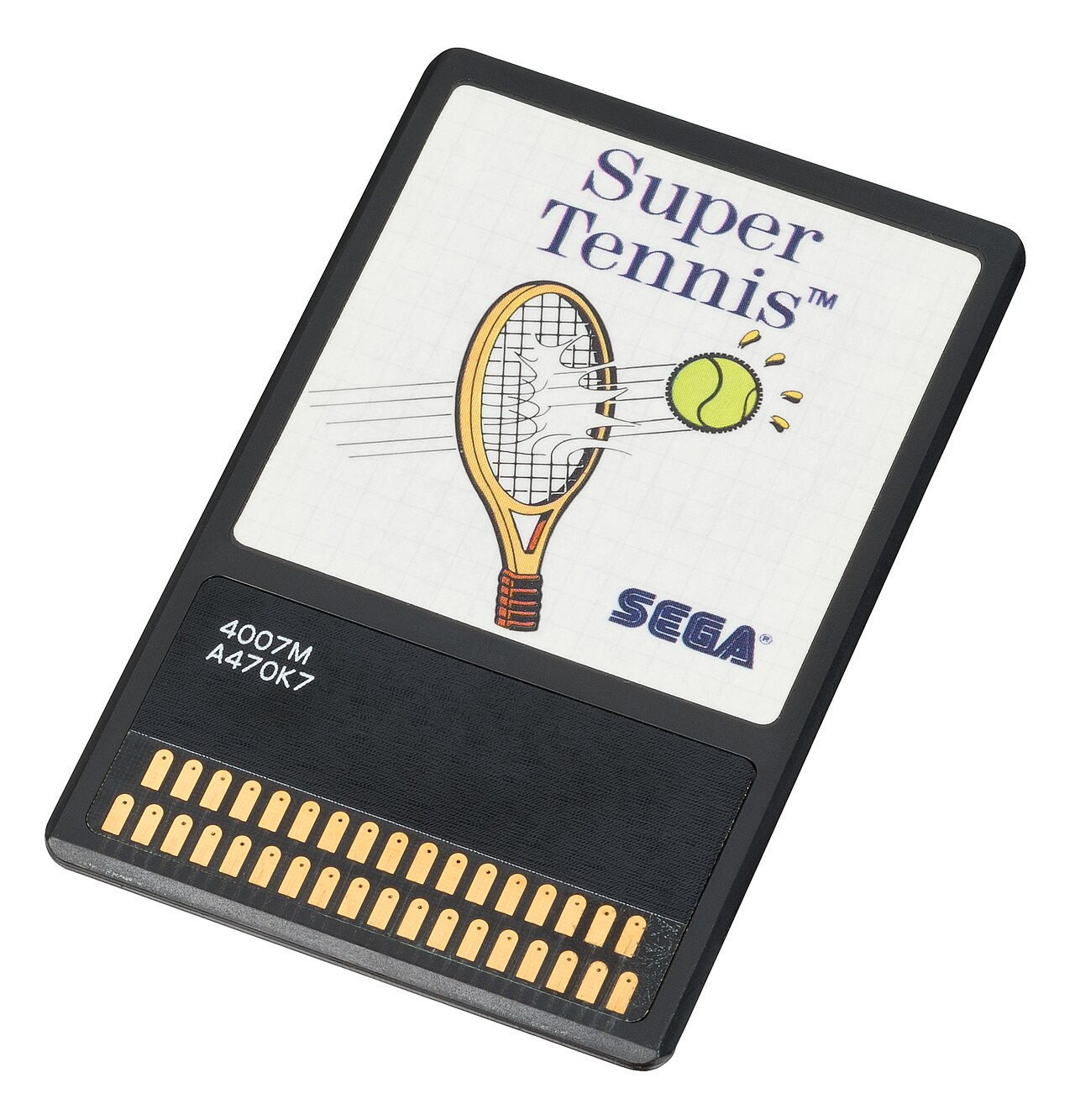
The result arrived on October 20, 1985: the Sega Mark III, ¥15,000, backward-compatible with the SG-1000 library and hungry for the Famicom’s crown. Its games came on cartridges and on My Card — credit-card-sized Sega Cards that were cheap to manufacture and cheap to buy, Sega’s bet that price could undercut Nintendo’s cartridges.
On paper, this was the strongest 8-bit hardware yet sold for the home. Paper, as Sega was about to learn on three continents, was never the problem.
Japan: Stronger Hardware, Locked Doors
The Mark III’s Japanese problem had nothing to do with the Mark III. Nintendo’s licensing regime bound Japan’s third-party publishers to the Famicom, and the publishers followed the installed base, which followed the publishers. Sega filled the gap largely from its own arcade catalogue — good games, faithfully converted, and nowhere near enough of them. A console cannot live on Hang-On alone, however good the conversion is.
Sega tried once more at home. In October 1987, Japan received the Master System itself — the export model brought back home, with one jewel the export model never got: a Yamaha FM sound chip built in, where Western machines made do with plain square-wave tones. The Japanese Master System is the best-sounding version of the hardware ever sold, and it was sold only in Japan. It changed nothing.
Japan’s final Master System game was the shooter Bomber Raid, in February 1989, and the home tally settled at roughly a million units. The lesson Sega carried into the 16-bit generation was the correct one, learned the expensive way: hardware power is not a library. Back in America, though, the same lesson was being taught in a much bigger classroom.
America: Beaten Before It Started
For the West, Sega redesigned the Mark III into something that looked like it meant business: a black wedge with red accents, a cartridge slot and a card slot under a smoked lid, and control pads with a tiny screw-in thumbstick nub. The Master System launched in the United States in September 1986 at $200, with the motorcycle racer Hang-On and the light-gun game Safari Hunt sharing one cartridge and the Light Phaser gun in the box. It was a generous package, and it was a year too late.
That first Christmas told the whole American story: about 125,000 Master Systems sold, against 1.1 million NES consoles. Nintendo had the head start, the retail relationships, and — through its licensing terms and its grip on shelf space — most of the third-party games. Sega’s machine was better hardware with a thinner catalogue, sold against an opponent who had arranged for the catalogue to stay thin.
None of which makes it a bad machine to remember. It had the SegaScope 3-D glasses, genuine shutter-glasses 3D across eight games, years before that trick came back. And it had the best secret of the 8-bit era: switch it on with no cartridge inserted, hold Up and buttons 1 and 2, and a complete hidden game — the Snail Maze — appears, written into the machine’s own BIOS. Every Master System kid knew. Nintendo kids got nothing of the sort.

In 1988, Sega handed American distribution to Tonka — a toy company. The arrangement is not remembered kindly. Under Tonka the console drifted: marketing thinned, retailers drifted away, and by the end of the decade Nintendo held about 80 percent of the US market, Atari most of what Nintendo left, and Sega a slice of the remainder. Sega took the rights back in 1990 and made one honest last attempt with the Master System II — a minimalist, cost-cut redesign with the card slot deleted and Alex Kidd in Miracle World built into the machine itself, ready to play out of the box.
It sold respectably as a budget console. It did not matter. North America’s final Master System release arrived in November 1991, and it deserved better company: Sonic the Hedgehog, not a cut-down port of the Genesis game but an original adventure built for the 8-bit hardware by the studio Ancient, with a soundtrack by Yuzo Koshiro. The Master System went out in America on one of its finest games. Production ended in early 1992 with the US total at somewhere between 1.5 and 2 million units — and with millions of Genesis owners still playing the old cartridges through the Power Base Converter, the machine’s American afterlife as an accessory outlasted its life as a console.
Europe: The Fight Nintendo Didn’t Show Up For
Now cross the Atlantic, and the story inverts. The Master System reached Europe in 1987 at £99 in Britain, distributed by Mastertronic — soon folded into Virgin Mastertronic — a company that understood budget-conscious British retail down to the ground. Crucially, Nintendo’s European operation was years behind its American one: distribution was patchy, prices were high, and the NES arrived in many European markets late and half-heartedly.
For once in the 8-bit era, the fight was fair. And in a fair fight, the Master System won it. It became the best-selling games console in Britain and outsold the NES there across the whole 8-bit period; France passed a million units; by the end of 1993 an estimated 6.8 million Master Systems were in European homes — a bigger European base, at that moment, than the mighty Mega Drive’s.

The library proves the point better than any sales figure. More than 300 Master System games were released in Europe, against barely a hundred in North America. European publishers kept the faith long after America had moved on — specialists like Codemasters were still shipping Master System games in the mid-1990s — and a whole shelf of the console’s best software, licensed gems and late originals alike, never crossed the ocean at all. If you grew up with a Master System in Leeds or Lyon, you did not own the console that lost. You owned the winner, and you were right.
Brazil: The Console That Never Died
And then there is Brazil, where the Master System’s story stops being a footnote to Nintendo’s and becomes something with no parallel in the industry.
TecToy was founded in 1987 to make high-tech toys, and its first Sega business was, fittingly, a toy: a light gun tied to the anime Zillion, one of Sega’s own properties. The relationship deepened fast. In September 1989, TecToy launched the Master System in Brazil officially — and launched it like a moonshot, with a $2 million marketing campaign built around a TV tips show, Master Tips, a fan club, and a telephone hotline where stuck players could call for help.
The conditions were unlike anywhere else on earth. Brazil’s import regime made foreign electronics punishingly expensive and effectively required local manufacture; TecToy built its consoles in the Manaus free-trade zone. And Nintendo, the giant that had crushed Sega in America and Japan, simply was not there — it would not arrive officially until 1993. TecToy did not have to beat Nintendo in Brazil. It had four uncontested years with an entire generation, and it used every one of them.
At its peak, TecToy held around 80 percent of the Brazilian market, with some 280,000 consoles already in homes by the end of 1990. This was no dump-and-run import operation, either: TecToy localized. Phantasy Star was translated into Portuguese — a landmark moment for Brazilian players. Wonder Boy in Monster Land was reskinned around Mônica, the heroine of Turma da Mônica, the most beloved comic in the country. Brazil got games of its own. And in 1997, when the rest of the world was playing 32-bit, TecToy ported Street Fighter II to the Master System — the only official 8-bit version ever made. The story goes that to win Capcom’s license, TecToy’s Stefano Arnhold demonstrated the game with the console hidden and Mega Drive pads in the rep’s hands, letting him judge it a poor Mega Drive game — before revealing the 8-bit machine that had actually been running it.
Arnhold himself tells the companion story on camera below: how TecToy pulled off another conversion nobody believed possible — Duke Nukem 3D, running on the Genesis.
The totals stopped making sense long ago: 8 million Master Systems sold in Brazil by 2016, in a country that kept buying them through the PlayStation era and beyond. TecToy still sells the machine today — the current Master System Evolution is a plug-and-play console with 132 games built in, on sale in 2026 for around R$220. Writers keep reaching for the same description, the longest-lived console in history, because four decades after the Mark III there still isn’t a better one. In Brazil, the 8-bit war never ended. The Master System just won it very, very slowly.
The Games: An 8-Bit Canon
For a console remembered as short of software, the Master System’s best shelf is remarkably deep. Start with the masterpiece. Phantasy Star arrived in Japan on December 20, 1987 — two days after the first Final Fantasy — and it was the bigger swing: a 4-megabit cartridge with battery-backed saving, first-person 3D dungeons in an era of flat maps, and a heroine, Alis Landale, carrying a console RPG outright. It was created by Chieko Aoki, designed by Rieko Kodama, directed by Kotaro Hayashida, and programmed by a young Yuji Naka. If the Master System had produced nothing else, Phantasy Star alone would justify the hardware.
Sega’s own mascot of the era was Alex Kidd, whose Miracle World (1986) mixed platforming with rock-paper-scissors boss battles and was later built into the Master System II itself — for thousands of European and Brazilian kids, it was simply the game the console came with. Connoisseurs put Wonder Boy III: The Dragon’s Trap (1989) at the top of the pile: one interconnected world, a hero cursed into five animal forms, and design so far ahead of its time that it reads like a modern indie metroidvania wearing 8-bit clothes. It still tops best-of lists for the system.
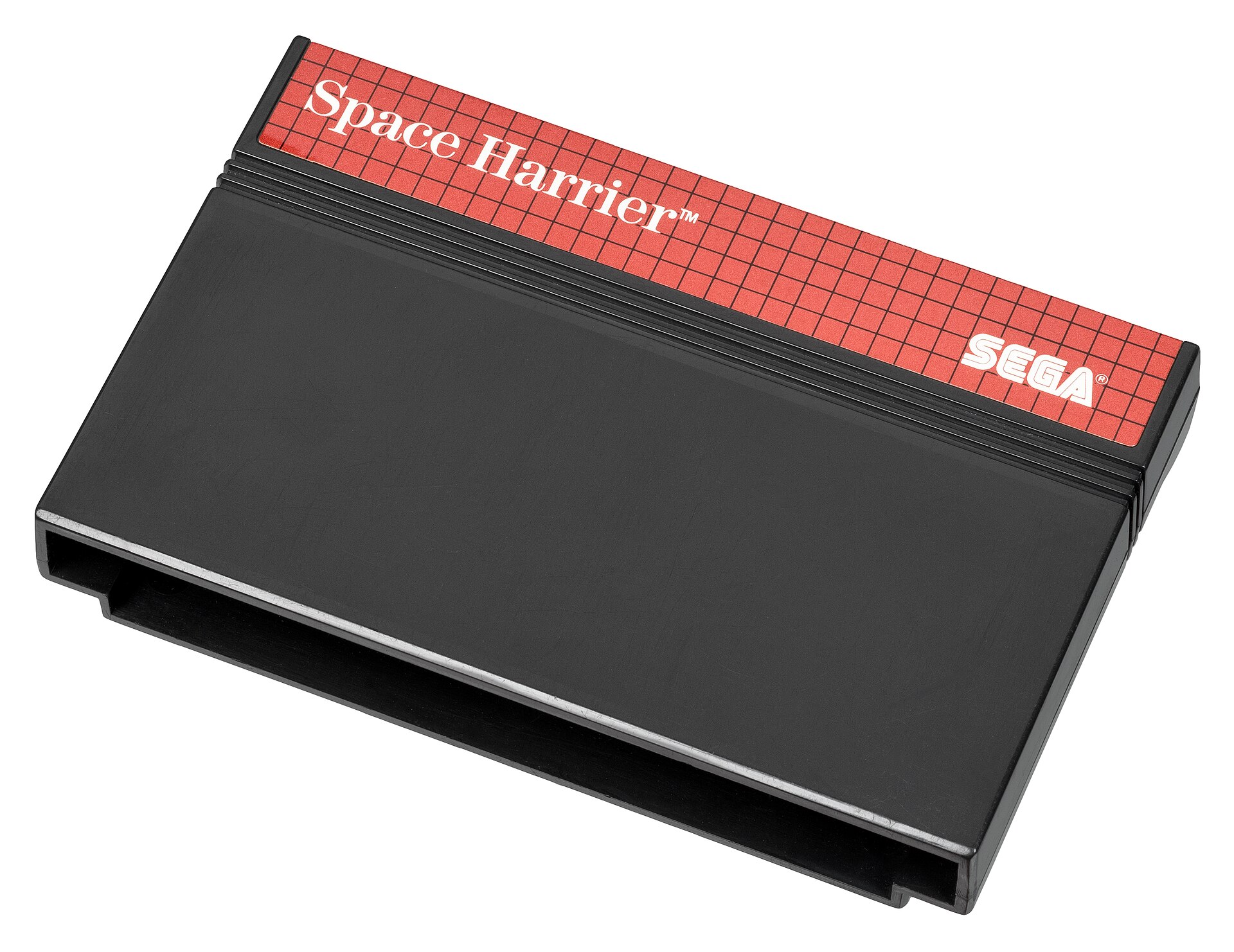
What gives the library its character is the double life behind it. The first wave is pure Sega: arcade conversions made by the people who built the arcade originals, on hardware descended from arcade boards — bright, fast, and unmistakably Sega in a way the NES library never tried to be. The second wave is the one America missed: once the console’s center of gravity shifted to Europe and Brazil, the catalogue filled with licensed adventures, local experiments, and late originals developed with no American market in mind at all. Put the two waves together and the Master System library is not a smaller NES library. It is a different one — and for a generation of players outside the United States, it was the main one.
The arcade conversions were Sega’s home turf and it showed: Hang-On in the box, Fantasy Zone — the first true cartridge release for the Mark III, in June 1986 — plus Out Run, Shinobi, and an R-Type conversion so strong it embarrassed machines with far more power. Then there is the shelf America never got: Castle of Illusion and Land of Illusion, Asterix, and late European originals like Power Strike II (1993), which is the corner of the library collectors now fight hardest over. And presiding over the end of the Western line, that original 8-bit Sonic the Hedgehog — Ancient’s game, Koshiro’s music, and proof the hardware had years left in it that the American market never gave it.
A Handheld Afterlife: The Game Gear
The Master System’s architecture had one more first life in it. On October 6, 1990, Sega launched the Game Gear: essentially the Master System’s hardware folded into a color handheld, with a far wider palette. With a Master Gear Converter slotted in, it played the entire Master System cartridge library — the 8-bit Sega catalogue, portable, years before that was a normal idea. Its story intertwines with this one at every step, and it has a hub of its own: explore the Game Gear.
The Long Tail: How a Loser Became Forever
The legal coda arrived too late to change the war and just in time to change the peace: in 1991, under US antitrust pressure, Nintendo entered a consent agreement and abandoned some of the licensing practices that had fenced the Master System out of American shops. The Genesis fought its war in the market that agreement opened up.
What remains is a machine that refuses every past tense you offer it. Emulation of the system is mature and exact, and the MiSTer FPGA core reproduces the hardware at signal level. The library is small enough to actually know — a few hundred games worldwide, not thousands — which has quietly made the Master System the connoisseur’s 8-bit console: collectible, completable, and still surprising. SMS Power!, the community archive founded in 1997, documents everything from manuals to music rips and still runs its annual coding competitions; brand-new Master System games are finished every year, in the 2020s, for hardware designed in 1985. The canon keeps returning in modern dress, too — Wonder Boy: The Dragon’s Trap was lavishly remade in 2017, and Alex Kidd in Miracle World DX followed in 2021.
And in São Paulo, on an ordinary shop shelf, the current model sits waiting for its next first owner. The Master System lost the famous war. It won the long one. “Forever” is doing some work in our headline — but after forty years, the console has earned it.
Watch: The Master System Story on Film
RetroAffaire’s full-length documentary calls the machine “Sega’s 8-bit underdog” and tells the whole saga in 25 minutes — the single best video introduction to the system.
Classic Gaming Quarterly reconstructs the 1986 American launch — the ads, the magazines, the moment it all went on sale.
“The Brazilian Consoles You’ve Never Heard Of” covers the clone wars and TecToy’s Sega empire — the essential companion to the Brazil chapter above.
The Master System Community Today
Meetups and shows
Retro gaming expos across the UK, Europe, and Brazil are reliably Master System country — expect rows of PAL and TecToy hardware, and expect the Brazil-made rarities to draw the crowds. The SMS Power! community has been the scene’s gathering point online since 1997.
Forums, docs, and deep cuts
SMS Power! is the archive of record: box scans, manuals, development documents, a complete VGM music library, and those annual homebrew competitions. The Sega Retro wiki’s Master System page is the deepest single reference for release data and hardware variants.
Buying and selling
Loose cartridges remain some of the cheapest collecting in the hobby, and the standard cartridge shell is shared worldwide, which keeps importing painless. The money lives where the history is: late European originals, the PAL exclusives America never saw, and TecToy’s Brazil-only releases — the rarest of which were made for a market of millions and kept by almost none of them.
Explore further: the Sega Retro Master System reference and the SMS Power! archive.
Keep reading: Bomber Raid — the last Master System game Japan ever got, and our companion flagship on Sega’s next big swing, Sega CD: The Add-On That Saw the Future.