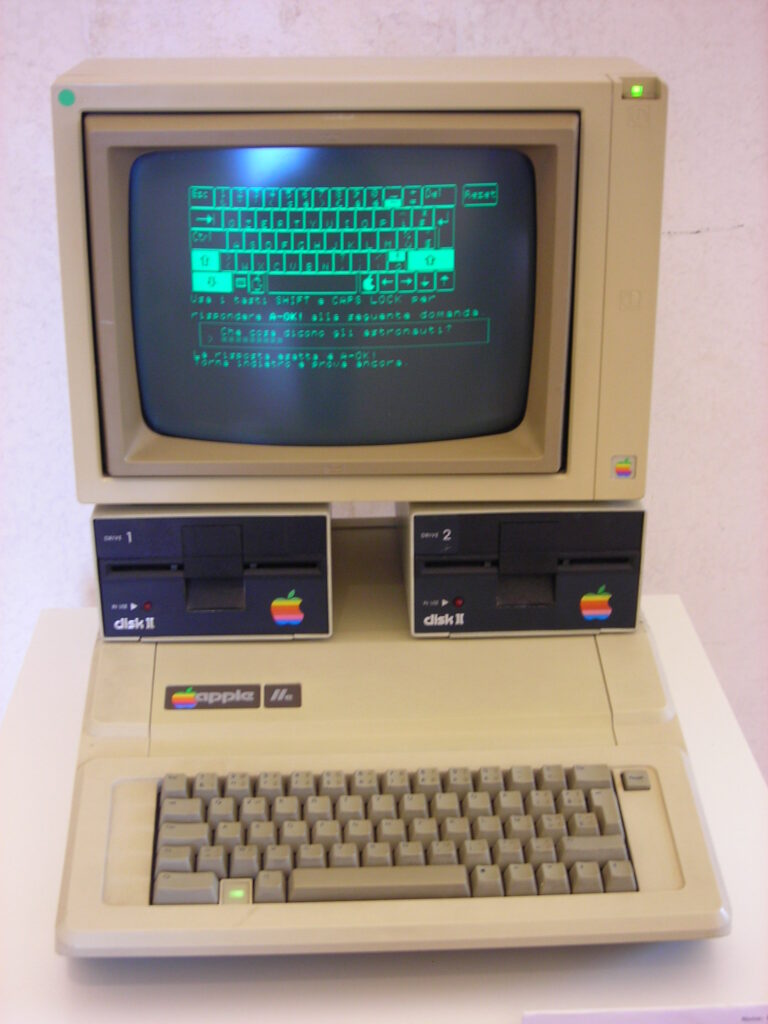
April 1977, San Francisco. The first West Coast Computer Faire had packed some 12,750 hobbyists into the hall — rows of bare circuit boards, kit computers in plywood boxes, machines you soldered together yourself or didn’t own at all. And at one booth sat something that looked like it had wandered in from a department-store shelf by mistake: a beige plastic wedge with a proper keyboard, plugged into an ordinary colour television, drawing pictures. In colour. No soldering iron. No terminal. No engineering degree required.
That was the Apple II, and the personal computer was never a hobbyist’s toy again. This is its whole story, A to Z: the lone engineer who designed it for an audience of one, the floppy drive sketched out over Christmas, the $100 spreadsheet that sold a fortune in hardware, the conquest of America’s classrooms, the glorious 16-bit swansong Apple barely bothered to advertise — and the fans who, decades after the last machine rolled off the line, simply refused to let it die.
One engineer, designing for an audience of one
The Apple II began as one man’s show-off project. Steve Wozniak — “Woz” — was a Hewlett-Packard calculator engineer who spent his evenings with the Homebrew Computer Club, the Silicon Valley hobbyist circle where the personal computer was being invented in real time. He had already designed the Apple I as a board for hobbyists. For its successor, he designed the machine he personally wanted: something that could play games properly.
That one decision shaped everything. Wozniak built the Apple II around the affordable MOS 6502 processor and wrote its Integer BASIC programming language himself, by hand. He coaxed colour out of the design by exploiting the quirks of the American NTSC television signal — timing the video circuitry so that colour appeared almost as a side effect, without expensive dedicated colour hardware. It was a magician’s trick performed with clock cycles, and it meant the Apple II could paint in colour on the family TV while rivals displayed grey text on specialist monitors.
Steve Jobs supplied the product sense. The circuit board went into a moulded plastic case designed by Jerry Manock — smooth, beige, deliberately more kitchen appliance than electronics kit. Engineer Rod Holt designed a compact switched-mode power supply that ran cool and quiet, with none of the heat or bulk of the linear supplies competitors used. And retired Intel executive Mike Markkula supplied the business: $91,000 of his own money plus a $250,000 credit line, in exchange for a third of the young company. At the Regis McKenna agency, designer Rob Janoff drew the famous bitten-apple logo — and Jobs insisted it wear rainbow stripes, because the machine’s party trick was colour.
1977: colour comes home
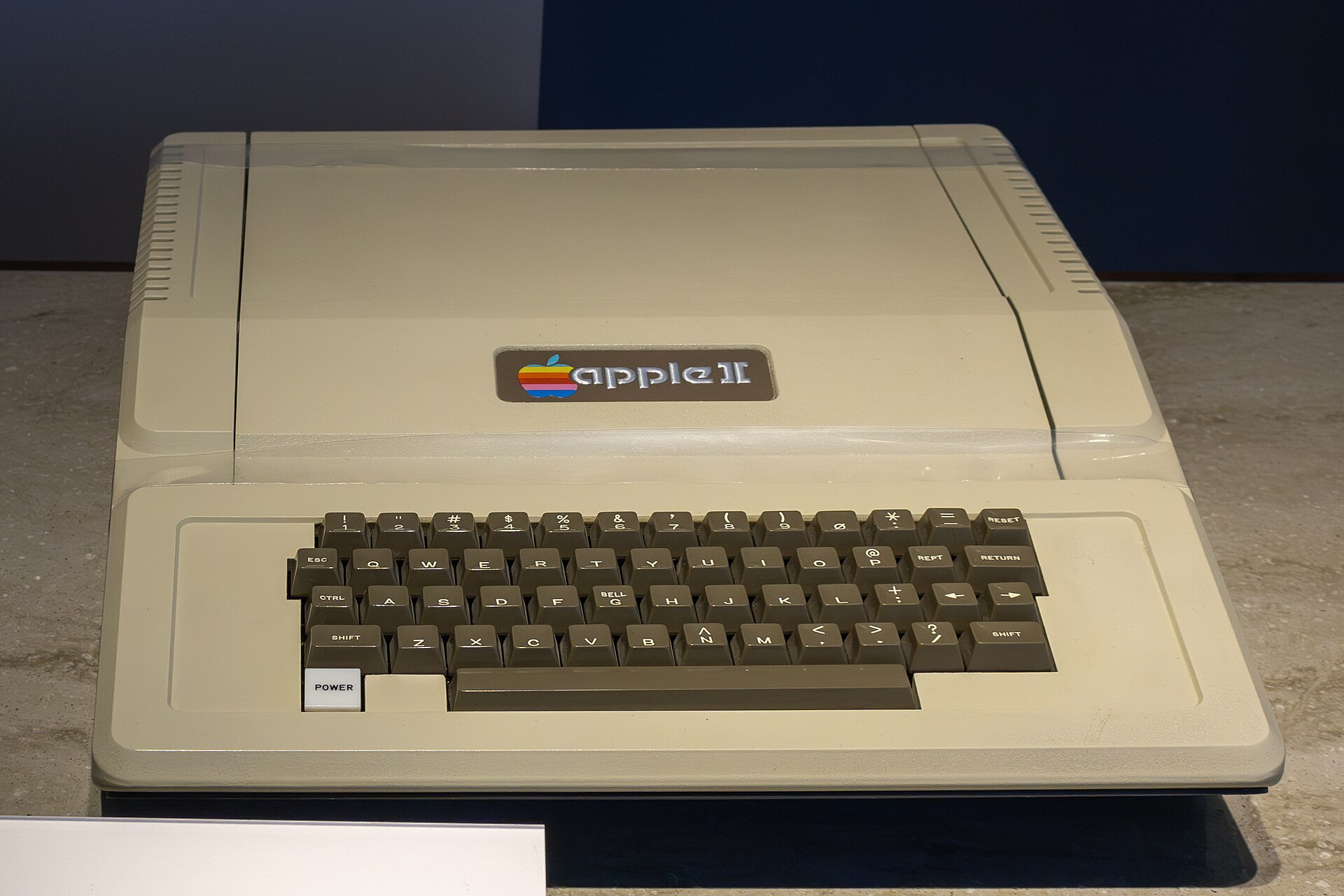
The Apple II debuted at the Faire in April 1977 — Commodore’s PET was unveiled the same weekend, and Tandy’s TRS-80 followed that summer — and the first machines shipped that June. The price was $1,298 for a model with 4K of memory. For the money you got something unprecedented: a finished computer in a case, with a built-in keyboard, BASIC waiting in ROM the instant you switched on (no twenty-minute cassette load just to start), 40-column text, high-resolution graphics at 280×192 in six colours, and ports for game paddles.
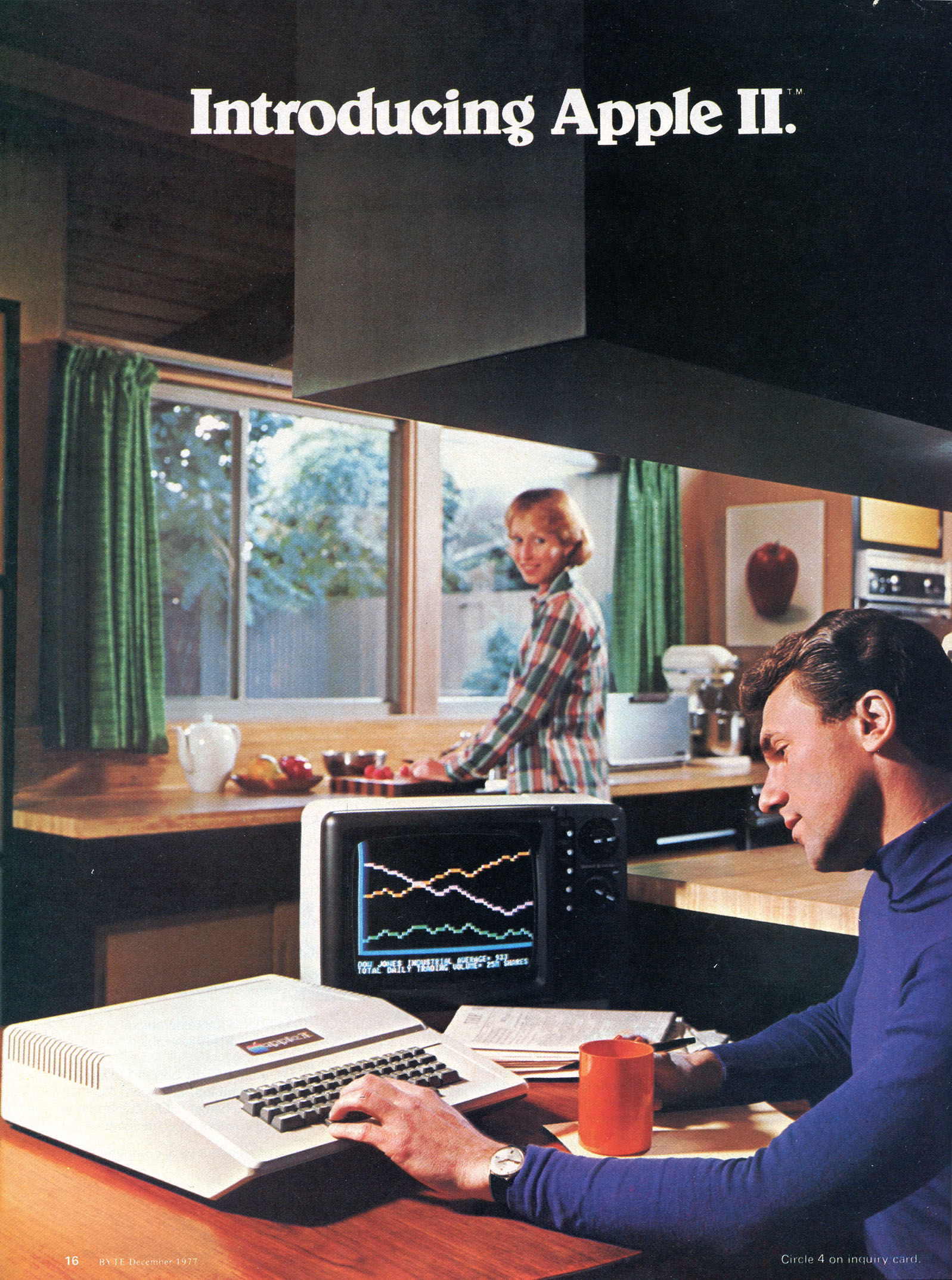
And then there was Wozniak’s masterstroke: eight expansion slots inside the case. Every other manufacturer treated its machine as a sealed product. Apple treated its machine as an invitation. Anyone could design a card — printers, modems, memory, 80-column displays, hard disks, things Apple never imagined — and the Apple II became a platform rather than a product. Apple pitched it the same way in print: the first advertisement, a two-page spread titled “Introducing Apple II,” ran in BYTE magazine in July 1977, written in plain, demystifying language aimed at ordinary people.
The first television commercial, from later that same year, made exactly the same argument:
The Disk II: a Christmas miracle in a handful of chips
For all its polish, the 1977 Apple II had one primitive flaw: it stored programs on cassette tape — slow, fiddly, and unreliable. Mike Markkula put a floppy disk drive at the top of his list of priorities, partly because a checkbook-balancing program he had written took forever to load from tape. There was one problem: Wozniak knew nothing about disk controllers.
So he learned, over the Christmas break of 1977. Working through the holidays, Wozniak designed a controller that did with a handful of chips what rival controllers needed dozens to accomplish — by common reckoning, about a tenth of the circuitry. A working prototype was demonstrated at the Consumer Electronics Show in January 1978; Shepardson Microsystems wrote the disk operating system under a $13,000 contract; and in June 1978 the Disk II went on sale — $495 for pre-orders, then $595 with its controller card. It was the cheapest floppy drive any computer company sold, built from roughly $140 in parts. Apple has been fond of healthy margins ever since.
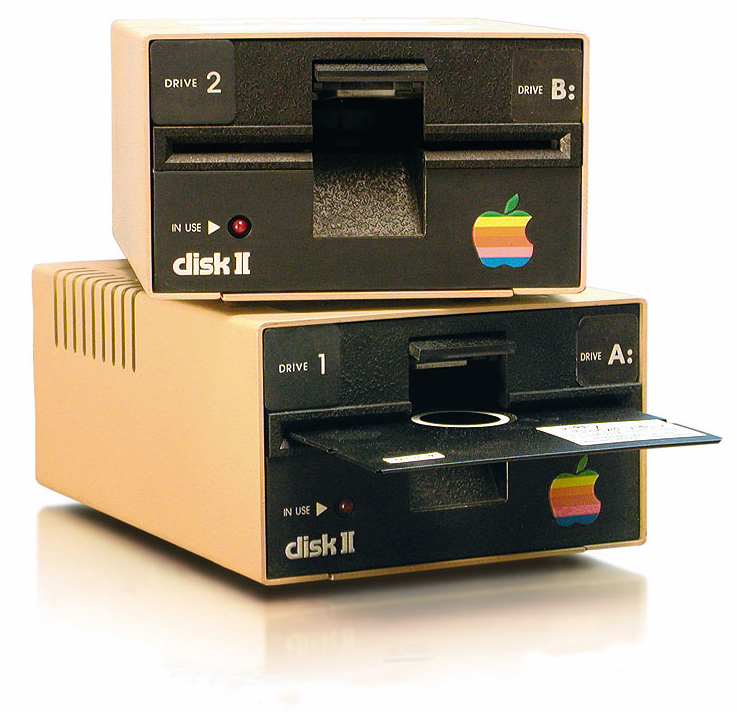
More importantly, fast and reliable storage changed what software could be. Programs could now load in seconds and shuffle real data around. The Apple II had been a delightful toy. The Disk II made it a tool — just in time for the program that would prove it.
VisiCalc: the $100 app that sold the machine
In June 1979 the original Apple II gave way to the Apple II Plus, with Microsoft’s Applesoft BASIC — floating-point maths included — burned into ROM and up to 48K of memory as standard. Around 380,000 were sold. But the Plus’s historical role is supporting actor. The star arrived on October 17, 1979, and cost $100.
VisiCalc was the first electronic spreadsheet, dreamed up by Harvard business student Dan Bricklin and programmed by Bob Frankston at their company, Software Arts. Publisher Dan Fylstra of Personal Software had loaned Bricklin an Apple II to build it on — one of the great accidental exclusives in business history, because for roughly its first year, VisiCalc ran only on the Apple II. Change a number and every total on the sheet recalculated instantly; accountants and small-business owners watched demonstrations and understood immediately. They walked into computer shops — a new kind of shop — and bought the $1,298 computer in order to run the $100 program. Wozniak later reckoned that small businesses, not the hobbyists Apple expected, bought around ninety percent of Apple IIs. Jobs, never generous with credit, said VisiCalc propelled the Apple II’s success more than any other single event. It sold more than 700,000 copies in its lifetime, and it invented an idea the industry now takes for granted: the killer app.
The software houses: where modern gaming grew up
A cheap computer with a disk drive and an exploding installed base was a gold rush, and the prospectors founded an industry. In 1980 Doug Carlston’s Brøderbund set up shop; Richard Garriott founded Origin Systems in 1983 to publish his own Ultima games; Trip Hawkins launched Electronic Arts in 1982 on the then-radical idea that programmers were artists, and marketed them like rock stars. And in the Sierra Nevada foothills, Ken and Roberta Williams’ On-Line Systems — later Sierra On-Line — accidentally founded the graphic adventure.
Read the release dates as a list of inventions. In May 1980, Mystery House — Roberta’s whodunit, illustrated with seventy of her own line drawings, the first copies duplicated by hand and sold by mail order — became the first adventure game with graphics. In 1981 alone, Wizardry and the first Ultima laid down the template for the computer role-playing game, while Silas Warner’s Castle Wolfenstein had players sneaking past guards in 1981, decades before “stealth” was a genre. Dan Gorlin’s Choplifter (1982) was so good that Sega later reversed the usual flow and ported it into the arcades. In 1983 came Douglas E. Smith’s Lode Runner, complete with a level editor that turned players into designers, and Bill Budge’s Pinball Construction Set, which did the same for a whole genre of build-your-own software. Jordan Mechner, still a student at Yale, gave games a cinematic pulse with the rotoscoped Karateka in 1984.
It wasn’t all play. Brøderbund’s The Print Shop (1984) — banners, greeting cards, signs — became a fixture of homes and school corridors. And when the decade closed, the Apple II bookended it: Interplay’s post-apocalyptic Wasteland (1988), the game the Fallout series descends from, and Mechner’s masterpiece Prince of Persia (1989), its hero’s movement traced frame by frame from film of the designer’s brother — written, like so much else, on an Apple II. If a genre exists today, there’s a fair chance its first draft ran on this machine.
The IIe and the classroom crown
By the early eighties the Apple II’s formula was proven, and Apple did the smartest thing available: it made the machine cheaper to build and easier to live with. The Apple IIe — the “e” stood for “enhanced” — arrived in January 1983 at $1,395, with 64K of memory as standard, a proper keyboard that could finally type lower-case letters (the earlier machines were upper-case only), and a drastically reduced chip count. It became the best-selling model of the line, and it stayed in production, with only minor revisions such as the Enhanced and Platinum versions, for nearly eleven years.
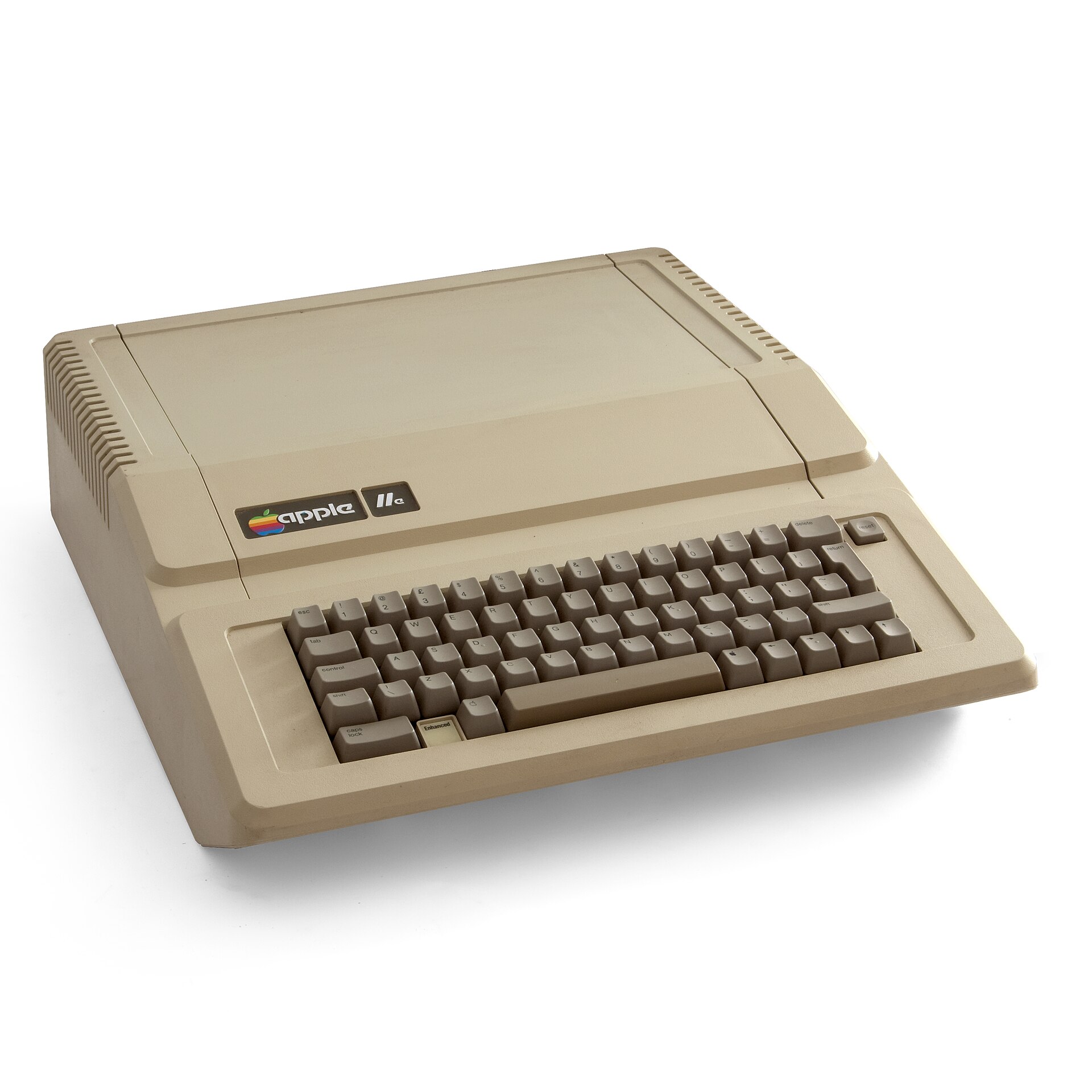
The IIe’s true kingdom was the classroom. Apple had courted schools from the beginning with discounts and support, and state programs like Minnesota’s MECC put Apple IIs in front of a generation of students — MECC’s own The Oregon Trail, remade with graphics in 1985, taught that generation about supply management and dysentery in equal measure. In 1983 Apple’s “Kids Can’t Wait” program simply donated a IIe system to every public school in California. Schools bought in depth, built labs around the machines, and taught computing on them for a decade.
Here’s the statistic that reframes Apple’s own mythology: in the first quarter of fiscal 1985 — a full year after the Macintosh launched to enormous fanfare — the Apple II line reportedly still accounted for 85 percent of the company’s hardware sales. The Mac was the future. The II paid for it.
The portable detour: IIc and IIc Plus
Three months after that Macintosh launch, in April 1984, Apple threw itself a San Francisco event pointedly titled “Apple II Forever” — and used it to launch the most un-Apple-II Apple II ever made. The IIc squeezed a complete system into a 7.5-pound case with a carrying handle that folded down to tilt the keyboard: 128K of memory, a built-in floppy drive, every important port already on the back, wrapped in the company’s new “Snow White” design language, for $1,295. Two thousand dealers at the event ordered more than 52,000 units on the spot.
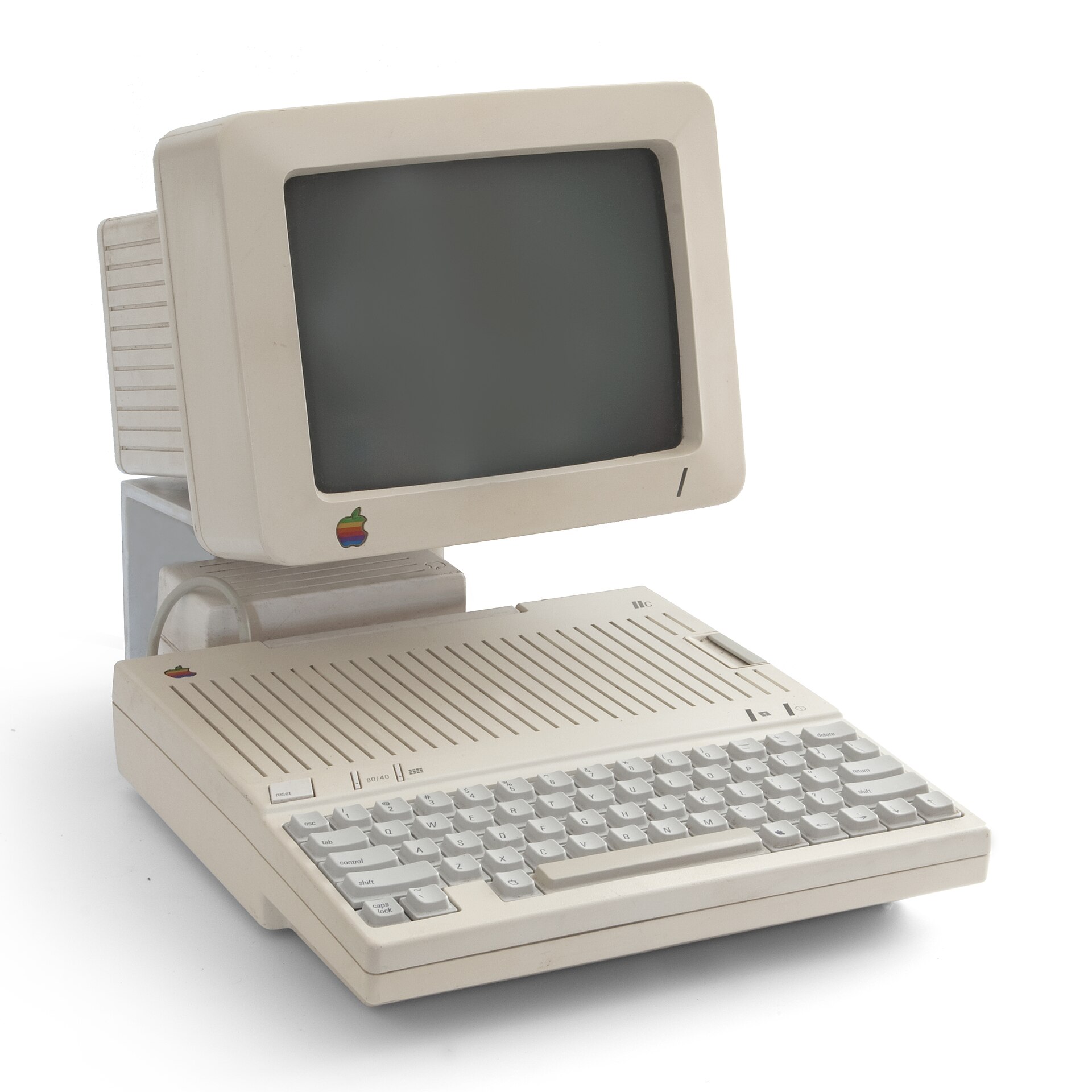
The catch was philosophical: the IIc had no expansion slots at all. The most open computer ever sold had become a sealed appliance. It still sold roughly 400,000 units, and its 1988 follow-up, the IIc Plus — a 4 MHz processor, a built-in 3.5-inch drive, an internal power supply, and a bargain $675 price — may quietly be the best 8-bit Apple II ever made. It simply arrived in a world that had stopped listening.
The IIGS: the 16-bit chapter
On September 15, 1986, Apple answered the Commodore Amiga and Atari ST with the Apple IIGS — the “GS” stood for Graphics and Sound, and both were a declaration of intent. Inside was a true 16-bit processor, the 65C816 running at 2.8 MHz; graphics modes that embarrassed the early Macintosh; and an Ensoniq wavetable synthesis chip — technology from professional music synthesizers — offering 32 voices of sound while a Macintosh still beeped in mono. It had a mouse, a Mac-like graphical system in GS/OS, and total compatibility with the mountain of existing Apple II software. The first production run even carried Wozniak’s signature on the case.
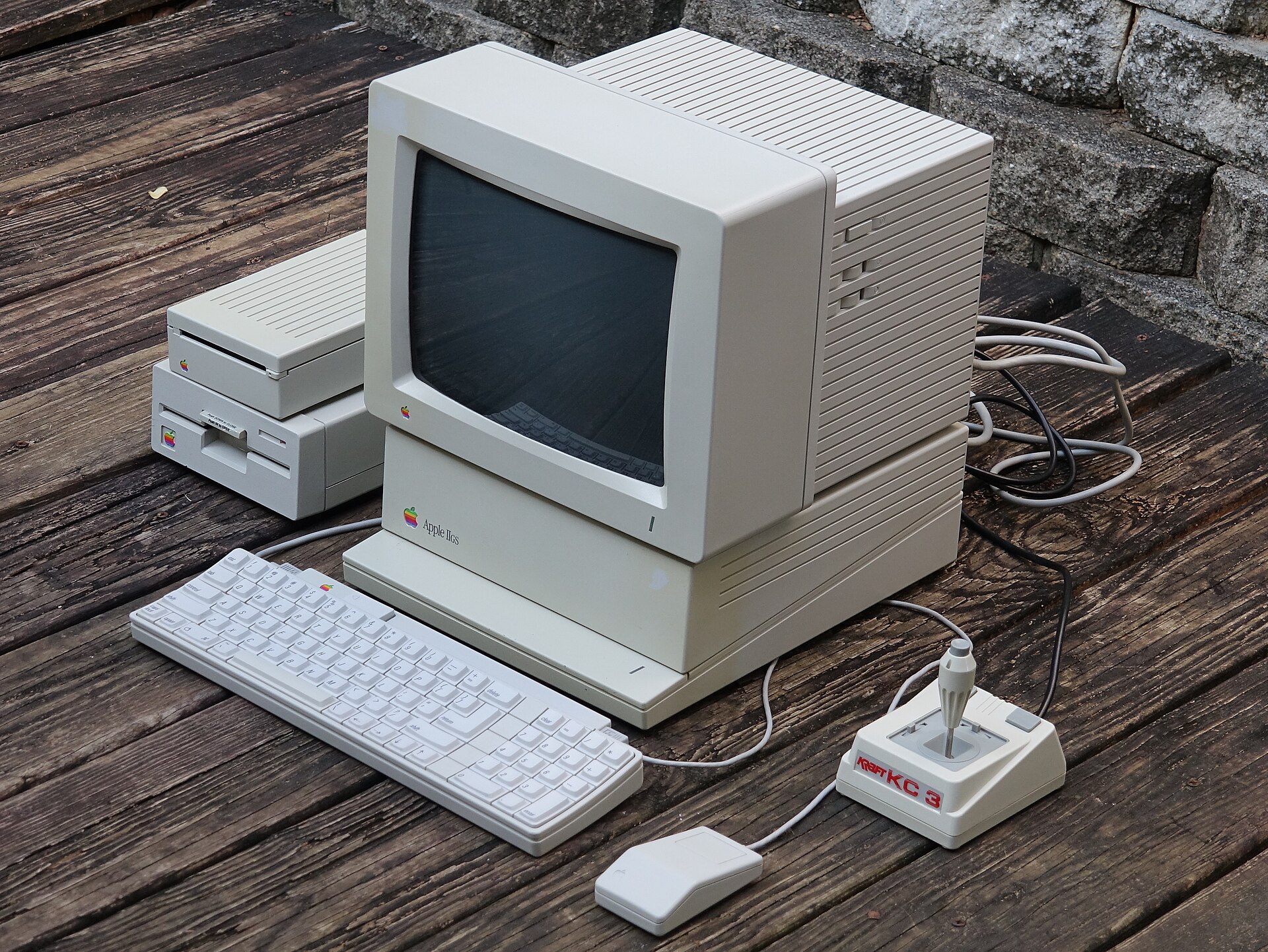
At $999 before a monitor, it outsold the Macintosh during its first year. Then Apple, determined that the Mac was the future, largely declined to market it. Around 1.25 million were sold before production ended in December 1992. The GS deserves — and on this site, gets — a chapter of its own.
The long goodbye
The 1990s were a slow fade rather than a cliff. Schools — still the II’s fortress — kept their labs running; as late as 1991 Apple shipped the Apple IIe Card, a plug-in board that let a Macintosh LC impersonate a IIe so classrooms could keep their software libraries alive on new hardware. The IIGS was discontinued in December 1992. And on November 15, 1993, with no ceremony at all, Apple discontinued the IIe.
The final tally: roughly six million Apple II-series machines sold over a sixteen-year production run, with a peak of a million machines in 1983 alone — one of the longest production runs of any home computer line in history, plus more than 190 clone models built around the world. Wozniak’s 1976 design had outlived the Apple III, the Lisa, the founders’ tenures, and several chief executives. The machine that started as one engineer’s hobby project ended as the computer that taught a generation what a computer was.
The afterlife: Apple II forever, literally
Apple’s 1984 slogan turned out to be a promise — the company just isn’t the one keeping it. Every July since 1989, enthusiasts have gathered for KansasFest, the Apple II convention that began as a developers’ conference in Kansas City, Missouri, dorm rooms and all, and still runs today in Springfield, Illinois. Call-A.P.P.L.E., the user-group publisher, has been printing Apple II material since 1978, and Juiced.GS remains a quarterly magazine devoted to the platform, delivered in actual mailboxes.
The hardware aftermarket is stranger still: this “dead” platform keeps getting new peripherals. Big Mess o’ Wires’ Floppy Emu pretends to be any disk drive the machine expects, fed by an SD card; ADTPro shuttles software between a modern computer and a II over a cable; Reactive Micro sells brand-new cards for it today. Homebrew programmers still write for the machine — new games appear every year, and at least one team has squeezed a port of Another World onto the 8-bit hardware. And if you don’t own a II at all, AppleWin, Virtual ][ and MAME emulate one faithfully, MiSTer FPGA recreates it in hardware, and the Internet Archive runs thousands of Apple II programs right in a web browser. Some of the Apple II’s newest accessories are younger than the iPhone.
Watch: the Apple II story on film
“The $140 Circuit That Turned the Apple II Into a Real Computer” — the Disk II’s Christmas-break origin story, told in full:
The 8-Bit Guy explains how old-school graphics worked — including Wozniak’s colour-from-nothing trick on the Apple II:
“The Apple IIe: 40 Years Later” — a retrospective on the model that ran for nearly a decade:
The 8-Bit Guy again, on the Apple IIe Card — the 1991 board that turned Macintoshes into Apple IIs:
The Apple II community today: meet, talk, and buy
Meetups & events
KansasFest: the world’s longest-running Apple II convention — every July since 1989, now in Springfield, Illinois. Talks, new hardware launches, and the famous dorm-room after-hours scene.
Vintage Computer Festival events run around the United States through the year; expect working Apple II exhibits — and owners eager to talk about them — at every one.
Forums & hangouts
Applefritter: the long-running home of Apple collecting and restoration, with an active Apple II crowd.
comp.sys.apple2: the Usenet newsgroup that has discussed this machine since the eighties and never stopped — now reachable through Google Groups.
r/apple2 on Reddit: the quickest place to get a repair question answered or show off a restoration.
Buying hardware & new kit
Reactive Micro: brand-new Apple II hardware, upgrades and parts, made today.
Big Mess o’ Wires: home of the Floppy Emu disk-drive emulator and other modern retro hardware.
eBay remains where most surviving machines change hands — IIe systems are plentiful; a working IIGS is the one to budget for.
Explore further
Internet Archive — Apple II Software Library: thousands of Apple II programs, playable in your browser
Apple II History: Steven Weyhrich’s book-length history of the platform, free to read online
KansasFest: the convention keeping the machine’s community together since 1989
Wikipedia — Apple II: the full technical history, model by model
This is the anchor of 16-Bit World’s Apple II coverage — the machine’s other stories live on our Apple II page. Keep reading: Floppy Days: The Top Ten Apple II Games — the ten games that define the machine. And if you came here from the future the Amiga promised, try its sister story: Amiga: The Computer That Saw the Future.