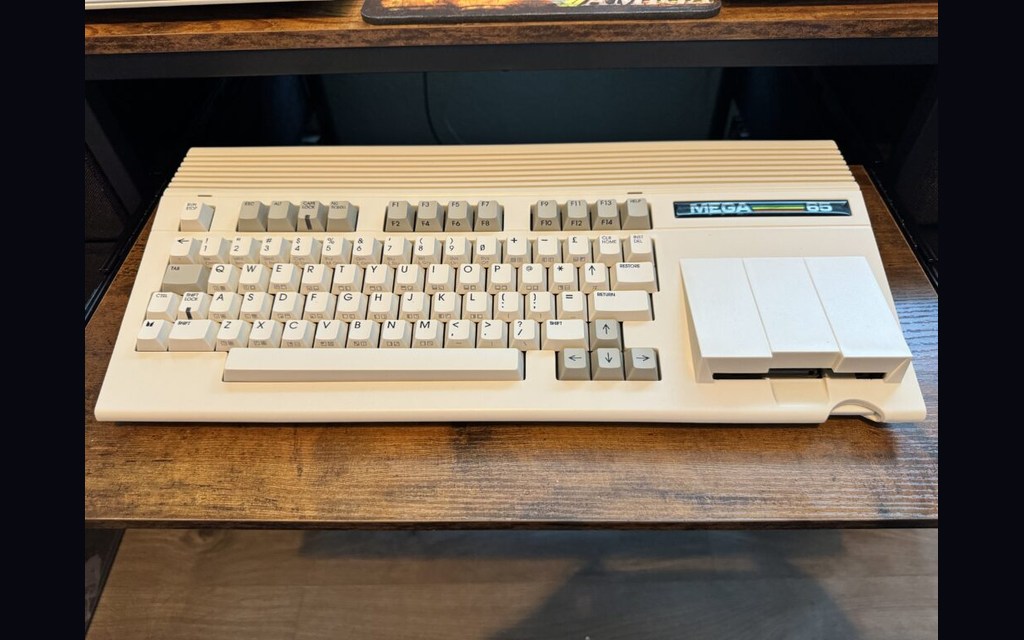
Every computer lineage has a ghost — the machine that was designed, prototyped, and cancelled, leaving its ideas to haunt the models that did ship. For Commodore’s 8-bit line the ghost is the C65: a 1990–91 prototype that would have succeeded the C128 with a faster processor, dual SID sound, a built-in 3.5-inch drive, and BASIC 10, the next evolution of the dialect that peaked in BASIC 7.0. Commodore cancelled it, the prototypes escaped into collectors’ hands, and the line ended. The MEGA65 is what happened when a museum decided the story shouldn’t end there: a production, FPGA-based recreation of the C65, built to modern standards, shipped from 2022 — and the closest thing the Commodore 128 has to a living heir.
The project’s parents tell you everything about its intentions. MEGA is the Museum of Electronic Games & Art in Germany; its partner is Trenz Electronic, an industrial FPGA house. The goal was never a nostalgia toy: it was to complete the C65 as a real, documented, open platform — housing the logic in a Xilinx FPGA, publishing the design, and wrapping it in hardware that honours the original: a wedge case descended from the C65 prototypes, a built-in 3.5-inch floppy drive (built, astonishingly, around refurbished ALPS mechanisms), and a full mechanical keyboard with Cherry MX switches and PETSCII-engraved keycaps, arranged much like the C128’s. The first production batch reached owners in May 2022 at a price north of nine hundred dollars — connoisseur money, and the queue formed anyway.

Why the heir wears the 128’s face
The lineage MEGA65 → C65 → C128 is not marketing; it is architectural. BASIC 65, the MEGA65’s native dialect, descends directly from the C65’s BASIC 10, which descends from the 128’s BASIC 7.0 — the structured commands, the graphics and sound statements, the disk dialect, all evolved rather than replaced. The processor, a 45GS02 running at 40 MHz, grows from the 4510 design intended for the C65, itself an evolution of the 8502 at the 128’s heart. The machine’s whole philosophy is the 128’s philosophy completed: take the 8-bit Commodore formula — instant-on BASIC, fluent hardware commands, real disk storage, serious text modes — and remove the compromises that 1985 economics imposed. Where the 128 gave you 128K and a choice of three modes arbitrated by a Z80, the MEGA65 gives you megabytes, a 40 MHz heartbeat, SD storage beside the floppy, HDMI beside the analogue outputs, and cores for the extended family: a C64 core, GEOS among its supported platforms, and — fittingly — a community C128 core in active if early development, so that the heir can host its ancestor.
The keyboard alone makes the argument in hardware. The C128’s board — full travel, numeric keypad, a row of dedicated function and cursor keys — was the interface of a machine meant for work, and the MEGA65’s Cherry MX recreation of that layout, PETSCII legends and all, is a declaration that the 128-generation interface was worth preserving at enthusiast-grade quality. Owners report serial numbers marching past a thousand units in the first years — small numbers by Commodore standards, enormous ones for a museum-born FPGA computer in the 2020s.
Spiritual heir, honestly weighed
The phrase “spiritual heir” is overused in retro writing, so let the claim be specific. The MEGA65 is not a C128 clone — it does not run the 128’s modes natively as its primary personality, its C128 core is a community work in progress rather than a headline feature, and its price and production model belong to a different economic universe than Commodore’s millions. What it inherits is the idea the 128 embodied and the C65 was meant to crown: that the 8-bit Commodore architecture was a beginning rather than a dead end, and that its BASIC, its storage model and its immediacy deserved a future. Commodore’s own management disagreed, in 1991, definitively. The MEGA65 is the appeal against that verdict, heard thirty years later, and won.
Commodore cancelled the C65 and ended the line. A museum, an FPGA firm and a few thousand owners voted to overrule — and built the 128’s grandchild by hand.
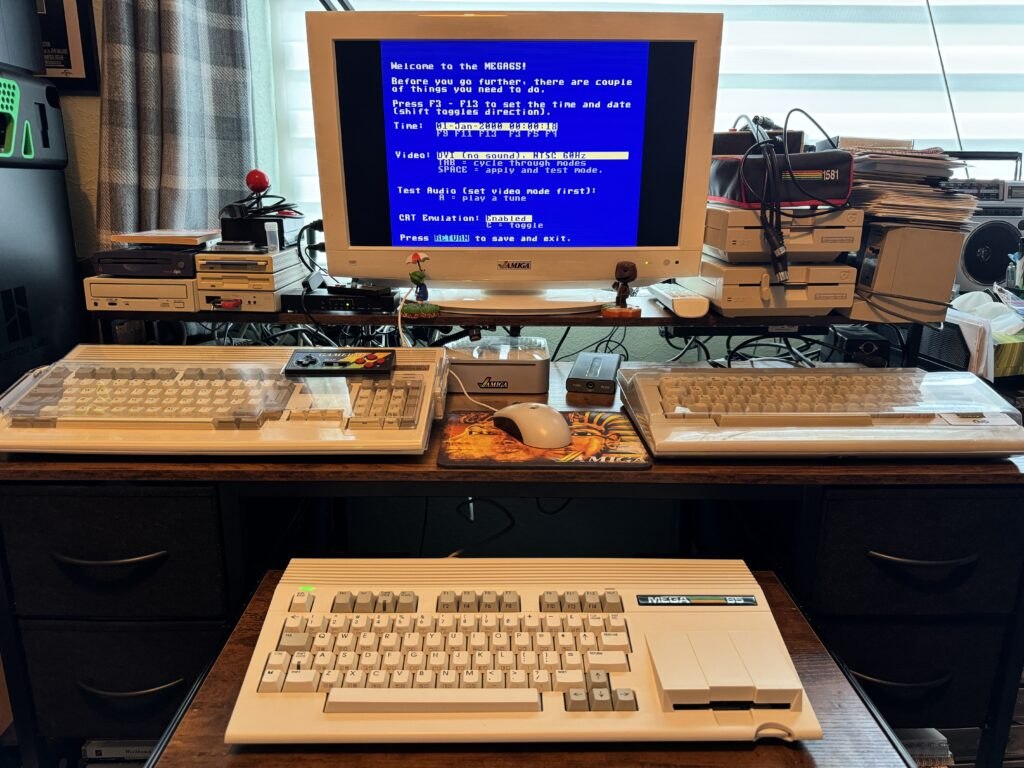
There is a pleasing circularity in the details. GEOS, the 128’s defining platform, is listed among the MEGA65’s supported systems. The demo scene that reawakened the VDC has a new 8-bit flagship to explore. And the 128 itself — so long the forgotten middle child — now sits visibly in a family tree with a living descendant, which changes how its own story reads: less a dead end, more an interrupted sentence. The MEGA65 will never sell four million units. It doesn’t need to. It needs only to exist, openly and completely, as proof that the line the 128 belonged to was worth finishing. On the evidence of its owners’ desks — floppies spinning beside modern monitors — it is.

Open by design
The decision that most separates the MEGA65 from both Commodore’s practice and the modern retro industry is its openness. The FPGA design is published; the documentation is written for programmers as much as owners; the machine is meant to be developed on, developed for, and understood — the exact inverse of the C65’s fate as a cancelled prototype whose few escaped units became five-figure collectibles precisely because the design was locked away. MEGA’s museum logic is curatorial: a platform preserved by being buildable. That philosophy has practical fruits — community cores and tools arriving continuously, ports of classic software, GEOS among the supported platforms, and the embryonic C128 core work that would let the descendant host the ancestor in the same silicon. It also answers the deepest criticism of the FPGA-revival genre, that such machines are expensive impersonations: the MEGA65 is better understood as a publication — the C65 design, released at last, with a production run attached. Owners aren’t buying a replica of a product. They’re subscribing to the ending Commodore declined to write.
Shipments tell the rest of the story in the plainest terms: batches sell through, the serial numbers climb, and second-hand machines rarely linger. For a four-figure FPGA computer descended from a cancelled 1991 prototype, that is not a niche. That is a constituency.
The owner’s desk, observed
Visit the machine’s owner community — the forums, the unboxings, the long-form desk tours — and a consistent portrait emerges: the MEGA65 is bought by people who program it. The combination is deliberate and rare: instant-on BASIC fluency in the Commodore tradition, modern conveniences (SD storage, HDMI, Ethernet) that remove the friction of living in 1985, and hardware documentation written to be used. Owners write games and demos in BASIC 65 and assembly, port classics, file bug reports against the open design, and — the detail that would have pleased Bil Herd’s Animals most — treat the machine as a workbench rather than a shrine. The 128’s native scene starved for exactly this population: users whose default mode was creation. The MEGA65’s constituency is small by Commodore standards and perfectly formed by the 128’s. Inheritance, in the end, is not about units shipped. It is about which habits survive. The habit of switching on a Commodore and immediately making something survived — routed through a cancelled prototype and a museum — into a machine with a floppy drive built in 2022.
The inheritance, itemised
BASIC 7.0’s descendants in ROM. A keyboard in the 128’s layout, built to outlive its owners. A floppy drive, because the ritual matters. An open design, because the community is the company now. The Commodore 128’s spiritual heir is not a reboot or a mini console; it is a continuation, engineered by the people who refused to let the story end in 1991. The 128 deserved an heir who understood it. It got one.