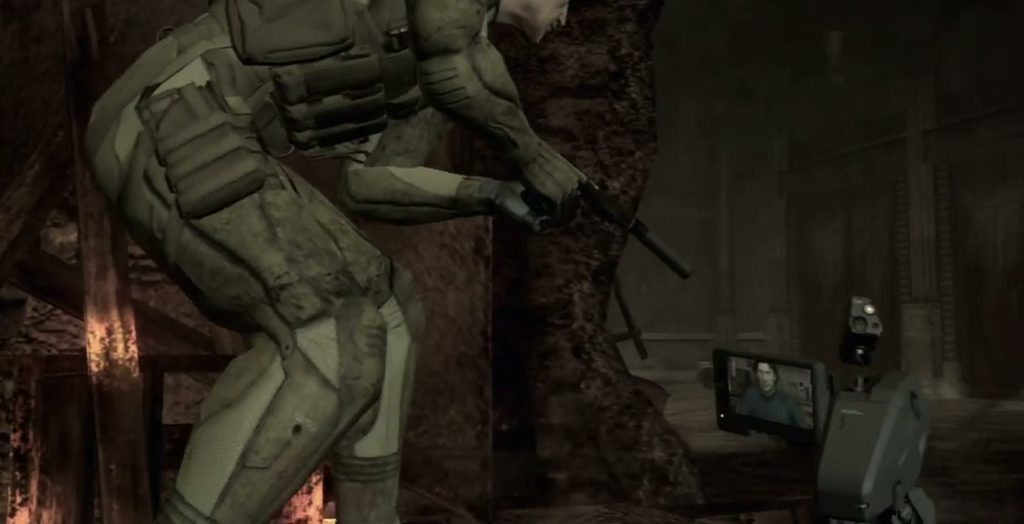
At a glance: Metal Gear Solid 4: Guns of the Patriots · PlayStation 3 · Konami / Kojima Productions, 2008 · Stealth action · Score: 9.0/10
For two years, Metal Gear Solid 4 was the reason the PlayStation 3 existed. Hideo Kojima’s conclusion to the Solid Snake saga was the console’s first true system-seller, a game so identified with the hardware that Snake himself uses a PS3 controller to pilot a robot in one of its cutscenes, and Otacon pauses the story to congratulate you on Blu-ray’s storage capacity while swapping no discs. It stayed a PS3 exclusive for the console’s entire life — the great white whale of the library. Playing it now is returning to a magnificent, maddening, utterly singular object: half stealth masterpiece, half feature-length act of closure, entirely unlike anything else on the system.
The war economy
The year is 2014. Private military companies have replaced national armies, every soldier and weapon is nanomachine-regulated by a system called Sons of the Patriots, and Liquid Ocelot is manoeuvring to seize the whole machine. Snake — Old Snake now, his cloned body ageing at a catastrophic rate, given perhaps a year to live — is sent to kill him. What follows is a five-act world tour: a Middle Eastern warzone, South America, Eastern Europe, a return to Shadow Moses Island that ranks among gaming’s great acts of nostalgia, and a final stand aboard Liquid’s haven, Outer Haven.

The audacity of the thing is its scale of intent. MGS4 exists to end a twenty-one-year story — to answer for the Patriots, the Philosophers, Big Boss, the clones, the whole glorious conspiracy — and it answers everything, at length, in cutscenes that total hours and include a finale that plays less like a game ending than a state funeral. Whether this is indulgence or devotion depends on your history with the series. For the faithful it is overwhelming catharsis; for newcomers it can be a lecture. Both reactions are understandable, and the game would rather be too much than leave a thread loose.
Stealth, modernised
Underneath the cinema sits the finest stealth sandbox of its generation. The OctoCamo suit samples the surface Snake presses against and repaints itself to match — floor, wall, statue plinth — turning camouflage from a menu percentage into a physical act. The battlefield is alive in a way no earlier Metal Gear attempted: two AI factions fight a war that ignores you, and you can sneak through it, aid one side to earn passage, or go loud with an arsenal sold by Drebin, a gun launderer who unlocks ID-tagged weapons mid-mission and fronts one of gaming’s great monkey sidekicks. The CQC system, the stress and psyche meters, the hold-ups, the cardboard box, the iPod loaded with unlockable music — every system from the series’ history is here, deepened.
MGS4’s battlefields are not levels with guards in them. They are wars with a game happening inside them, and Snake is merely the most interesting soldier on the field.
Act 3’s tailing mission and Act 4’s return to Shadow Moses — complete with a playable flashback to the PS1 original and a duel between two Metal Gears that fans had demanded for a decade — are series highlights. The boss squad, the Beauty and the Beast Unit, are conceptually rich and mechanically patchier, but their encounters, especially Crying Wolf’s sniper duel in a blizzard, hold up. The controls were the series’ great modernisation: a proper over-shoulder camera and shooter scheme that finally let the action match the ambition.

The installation-era time capsule
An honest word about the packaging, because it is part of the PS3 experience: MGS4 originally installed data before each act, with Snake smoking on the loading screen under health warnings, a process later streamlined by a patch that allows one full install. Even by 2008 standards it was a lot. Today it reads as charming period texture — the moment a console game first wrestled with being too big for its own medium. The visuals justified the wrestling: this was the PS3’s first true graphical landmark, with facial animation and material detail that embarrassed launch-era software, and it holds up remarkably, its frame rate target of sixty dipping in the busiest firefights but its art direction never ageing.
Metal Gear Online, in memoriam
The bundled Metal Gear Online was a cult stealth-shooter with modes no mainstream game would attempt, and a devoted community that kept it alive until its servers closed in 2012. It is gone from the disc’s living functions now, preserved by fan projects elsewhere. The campaign needs nothing else, but a complete account of MGS4 on PS3 should record that for four years, this disc held two games, and both were loved.
The detail is the devotion
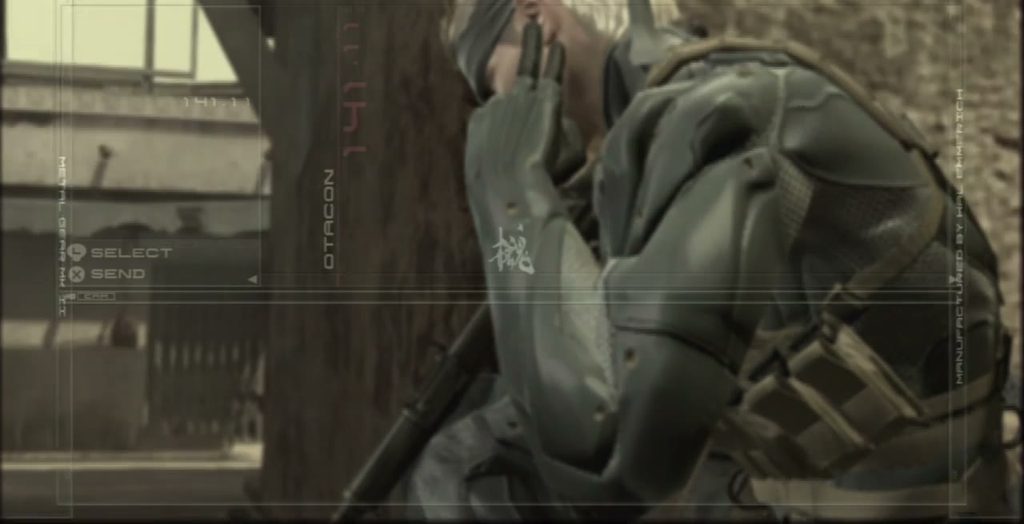
No account of this game is complete without its mania for texture. Snake can acquire a face-camo of every major character, play songs on an in-game iPod that alter his stress levels, shake the controller to shake off his camouflage, and hold up a soldier during the game’s loving recreation of its own history. Act 4 opens with a playable dream of the original Shadow Moses rendered in PS1 polygons — the actual 1998 game, erupting out of Snake’s memory — before the camera pulls back into the present-day ruins, the same corridors emptied and patrolled by machines. The microwave-corridor sequence near the end reduces gameplay to holding forward while a man destroys himself to keep moving, and it is somehow one of the most affecting scenes in the medium. The final fight, staged atop Outer Haven as a tour through the combat styles and health bars of every era of the series, is fan service engineered like a symphony’s last movement. Critics in 2008 sometimes called this self-indulgence. A decade and a half on, with the series dormant and its creator departed from the studio, it reads as something else: a creative team using a once-in-a-generation budget to say goodbye properly, in public, at full length, and refusing to be embarrassed about loving what they had made. The PS3 is the only place that goodbye still lives in its native form.
A note on playing it cold
Should newcomers start here? Honestly: no, and the game knows it. MGS4 assumes you carry three games of lore in your head and spends its enormous cutscene budget paying that lore off rather than re-teaching it. Play the earlier entries first — the PS3 conveniently hosts the whole saga in its HD collections — and arrive at Guns of the Patriots as the finale it was designed to be. Played in sequence, its indulgences become rewards; played cold, the same scenes are a very beautiful lecture in a language you do not speak. Either way it must be played on this machine or not at all: it never left the PS3, and its jokes, its controller gags, its disc that never needs swapping are all addressed to this hardware specifically.
The verdict
Metal Gear Solid 4 is excessive in every direction at once — too long in its explanations, too generous in its systems, too devoted to its own mythology — and that excess is its identity. As a stealth game it is superb. As a finale it is unmatched in its commitment to actually ending. As a PS3 artefact it is essential: the exclusive the console was bought for, still playable only here in its original form. Kept you waiting, huh? It was worth it.
Score: 9.0/10 — A sprawling, sentimental, mechanically brilliant farewell. The PS3’s definitive event game.