
At a glance: Metal Slug: 1st Mission · Neo Geo Pocket Color · SNK, 1999 · Run-and-gun · Score: 8.5/10
Metal Slug should not fit on a handheld. The arcade games are famous for excess — hundreds of frames of hand-drawn animation, screen-filling machinery, jokes buried in every background. The Neo Geo Pocket Color has a 160-by-152 screen and a palette you could count on your fingers during a slow afternoon. And yet 1st Mission, released in 1999 as one of the young system’s flagship action titles, captures the soul of the series with startling fidelity: the grin, the weight, the glorious overkill.
You play a fresh Peregrine Falcons cadet — you pick your recruit at the start — dropped into a campaign against General Morden’s forces that plays out across a branching map of missions. That structure is the game’s first smart idea. Rather than a straight line of levels, completing a mission opens routes across the theatre, and some exits are hidden behind the kind of exploration the series rarely asks for. It gives a run-and-gun game genuine replay value: one run through the campaign will not show you every stage, vehicle or prisoner of war waiting to be rescued.
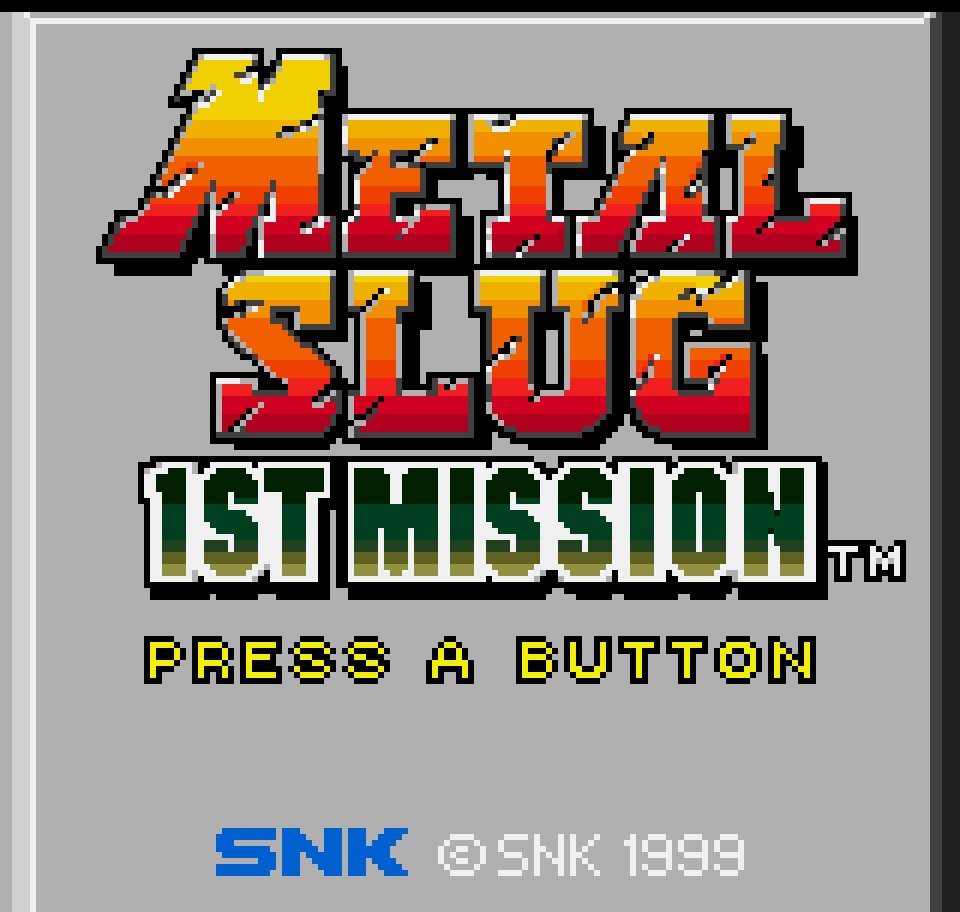
Small screen, big war
The core run-and-gun feel survives remarkably well. Your cadet runs, jumps, crouches and fires in eight directions of travel if not of aim, and the two-button layout keeps things honest: shoot, jump, and a grenade supply you will always spend too early. The Heavy Machine Gun, Rocket Launcher and Shotgun all appear, each announced by that famous voice sample rendered in miniature. Enemies include the full Morden infantry comedy troupe — shield troopers, grenade lobbers, the ones who panic — and the animation, while necessarily reduced, keeps the series’ character: soldiers still warm their hands, peek, and flee.
Vehicles were the obvious casualty-in-waiting, and instead they are a highlight. The SV-001 Metal Slug tank appears in ground missions, all crouching turret and vulcan cannon, and airborne stages put you in the Slug Flyer for short scrolling shooter sections that change the pace completely. Parachute drops, a submarine-flavoured underwater stretch and base interiors round out a campaign that never lets one idea outstay its welcome. Levels are short — pocket short — but dense.
It captures the soul of the series with startling fidelity: the grin, the weight, the glorious overkill.
Where the seams show
Honesty requires noting the compromises. There is slowdown when the screen gets busy, particularly in the tank sections, and the colour palette, while well chosen, cannot reproduce the arcade games’ lush detail — backgrounds are sparer and some set-piece bosses are scaled down to fit. The difficulty is gentler than arcade Metal Slug, too: generous lives and short stages mean a determined player will see the ending quickly, with the branching map and POW rescues providing the real longevity. Your score-chasing is supported by a ranking system that grades your performance, which gives the second and third runs their purpose.

Sound deserves a special mention. The pocket’s little speaker delivers crunchy renditions of the series’ military marches, and the digitised shouts — the POW’s grateful salute, the weapon announcements — are present in compressed miniature. Playing with headphones is a small joy. Battery life, the hidden virtue of the whole NGPC library, means this is a campaign you can genuinely carry around: the hardware sips power for dozens of hours on two AAs, and the game’s mission structure suits five-minute sessions perfectly.

How it sits in the series
Chronologically, 1st Mission arrived between the arcade’s Metal Slug X and Metal Slug 3, at the absolute height of Nazca’s powers, and it shows in the details the pocket team chose to protect: the POW who salutes and vanishes, the mummies’ shambling menace translated into a handful of frames, the way a stage always ends one explosion bigger than it needed to. What they invented for the format is just as interesting — the branching theatre map would not become a series staple elsewhere, and the cadet system, letting you pick your recruit’s profile, quietly anticipated the character-select variety later Slug games would embrace.
For collectors, one wrinkle: the game exists in an earlier monochrome-compatible form in Japan and in the full Color edition most Western players know, and the cartridge is dual-compatible in a way that makes it a gentle way to experience the mono machine’s charms too. However you meet it, 1st Mission is the moment the NGPC announced it would do its own versions of the crown jewels — smaller in scale, never in spirit — and the sequel waiting one year later would be better still. As an opening mission, though, this is close to flawless briefing.
Technically, the cartridge is also a small lesson in respecting a platform. Rather than shrinking arcade sprites until they turned to soup, the artists redrew the Slug world at native resolution — chunkier, bolder, readable at speed — and the game is more handsome for it today than many technically ‘faithful’ ports of its era. The colour choices, limited as they were, do real work: enemy uniforms pop against backgrounds, hazards read instantly, and the whole game has the saturated Saturday-morning brightness the series wears at its best.
Finally, a practical note for modern players: of all the NGPC’s action games, this is the friendliest first cartridge. The difficulty welcomes, the sessions are short, the humour needs no series knowledge, and the save-and-rank structure respects your time. Start here, and the system’s whole action library opens in the right order — this mission first, its bigger sequel second, and a lifelong habit of checking small cartridges for big games thereafter.
It is also, not incidentally, a kind game to learn the system with. The stick’s precision shows in the eight-way movement, the screen’s clarity shows in the sprite work, and the battery simply refuses to die mid-campaign. If the NGPC had a pack-in audition tape for its hardware virtues, this would be side one. Side two, of course, is the sequel — but every legend in this library starts with a first mission, and this one remains the correct place to enlist.
Verdict addendum, in the spirit of the series: heavy machine gun. The cartridge earns it — a pocket war with a grin, a tank and a hundred small jokes, fired off in 1999 and still landing today.
Verdict
Metal Slug: 1st Mission is best understood as a declaration of intent: SNK’s pocket machine would not be a dumping ground for cut-down ports, but a place where the company’s crown jewels got proper, purpose-built editions. It is slightly easier and slightly smaller than the arcade legend, and its sequel would outdo it, but as a handheld run-and-gun of its era it has almost no competition. The Game Boy Color never got anything like this. That, in one cartridge, was the whole SNK argument.