
Every console gets one game that justifies the hardware on its own terms, and for the Wii that game is Super Mario Galaxy. Released in 2007, a year into the life of a machine the industry had dismissed as underpowered, Galaxy did something nobody expected: it out-invented every platformer on the bigger, shinier consoles, and it did it by throwing away the rulebook Mario himself had written. Gravity became a toy. The floor became optional. And the little standard-definition box under the TV produced the most joyful game of its generation.
At a glance: Super Mario Galaxy · Nintendo EAD Tokyo · Wii · 2007 · 3D platformer · Players: 1 (with a gentle second-player assist mode)
A plumber, a princess, and the entire universe
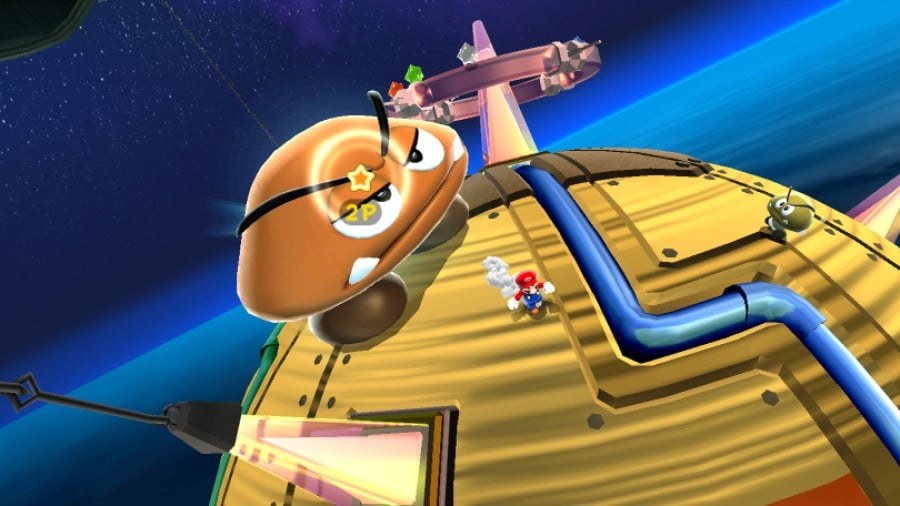
The setup is comfortingly familiar and quietly stranger than it looks. During the Star Festival, Bowser does not merely kidnap Princess Peach — he lifts her entire castle out of the ground and tows it into space. Mario, flung across the cosmos, wakes on a tiny planetoid and is rescued by Rosalina, the serene watcher of the stars, whose Comet Observatory has lost the Power Stars it needs to fly. Your job is the classic one — collect stars, unlock new areas, save the princess — but the scale of the stage has changed beyond recognition. Instead of one large kingdom, Galaxy gives you dozens of small worlds: planetoids, cylinders, discs, hollow spheres and ribbons of land floating in a starfield, each one a self-contained idea.
That structure is the game’s genius. A conventional 3D platformer level is a place; a Galaxy level is an argument. One planet asks what happens when you can walk all the way around it. The next asks what happens when gravity points in several directions at once, marked by arrows on the floor. A third is a flat plane of flipping panels suspended over nothing. Because each idea gets its own little world, the game never has to dilute a concept to fill space — and when an idea is exhausted, the planet ends and you are launched, in a burst of starlight, to the next one. It is level design as a variety show, and nearly every act lands.
Gravity is the greatest power-up Nintendo ever made
Mario’s moveset is deliberately modest. He runs, triple-jumps, long-jumps, wall-kicks, ground-pounds and spins — the spin, triggered by a flick of the Wii Remote, is the one great addition, serving as attack, extra lift and interaction all in one. There is no sprawling combo list to memorise, because the complexity lives in the worlds rather than in Mario’s hands. Spherical gravity means a long jump from a small planet can slingshot you into orbit; a badly judged leap can send you sailing past your target entirely, or — in the game’s best running joke — leave you circling a planetoid while you work out how to break free.
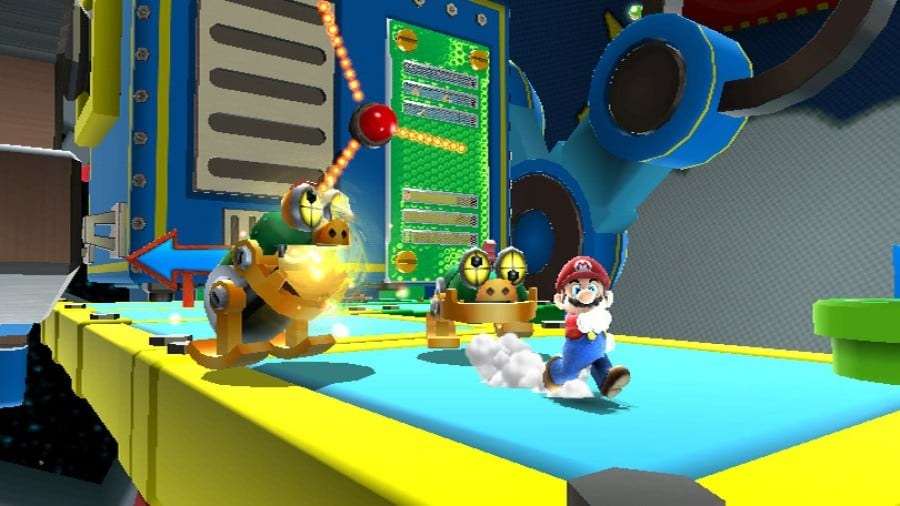
The famous power-ups are handled with a light touch. Bee Mario floats and clings; Spring Mario turns precision platforming into a glorious argument with the controls; Boo Mario drifts through grates; the Fire Flower returns for timed bursts of old-school satisfaction. None of them outstays its welcome. Galaxy understands something many sequels forget: a mechanic is a spice, not a main course, and the game seasons relentlessly, introducing a new twist every few minutes for its entire length. Even the much-discussed motion controls are restrained — pointing to hoover up Star Bits, the odd tilt-controlled ball-rolling or manta-surfing stage as a palate cleanser. It is a Wii game that uses the Wii Remote like a scalpel rather than a flag.
The little console that painted like a giant
Let us address the technical point head-on, because it still startles: Super Mario Galaxy is one of the best-looking games of its entire generation, on hardware a fraction as powerful as its rivals. Nintendo achieved it with art direction instead of horsepower — saturated colours, soft glowing light, characters modelled with an almost clay-like roundness, and a camera that always knows where the beauty is. Worlds hang in space against painted nebulae, so the modest polygon budget is never wasted on empty ground. In motion, at the Wii’s native standard definition, it remains genuinely lovely; played today through a decent display setup it holds up far better than most of its contemporaries, precisely because it never chased realism.
The music deserves its own paragraph. Galaxy was a landmark for Nintendo: a big Mario game scored substantially by a live orchestra, with sweeping, waltzing themes that give the adventure a scale its story only hints at. The Gusty Garden Galaxy theme in particular has entered the permanent Nintendo canon, and rightly so — it is the sound of the game itself, wonder with a slight ache underneath. Rosalina’s quiet storybook, read between chapters in the Observatory library, gives that ache a source. It is optional, brief and surprisingly sad, and it lifts Galaxy from a brilliant toy into something with a heart.

An observatory worth coming home to
Between galaxies sits the Comet Observatory, Galaxy’s hub, and it deserves more credit than it usually gets. Where Mario 64’s castle was a playground and Sunshine’s Delfino a town, the Observatory is a place of calm — domes opening one by one as you restore its power, each dome a doorway to a cluster of galaxies, with Rosalina watching over it all and a small library where her storybook waits. It gives the adventure a breathing rhythm: plunge into a frantic, idea-dense little world, then surface into quiet music and starlight before choosing the next plunge. The Prankster Comets that periodically invade cleared galaxies — speed runs, daredevil one-hit challenges, purple-coin hunts — are the game’s way of asking whether you truly mastered a world or merely survived it, and they extend a generous game into a very large one. A full completion, earning every star and unlocking the game’s final, mischievous reward, is a commitment measured in dozens of hours, and the design almost never repeats itself on the way there. That restraint — hundreds of stars, each built around something specific — is why Galaxy is still the yardstick. Later Mario games, including its own sequel, would refine pieces of this formula. None has ever made the whole thing feel this effortless, or this kind.
The honest caveats
No game is flawless, and Galaxy’s flaws are worth naming. The camera, usually invisible, occasionally fights you on the smallest planetoids, where “up” changes faster than the framing can follow. A handful of the purple-coin and daredevil comet challenges cross the line from demanding to fiddly, and players who want to stop at the credits will find the back half of the star hunt more repetitive than the front. The second-player mode — a helper cursor that can grab Star Bits and pin enemies — is charming for playing alongside a child, but it is an assist, not a partnership. And by modern standards the opening hour is slow to hand over the good stuff. These are real complaints. They are also complaints about the margins of a masterpiece.
Verdict
Super Mario Galaxy is the Wii’s masterpiece and one of the finest platformers ever made — a game that took a mechanic as fundamental as gravity and turned it into an endless box of toys. It is generous, surprising and beautifully judged from its first planetoid to its last, and it remains the single strongest argument that imagination, not horsepower, is what ages well. If you own a Wii, you owe it this game. If you do not own a Wii, this game is the best reason ever made to pick one up.
Score: 9.5/10